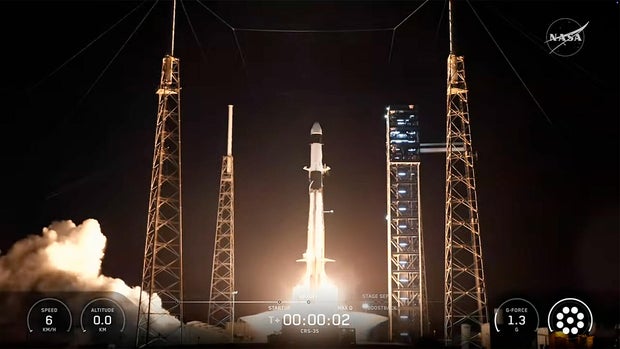
On Tuesday morning, a SpaceX Falcon 9 rocket successfully launched an unpiloted Dragon cargo vessel into space, setting the stage for docking with the International Space Station (ISS) early Thursday. The cargo ship carries more than 6,300 pounds of crucial materials, including research supplies, spare parts, and crew provisions.
A pair of new roll-out solar array blankets are included in the cargo, marking the final sets needed to upgrade the ISS and counteract degradation of the station’s original eight solar wings. Since June 2021, six ‘IROSA’ blankets have been fitted during spacewalks. The seventh and eighth arrays aboard this mission will be installed later this month and into early November.

The rocket launched from Cape Canaveral Space Force Station at 6:33 a.m. EDT, ascended propelled by 1.7 million pounds of thrust from the Falcon booster’s nine first-stage engines. After two-and-a-half minutes, the first stage separated and returned to Cape Canaveral for a successful landing. Meanwhile, the second stage continued its journey into orbit.
At nearly the same moment, spectators at Kennedy Space Center were treated to a remarkable sight as the ISS streaked across the sky 260 miles above, captured in a time exposure including the Falcon 9’s exhaust trail.

The first stage landed close to its original pad at 6:41 a.m., followed by the shutdown of the second-stage engine. Shortly thereafter, the Dragon Cargo separated and began its solitary voyage. Expectations are set for an automated docking at the space station’s Harmony module by 11 a.m. Thursday.
The lift-off displayed an impressive ‘jellyfish effect,’ as the sunlight illuminated the expanding exhaust plume from the Falcon’s second stage, a sight frequently cherished by rocket aficionados.
The Cargo Dragon contains a variety of supplies: 844 pounds intended for the crew, 1,307 pounds of scientific equipment, 417 pounds of tools for spacewalks, and 880 pounds of hardware and computer components. An array of fresh foods, such as oranges, apples, grapefruits, tomatoes, blueberries, baby carrots, and mini sweet peppers, accompanies the cargo, according to Bill Spetch, space station program manager. Also included are pizza kits, cookies, and candy, alongside special holiday treats.
The IROSA arrays weigh 2,635 pounds on Earth and are secured inside the Dragon’s unpressurized trunk. Once installed, each blanket can produce 20 kilowatts of power, effectively rejuvenating the station’s energy output to optimal levels. “The newer arrays are placed over the existing solar panels,” explained Dana Weigel, director of low-Earth orbit operations at Johnson Space Center. “The parts of the older arrays still generate power in conjunction with the new ones.
The solar cells integrated into the IROSA arrays exhibit superior efficiency compared to the original cells, boasting a higher energy density that collectively boosts energy production beyond what the initial arrays could achieve, even when brand new,” added Weigel.