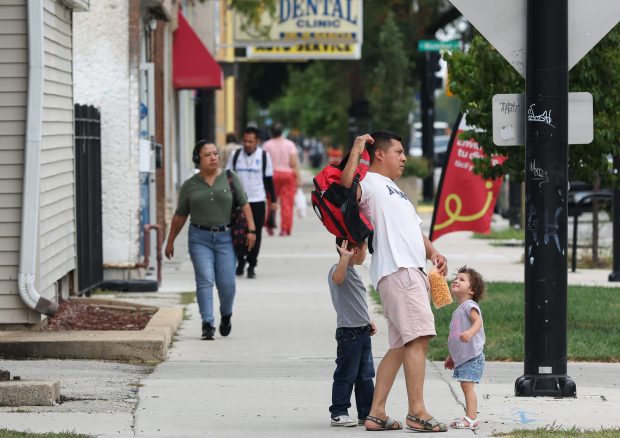
Little Village has long been celebrated as a cultural center for Latino Chicago. Its significance is evident with events like the Mexican Independence Parade, drawing large crowds to the 26th Street corridor annually. However, a recent study by the University of Illinois Chicago reveals an unexpected shift. The largest Latino population in Chicago is no longer in Little Village or Pilsen. Instead, Belmont Cragin on the Northwest Side now holds this distinction.
According to UIC’s Great Cities Institute, Belmont Cragin is home to over 57,000 Latino residents, making up about 80% of its population. With nearly 802,000 Latinos citywide, Belmont Cragin’s demographic change is notable. This neighborhood transformation reflects broader shifts occurring across the city.
Oswaldo Alvarez, executive director of the Illinois Legislative Latino Caucus Foundation, emphasizes the depth of the community analysis. “For us, it’s about taking a comprehensive look at who the Latino community actually is,” he said, highlighting the community’s role in shaping Chicago.
“It’s about having a snapshot of who the Latino community is and how the Latino community has been able to bring Chicago to its next level, without necessarily Chicago’s help.”
The Belmont Cragin neighborhood showcases these demographic shifts vividly. Mexican, Puerto Rican, Central, and South American communities, including Guatemalan and Ecuadorian residents, enrich the area. Banners and signs along Fullerton Avenue reflect this diversity.
Notably, Fullerton Avenue ranks as Chicago’s busiest commercial corridor, surpassing the 26th Street “Mexican Magnificent Mile.” It generated around $181 million in taxable sales in 2024, as the study reported. This commercial growth underscores Belmont Cragin’s rising economic significance.
Luisa Rodriguez, who runs a small business nearby, notices this cultural blend firsthand. Her clientele comes from varied Latin American backgrounds, reflecting the community’s breadth. This diversity exemplifies the Southwest and Southeast sides that remain prominently Mexican, while the Northwest Side displays a mix of Latino nationalities.
Other neighborhoods, like Austin on the West Side, have seen the largest increase in Latino residents. Meanwhile, traditionally Latino communities such as Logan Square and Pilsen have experienced population declines. Housing costs are one key factor driving these shifts, with gentrification pressing many residents out of central areas.
The study indicates that about half of all Latino renters face significant financial burdens, spending over a third of their income on housing. Rising rents and property taxes exacerbate this issue, as Alvarez noted.
Despite these challenges, Latino homeownership thrives in areas like Ashburn and Garfield Ridge. Latino borrowers dominate mortgage markets in Gage Park and other areas, suggesting a shift towards homeownership and wealth-building opportunities.
This demographic evolution runs parallel with the rise of a Latino middle class. Currently, nearly one-third of Latino households earn at least $100,000 annually, a notable increase from a decade ago. Educational attainments among Latinos have also risen, with more achieving bachelor’s degrees or higher and occupying professional roles.
Alvarez cautions against viewing these gains as a sign of a diminishing Latino working class. Most Latino employment remains concentrated in traditionally lower-paying industries. The report’s purpose is to generate discussions across various issues and questions preconceived notions about the Latino community.
“My hope is that it provokes questions, that it provokes a lot of questions of cross-issue areas and that it challenges the way we are thinking or boxing what the Latino community actually is,” Alvarez said.
 Chicago’s Business Community and Civic Engagement: A Path Forward
  Kennedy Center Faces Layoffs Amid Ongoing Legal Dispute
  Controversy at University of Texas Over Racist Remarks
  Disappearing Meals: How Modern Life is Changing How We Eat
  Closure Found Decades After Tragic Humboldt Bay Accident
  Potential Nor’easter Poised to Impact East Coast