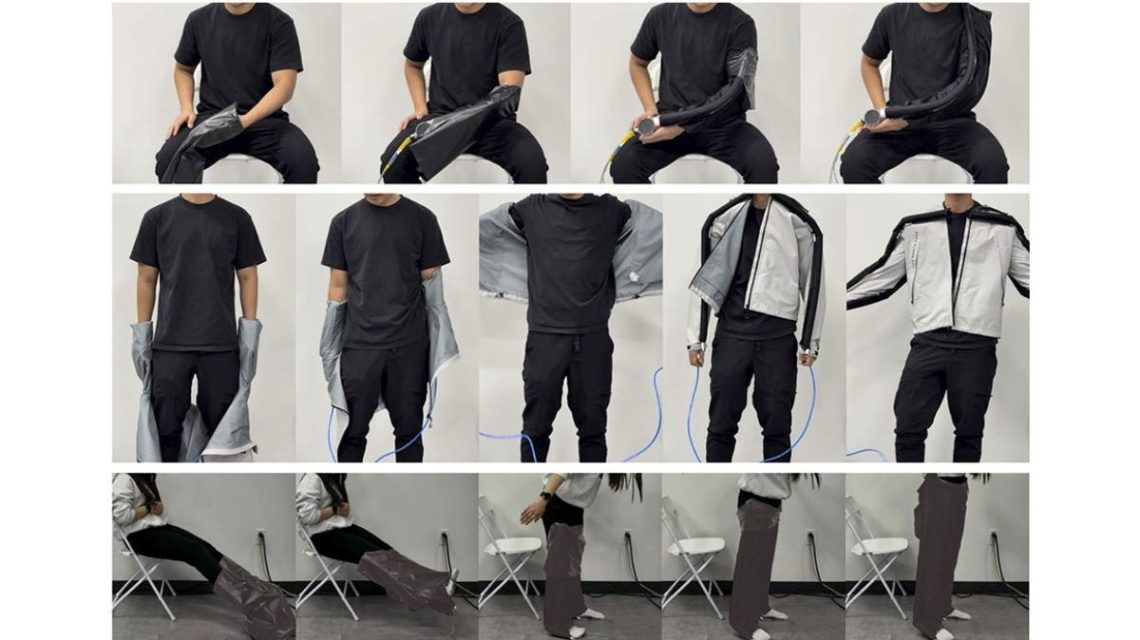
Typically, getting dressed is a routine task. But for those with mobility issues, it can be difficult. A new development from researchers in South Korea and Stanford University has introduced self-dressing clothing. These clothes use soft, air-powered robots to assist wearers, potentially offering independence to older adults and those with mobility challenges.
Revolution in Clothing
Researchers have embedded soft, air-powered robots into garments. These robots allow clothes to move into place on the wearer’s body. Although this technology is still in its early stages, its potential for enabling independent living is significant.
Understanding the Self-Dressing Mechanism
The approach, named the Self-Wearing Adaptive Garment (SWAG), integrates soft robotic structures. By using air pressure, these garments adjust themselves around the body’s contours, offering a custom fit without unnecessary friction. The technique resembles the growth pattern of ivy, which grows along surfaces without dragging its entirety.
The Genesis and Implementation of the Idea
Nam Gyun Kim, influenced by an experience on a rainy day, spearheaded the idea. By thinking about clothing that adapts to the body without manual interference, he and his team have pursued a vision where clothing seamlessly assists in dressing.
Practical Uses and Potential Impact
SWAG’s technology is particularly beneficial for older adults and those with physical disabilities. The product has industrial applications too. Cleanroom workers and emergency personnel could benefit from quickly donning protective garments without extra manual effort.
Challenges and Future Directions
Currently, the system remains in prototype along with its pneumatic system. Costs and general availability also remain undefined. Future versions may integrate adjustable materials to fit diverse body types. Importantly, clinical trials are essential to ensure the system is practical and comfortable for those it aims to help. Additionally, simplifying the removal process is a noted goal.
Why This Matters
While it may be some time before this technology is mainstream, its implications for daily autonomy and privacy are profound. The innovation could significantly aid those with mobility issues, offering them the dignity to handle personal routines independently.
Understanding the needs behind self-dressing clothing can help us appreciate such innovations. It promises to make getting dressed less exhausting and more dignified. Challenges remain, yet the potential to enhance everyday life through something as fundamental as clothing is a promising field of exploration.
 Experts Warn Against Alarmism in AI Governance
  AI and the Changing Nature of Google Searches
  Data Centers Stir Controversy in Texas Amid Growth Boom
  The Technology Rivalry: Trump’s Meeting with Xi and the AI Ecosystem Clash
  Ways to Protect Your Finances from Cyber Threats
  Interview with Nvidia CEO Jensen Huang: AI Outlook and Business Strategy