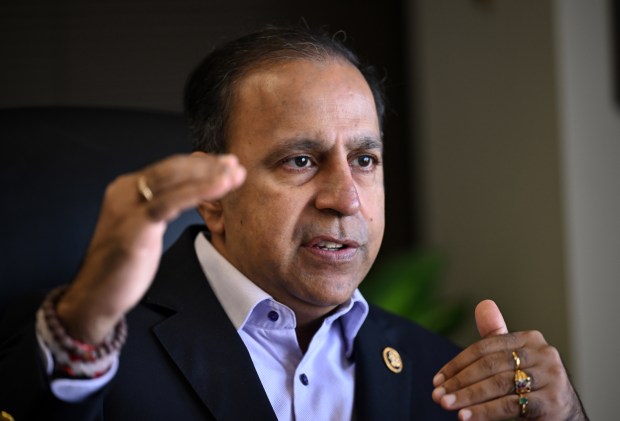
After years of preparation, substantial fundraising efforts, and aspirations to represent Illinois as a senator, U.S. Rep. Raja Krishnamoorthi’s political ambitions were halted when he lost the March 17 primary election to Lt. Gov. Juliana Stratton. The Schaumburg Democrat is now navigating the outcome and preparing to leave Congress after ten eventful years. These years encompassed significant events like a pandemic, insurrection, and impeachment proceedings. Krishnamoorthi expressed his sentiments in a Thursday interview with the Daily Herald, stating, “I think we have to move forward. We have to look to the next challenge and see how we can try to serve the higher cause.” He endorsed Stratton in the November 3 general election, affirming, “She’s going to be a great senator.” As he approaches the end of his term, Krishnamoorthi remains focused on his duties, saying, “At this point, I truly am focused on finishing the year strong. We just don’t want to leave anything on the field at this point.” One of the tasks in his final weeks includes addressing numerous constituent issues, particularly involving immigrants affected by recent federal changes. “These are people who have legally followed every step of the process and they are facing tremendous uncertainty,” he noted.
Krishnamoorthi’s impending departure involves packing up offices in Washington, D.C., and Schaumburg, where personal memorabilia and photographs, including images with President Barack Obama and pictures of his children, await relocation. “It’s an interesting and poignant time,” he remarked.
“Call me Raja”
In 2012, Krishnamoorthi faced a setback in the 8th Congressional District race, losing to then-U.S. Sen. Tammy Duckworth. He bounced back and secured the seat in 2016. Hailing from an immigrant family, Krishnamoorthi understands the challenges associated with his full name, Subramanian Raja Krishnamoorthi, which spans 29 letters. He simplified interactions by encouraging voters, “Call me Raja,” a phrase that featured prominently in his early campaign advertisements. His political journey began when he assumed office on January 3, 2017. “One of the happiest moments was being sworn in and having my wife and three kids there with me,” Krishnamoorthi fondly recalled.
A Short Honeymoon
Krishnamoorthi entered Congress during a challenging period for Democrats as Republicans controlled both the House and Senate following President Donald Trump’s election. Shortly after, on January 28, 2017, Krishnamoorthi actively participated in protests at O’Hare International Airport against Trump’s executive order restricting entry from seven Muslim-majority countries. Outgoing Congressman Raja Krishnamoorthi shared perspectives on his congressional tenure during an interview in Schaumburg on October 8, 2026. “That was a harrowing moment,” Krishnamoorthi recounted. “I remember finishing up my events for the day in the early evening and heading home when I got a call about ‘Muslim ban 1.0.'” He promptly turned around and proceeded to the airport to assist detained Chicago-area Muslims holding green cards.
Front-Row Seat to History
Krishnamoorthi, as part of the Committee on Oversight and Reform and the Permanent Select Committee on Intelligence, experienced historic Congressional inquiries. He conducted questioning sessions with high-profile figures like former FBI Director James Comey and Trump’s ex-attorney Michael Cohen, exploring matters such as Russian interference in the 2016 election. His involvement in these hearings catalyzed his transition from a relatively unknown suburban lawmaker to a frequent commentator on major network channels. When Cohen testified in February 2019, Krishnamoorthi persistently sought insights into Trump-related controversies from Cohen. The ensuing viral exchange drove additional investigations and inquiries, establishing Krishnamoorthi’s significant role in these processes.
Capitol Under Attack
On January 6, 2021, Krishnamoorthi anticipated a routine day for certifying the election, only to be disrupted by an urgent evacuation signal from Capitol Police. “It turns out that there was a pipe bomb planted within hundreds of feet of my office,” Krishnamoorthi recollected. As rioters overwhelmed the Capitol, Krishnamoorthi and his staff took refuge in the Rayburn House Office Building. Despite the turmoil, Krishnamoorthi later recalled voting as a “proud moment.” A flight to Chicago presented an unusual encounter with a fellow passenger who scrolled through photos taken inside the Capitol during the insurrection, ironically identifying herself as part of the revolt.
Campaign Crucible
Krishnamoorthi amassed extensive funds in preparation for a promising 2026 Senate campaign. His prospects shifted dramatically with Stratton’s entry backed by substantial support from Chicagoan allies, including significant contributions from Gov. JB Pritzker. “It presented a unique challenge and obviously it was a challenge that I had not faced before,” Krishnamoorthi noted. He acknowledged the impact of current political polarization influenced by the Trump presidency, shaping the campaign dynamics. Stratton’s stance as a “fighter” against Trump attracted formidable support, presenting further obstacles for Krishnamoorthi. Despite encountering intense competition, Krishnamoorthi expressed pride in rallying widespread support throughout Illinois.
Concurrent with the primary, Chicago experienced turmoil through arrests, deportations, and violence connected to Operation Midway Blitz, a federal immigration campaign. “People were particularly angered by the president, and that helped to color the campaigns in important ways,” Krishnamoorthi noted. Through this challenging period, Krishnamoorthi relied heavily on his family’s unwavering support as his “safety net.” Reflecting on the electoral defeat, Krishnamoorthi stressed focusing on future contributions rather than revisiting past setbacks. He emphasized pursuing reforms aimed at improving government functionality.
A Federal Election Commission filing revealed Krishnamoorthi’s campaign financial dynamics, reporting $31.6 million in receipts, largely sourced from his House election fund, and a spending total leaving approximately $74,000. The future allocation of remaining campaign funds awaits determination.
Congressional Legacy
Krishnamoorthi’s congressional tenure is marked by achievements such as laws advancing skills-based education systems and securing $46 million in community project grants. His investigative efforts addressed critical issues like youth vaping and hazardous metal levels in baby food, resulting in effective regulations. However, Krishnamoorthi treasures most his role in resolving over 15,000 constituency service cases, aiding in matters from locating Social Security checks to facilitating safe passage for a military interpreter from Afghanistan.
What’s Next?
Concerning his next career phase post-Congress, Krishnamoorthi remains uncertain, saying, “The prospect of winding up my time here is really consuming the majority of my brain share.” Various individuals have proposed unconventional career paths ranging from video gaming to rideshare driving. Krishnamoorthi, while amused by such suggestions, affirmed his profound connection to public service, describing it as his “calling.” He expressed immense fulfillment derived from his team’s endeavors in positively impacting constituents’ lives.
 Court Halts Tree Removal at East Potomac Golf Links
  Supreme Court to Review DISPUTE Over DOGE Service Records
  Katie Zacharia’s Brief Debut as White House Press Secretary
  Youth Protests Challenge Prime Minister Modi’s Political Control
  News Highlights: Guilfoyle Scandal, Iowa Senate Race, and Alaska Rally
  Katie Zacharia Steps In as White House Press Secretary