In a strategic move, a small company, collaborating with NASA and Northrop Grumman, has launched an experimental space tug to extend the life of the Neil Gehrels Swift Observatory. This ambitious operation aims to prevent the telescope from plummeting back to Earth and burning up by the end of the year.
The Mission Details
The tug, equipped with small robotic arms, will engage with the $250 million observatory. It plans to elevate the satellite to a safer altitude, allowing it to continue its mission of detecting violent cosmic explosions.
The Launch
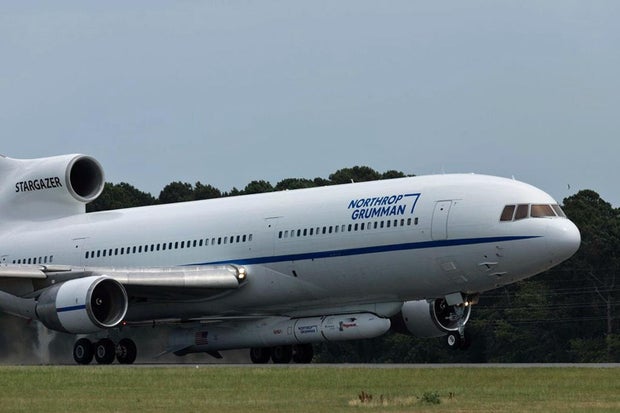
Northrop Grumman dispatched the last operational L-1011 transport plane from NASA’s Wallops Island, Virginia. Their destination was the Marshall Islands in the Pacific, where the Pegasus XL rocket, carrying Katalyst Space’s LINK space tug, was launched.
The LINK satellite, developed under a $30 million contract with NASA, undertook an eight-month journey from design to launch. It was released at 4:36 a.m. ET, three days later than scheduled due to weather and software issues. The rocket successfully placed the satellite in orbit.
Technical Challenges
Once in orbit, flight controllers verified the deployment of LINK’s solar arrays. Several weeks are planned for system checks before LINK attempts to rendezvous with Swift. The mission includes using ion thrusters to boost the telescope’s altitude to approximately 370 miles. This maneuver could extend Swift’s operation by an additional decade.
“What the Katalyst team has accomplished in just eight months is extraordinary,” Ghonhee Lee, CEO of Katalyst Space.
Urgency of the Mission
If the reboost mission does not succeed, the Swift Observatory is expected to exit orbit by year-end. Since its 2004 launch, Swift has significantly contributed to the study of gamma-ray bursts, providing crucial data about cosmic phenomena.
Swift’s capability to rapidly detect and reorient towards gamma-ray bursts has confirmed that heavy elements, such as gold, are formed during such events.
Swift’s Current Status
Over two decades, Swift’s altitude has decreased due to atmospheric drag. It is currently descending at five miles per month. Atmospheric conditions can further accelerate its fall.
“We have several months where Swift will be at a sufficiently high altitude to give the Katalyst folks a great chance to capture and boost us,” Brad Cenko, Swift’s principal investigator.
The Future of Satellite Servicing
Katalyst is leveraging this mission to showcase robotic satellite servicing. A successful mission could pave the way for future satellite reboosting, refueling, and repairs. Eventually, such technology might even be used to maintain the Hubble Space Telescope, which faces a similar fate in the near future.
“You should be able to refuel, reposition, repurpose, repair, and even upgrade satellites,” Robert Lamontagne, Katalyst VP of strategic partnerships.
Katalyst aims to end the era of disposable satellites, ushering in a new model of sustainable space operations.
 Ice Age Mastodon Tooth Unearthed in California Creek
  The Unique Challenges of the Pumpkin Toadlet
  Animal Self-Medication Insights
  Carlo Rovelli’s Perspective on Physics and Ultimate Reality
  Department of Defense Legal Waiver Promotes UAP Disclosure
  Ancient Ring Offers New Insight on Pontius Pilate’s Authority