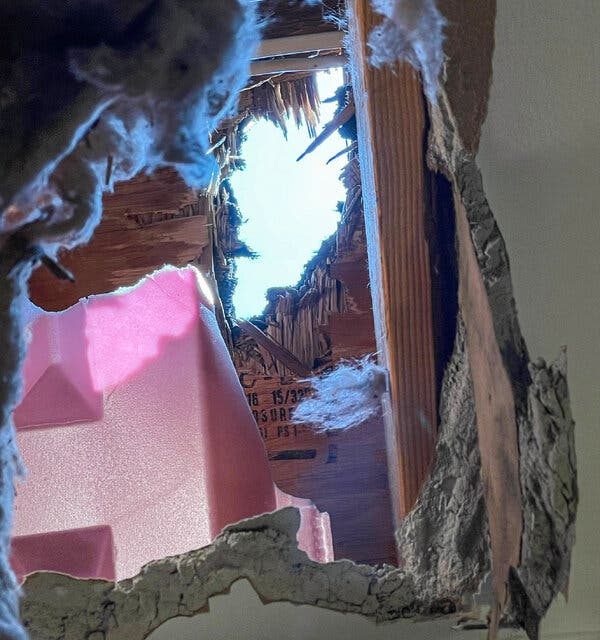
Damage to a home in Hillsborough, N.J., struck by a meteorite on July 16, 2024, provides insights into asteroid composition.
On the morning of July 16, 2024, a meteor streaked over New York City, causing a sensation. Observers reported seeing the fiery trail and hearing a thunderous sonic boom echoing across Connecticut, Rhode Island, and Pennsylvania.
NASA initially believed the meteor, thought to be about a foot long, would not survive its fall to Earth. The agency suggested that it would vaporize during its descent through the atmosphere.
Owners of a house in Hillsborough, New Jersey, would contest NASA’s assertion. At 11:20 a.m., while working in his home office, one of the homeowners experienced an abrupt disturbance. He described hearing a powerful crash and feeling the house tremble, like kitchen cabinets dropping off their mounts.
Upon recovering from the initial shock, he ventured into the main bedroom. There, he discovered a gaping hole in the ceiling above his bed.
The man noticed the air carried a foul smell, reminiscent of sulfurous eggs, and was accompanied by a fine dust that settled on surfaces. Black soot appeared to cover both horizontal and vertical areas. Among the debris on his pillow were several dark stones.
The homeowner remarked, “Good thing I didn’t sleep in,” expressing relief at his narrow escape from injury.
The couple, choosing anonymity to keep their exact location undisclosed, later contributed to scientific research on asteroid composition by allowing examination of the meteorite fragments.
This unexpected incident turned their misfortune into a scientific boon, helping researchers understand the makeup of unusual asteroids that find their way to Earth.
 Navigating Relationships with Inconsistent Communication
  Historical Highlights of September 22 in Chicago
  Austin Protests Erupt After ICE Agent Shoots Venezuelan Man
  Cindy Crawford’s Son Presley Gerber Dies
  Democrats Navigate Transgender Athlete Debate Amid Midterm Elections
  Family Conflict Over Heirloom Necklace