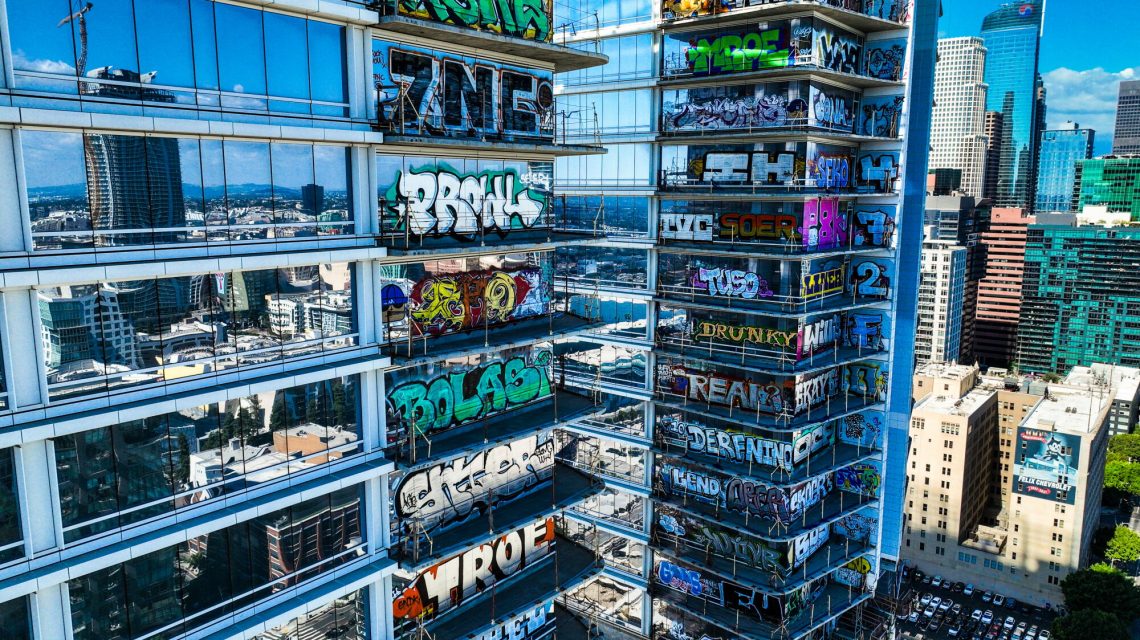
In Los Angeles, graffiti evokes mixed reactions. Some view it as vandalism, while others see it as art. Graffiti serves various purposes, from marking gang territory to political dissent. Over the years, it has become a staple in the city’s landscape despite efforts to remove it. Currently, graffiti culture in L.A. is undergoing a notable change.
Traditional canvases such as walls and bus stops remain popular. But modern taggers are also targeting high-profile locations and using social media to reach wider audiences. This shift in approach has caught the world’s attention.
Last year, taggers began targeting abandoned high-rises downtown, altering the city’s skyline. More recently, several empty Hollywood Hills mansions have been painted. According to Bruno Hernandez, executive director of the STP Foundation, graffiti has become bolder and more daring. He notes that while graffiti norms are evolving, the scale of graffiti has expanded, making it seem more uncontrolled.
The urge to venture into risky, high-profile locations aligns with social media’s influence. Taggers seek areas where they can work unnoticed, such as abandoned spaces, and achieve recognition online. The move from tagging street benches to skyscrapers has been gradual.
In the 1980s, graffiti on buses and buildings signaled a burgeoning street art scene often seen as vandalism. After the 1992 riots, taggers expanded their canvases to include city structures impacted by the riots, seeking both anonymity and recognition, says Stefano Bloch, a former graffiti artist and criminology professor.
Arturo Gonzalez, founder of East Side of the River, recalls using graffiti as an escape while growing up in East L.A. Initially, he was bothered when others tagged over his murals. He eventually accepted this as part of the artist’s journey. Nowadays, even painted-over graffiti finds permanence through social media posts.
Downtown skyscrapers offered abandoned space perfect for graffiti, observes Bloch. Many artists took advantage, leading to colorful tags in the skyline. These actions received worldwide attention earlier this year.
High-profile graffiti incidents have highlighted issues around neglected properties. City Councilmember Nithya Raman acknowledges the difficulties in taking action against such properties. She advocates for a streamlined approach to handling neglected assets.
Historically, Los Angeles has had a complex relationship with graffiti. In 2002, LAPD Chief Bill Bratton aimed to make graffiti eradication a priority. However, an established graffiti unit was disbanded within a year. The city’s stance towards graffiti shifted in the following years, culminating in several legal actions against graffiti artists, with mixed results.
The Office of Community Beautification spent $11 million last year to cover 32 million square feet of graffiti. However, information on clean-up locations is scarce, and police have withheld comments.
Earlier this year, Councilmember Kevin de León called for action against Oceanwide Holdings, owner of the graffiti-laden downtown towers. The city attempted to address the issue through policing and security measures, though it’s unclear if action was taken against the developer. The Hollywood Hills mansion faced a city lien and fencing off following public outcry.
Mainstream culture attempts to embrace aspects of graffiti culture. Hernandez notes increasing interest from venture capitalists in engaging with graffiti art, highlighting a growing crossover between corporate interests and street art.
 Immigrant Story of Strength Displayed at Orland Park Library
 Changes and Challenges at the Kennedy Center
 Data Visualization: Humanizing Numbers with Mona Chalabi
 Actor Kerr Smith Reflects on His Unexpected Journey Into Acting
 Emily Hanson-Miller, Known as ‘ThriftyFatty,’ Dies at 37
 Celebrating Unity in 2026: Music, Film, Sports, and Television