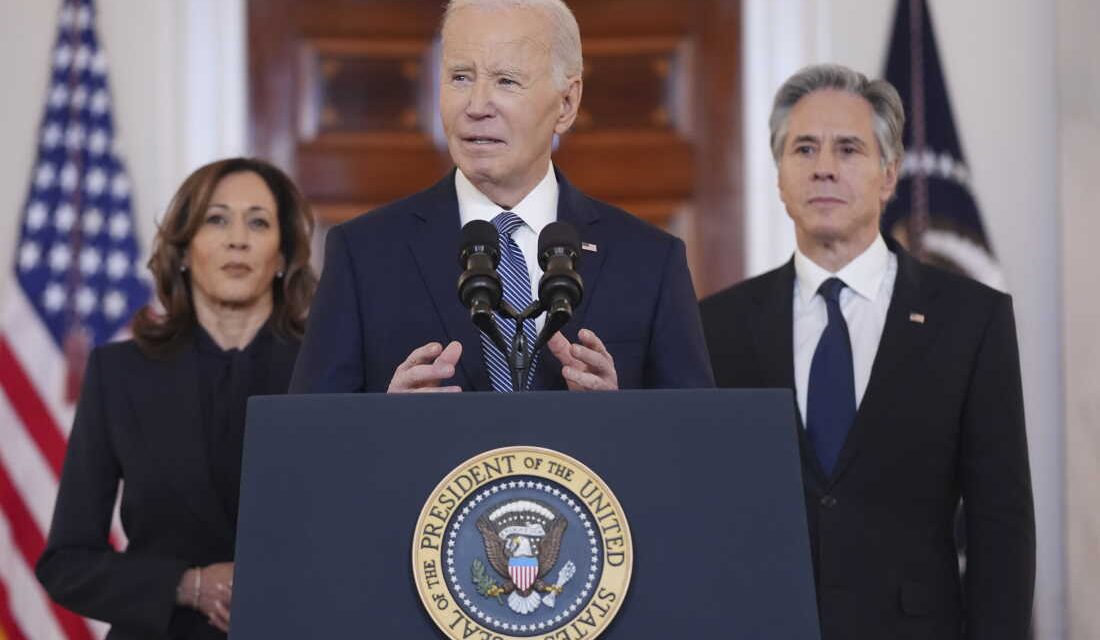
On January 15, 2025, President Joe Biden, alongside Vice President Kamala Harris and Secretary of State Antony Blinken, addressed the nation from the White House following the announcement of a ceasefire in Gaza. Renowned journalist Akbar Shahid Ahmed, who has extensively covered U.S. foreign policy promises versus actions, sheds light on these developments in his latest work.
Ahmed, formerly with HuffPost, reported on Biden’s 2019 Middle East promises, such as making Saudi Arabia a pariah, and covered subsequent events from Israel and Gaza. After the Hamas-led attack on Israel in 2023 and the subsequent Israeli military response, he traced key decisions back to the U.S., arguing that dissent and objections within Washington were often recorded in memos but were not acted upon by a close-knit inner circle advising the President.
Now a diplomatic correspondent for The Washington Sun, Ahmed shared with NPR’s Morning Edition findings from his book, Crossing the Red Line: Biden, His Advisors, and Israel’s War in Gaza. Based on interviews with over 150 policy-makers involved in U.S. decisions, he discusses the insularity within Biden’s administration. He indicates that high-level decisions regarding Gaza were often made by a small group, which shaped U.S. support for Israel.
One example from Ahmed’s book highlights the internal discussions post the 2024 U.S. presidential election on whether the U.S. bore complicity in alleged war crimes. Key figures such as Cabinet members, Brett McGurk, and Ambassador Jack Lew participated in these talks, acknowledging Israel’s intent to continue its campaign, contrary to public suggestions of restraint before operations expanded to Rafah.
The book delineates a pattern where even minor decisions reached the highest levels of the White House, causing action delays and missing chances to pressure Israel to curtail its offensive. He notes a term from a former State Department official, “herd impunity,” indicating a culture where officials avoided decisive stances on potential Israeli war crimes, resulting in inaction.
“The idea that everyone is in the clear if no one says, ‘Yes, this one instance was a war crime,'” Ahmed stated.
Following Biden’s departure from office, scrutiny continued. An independent U.N. commission in September 2025 concluded Israel committed genocide against Palestinians in Gaza, a claim Israel denied, including allegations of war crimes while asserting investigations into misconduct accusations.
Ahmed’s work further explores U.S. policy continuity, notably the $3.8 billion annual military aid to Israel, supplemented by an $8.7 billion aid package during the 2023 Gaza conflict. In recent reports, a $2.8 billion weapons sale under President Trump was also documented.
Biden, alongside Blinken and McGurk, has upcoming books promising insights into their foreign policy roles. Ahmed urges deeper examination of internal administration deliberations, uncertainties expressed by senior officials, considered alternatives, and responsibilities related to U.S. Middle East policies.
In a Q&A, Ahmed discussed a significant red line outlined by Biden concerning Israel’s actions in Rafah, home to 1.4 million Palestinians. Despite Biden’s pledge to limit weaponry to Israel upon red line breaches, the administration instead supported narratives denying such violations.
Careerism in Washington and Biden’s skeptical views of the Palestinian plight influenced this policy, Ahmed elaborates, evidenced by minimal contact between U.S. officials and Palestinians contrasted against high-level war crimes discussion absence.
Reflecting on Hamas’ role, Ahmed concurs with human rights organizations’ findings of violations by Hamas. Yet, emphasizing the U.S. military support to Israel, he contends that American weaponry enabled the offensives, drawing attention to Biden’s own advisory warnings against fueling violence.
“It’s a period that reshapes the standards of warfare,” Ahmed comments referring to the lasting implications of the administration’s decisions.
His book argues that all officials involved in executing these policies should be accountable, noting shifts in global warfare risks and democratic accountability expectations.
The interview with Leila Fadel, adapted for the web by Majd Al-Waheidi and edited by Adriana Gallardo, concludes with Ahmed’s appeal for reevaluating past policy choices and their impacts on U.S. international roles.
 Immigration Debate: Democrats and Republicans Face Messaging Challenges
  Systemic Issues Plague U.S. DOGE Service
  The Scope of Accountability in Missouri’s Education System
  Faith and Politics: Democratic Candidates Embrace Religion in Congressional Campaigns
  Navigating Republican Challenges in Upcoming Midterm Elections
  Bobby Pulido: A Latin Grammy Winner in Congress?