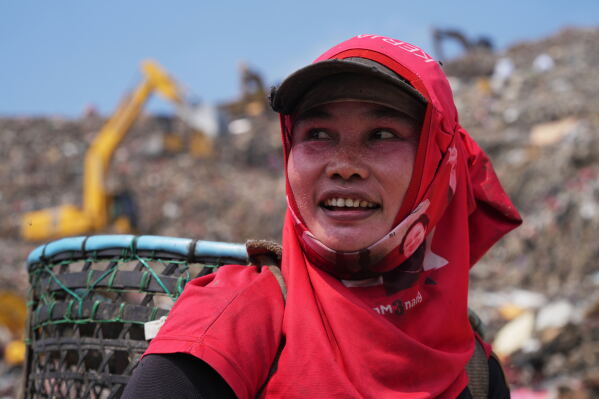
Before dawn at Bantargebang, Indonesia’s largest landfill, waste pickers like Nur Wencih scour the heaps of rubbish. A 35-year-old widow, Wencih has been working at this site on Jakarta’s eastern outskirts for two decades, following her parents’ footsteps. The landfill has sustained her, covering food and rent expenses, while her two daughters stay with relatives in a village. She hopes they find better opportunities.
Wencih lives in a rented room near the landfill and makes around 200,000 rupiah ($12) on good days by collecting items like toys, cardboard, and plastic bottles before they get buried by fresh waste. Rarely, she uncovers gold jewelry. She describes these finds as striking luck.
“It feels like hitting a jackpot,” Wencih remarked. But such discoveries, along with her livelihood, might soon become scarce.
Indonesia’s Waste Management Overhaul
Starting August 1, Indonesia will implement a waste management overhaul, transitioning landfills from open dumping to more controlled systems. This plan will close down open-dumping activities at 343 out of the country’s 550 landfill sites. The government aims to shift these sites to controlled or sanitary landfills, allowing only non-recyclable and non-compostable waste like diapers, dirty paper towels, and stickers.
Residents are encouraged to separate organic waste and recyclables for processing. This practice is unfamiliar to most households. Dudi Gardesi Asikin, head of Jakarta’s Environment Agency, stated the policy’s goals are to enhance environmental health, reduce pollution, and curtail methane emissions.
Methane significantly contributes to global warming. It traps more heat than carbon dioxide, making its reduction a global priority. U.N. Secretary-General António Guterres is among those advocating for decreased methane emissions as a swift method to combat climate change.
Bantargebang Landfill’s Methane Challenge
Bantargebang is one of the largest methane emitters among global landfills, placing it at the forefront of reform efforts. Originally opened as a sanitary landfill in 1989, it was equipped to handle methane. However, following the end of a private contract in 2016, it turned towards open dumping, said Asikin.
Currently, only two out of 12 initial methane extraction wells remain functional. The new plan involves covering more of the landfill with tarps, a measure estimated to cost 200 billion rupiah ($12 million). Implementation has already begun at certain sections.
Impact on Waste Pickers
The transition poses a dilemma for Indonesia, which relies on approximately 600,000 waste pickers nationwide for its waste management. Bantargebang alone supports over 4,000 registered waste pickers daily.
These individuals recover materials to sell to traders and recycling businesses. Wencih worries about feeding her family as bulldozers dispose of fresh waste behind her.
Asikin noted the government seeks to enhance conditions for waste pickers, who access some workplace protections and healthcare via social security. The policy aims to provide safer formal jobs in recycling and composting. According to Asikin, waste pickers currently risk their safety by racing against machines for recyclables.
Bantargebang’s Growing Heap
Bantargebang spans around 110 hectares (272 acres), reaching heights close to 60 meters (196 feet), much like a 20-story building. It receives approximately 7,500 tons of waste daily from the capital.
A collapse due to heavy rain in March resulted in seven fatalities, highlighting the landfill’s dangers. Agung Pujo Winarko, in charge of the facility, emphasized the urgent situation due to the landfill nearing its capacity.
Shift in Waste Management Culture
The new policy requires Jakarta residents to sort food scraps and other organic waste from recyclables and residual trash. New refuse-derived fuel plants are part of the strategy.
“This is somewhat revolutionary,” Asikin commented. “For decades, no one had to separate waste.”
However, many households are unaccustomed to this system, raising concerns about public awareness. Rukasih Wanti, a Central Jakarta resident, expressed confusion over the new rules’ inconvenience.
Efforts are receiving support from various government institutions, including education and health ministries.
Environmental groups advocate for further recycling and composting infrastructure. According to government statistics, only a quarter of Indonesia’s daily waste is managed formally; the rest is primarily unmanaged.
David Sutasurya, from the environmental group YPBB, highlighted that roughly 80% of Jakarta’s waste is recyclable or compostable.
Community waste initiatives, like one led by Monica T. Anggriani in West Jakarta, have been pivotal. Her neighborhood project processes about a ton of organic waste daily through composting and other methods.
“We were never taught to separate waste,” Anggriani observed. “If change doesn’t start now, the future remains bleak.”
 Teen Arrested in Penn State Student’s Murder; Second Suspect at Large
  EPA Dismantles Greenhouse Gas Rules, Causing Concern
  Carnival Panorama Passenger Jumped Overboard During Final Leg of Cruise
  How Battery Innovations Transform Renewable Energy
  Data Centers Stir Controversy in Texas Amid Growth Boom
  Nikole Hannah-Jones Reflects on Educational Choices for Her Daughter