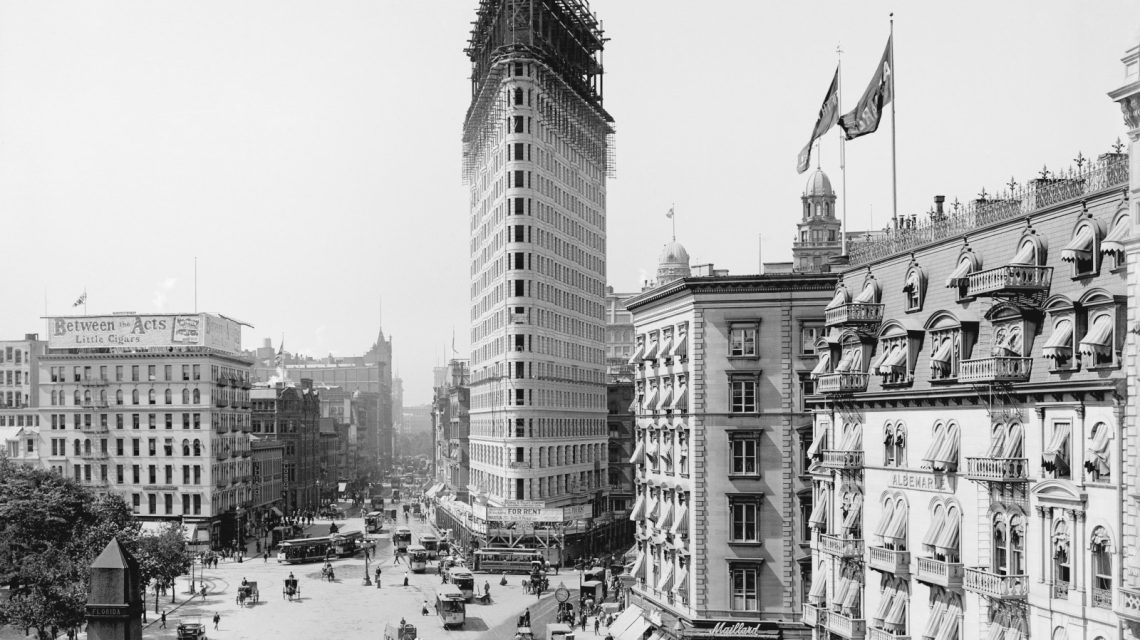
Over a hundred years before Manhattan became known for its towering skyscrapers, significant footage captured one of New York City’s earliest vertical structures. This black-and-white film, dated October 8, 1902, was recently shared by the Library of Congress. It documents a panoramic view of the newly completed Flatiron Building.
The footage opens at street level, showing bustling activity on the Manhattan streets. The cameraman gradually pans upward, revealing the upper reaches of the 24-story structure. On sharing the footage, the Library of Congress noted that it presents “a view looking south from Madison Square, across the intersection of Broadway, Fifth Avenue, and Twenty-third Street, to New York’s famous skyscraper, the Fuller (or ‘Flatiron’) Building, with a panorama of the surroundings.” The camera clearly captures the transition from street level up to the roof.
With its completion in 1902, the 307-foot-tall Flatiron Building was among the earliest skyscrapers globally. Its distinct triangular shape and pioneering steel-frame construction brought it fame. Today, the building undergoes significant changes. Just last month, for the first time in its 124-year history, the landmark was illuminated as it transitions into private residences. This shift represents a broader restoration movement for historic buildings throughout New York City and across the United States.
The American Institute of Architects states that almost half of America’s 125 million buildings are over 50 years old. A recent RentCafe report indicated that nearly 25,000 apartments resulted from office and building conversions nationwide in 2024, marking a 50% increase from the previous year.
An Iconic Building That Once Dominated the Skyline
In the early 20th century, the Flatiron Building significantly altered New York City’s architectural landscape. According to historian Kevin Draper, founder of NY Historical Tours, “The Flatiron Building was one of the earliest of New York City’s new skyscrapers at the time.” Despite its innovation, many residents debated the necessity of such tall buildings, worrying about the shadows they cast on areas like Madison Square Park during times when Madison Square Garden was still nearby.
Similar debates continue today, with concerns over supertall buildings affecting Central Park. Draper notes that conversations about building height laws existed a century ago, mirroring modern discussions. The footage from 1902 illustrates how imposing the Flatiron was in its early days compared to surrounding structures. Draper comments on the irony of the building’s current appearance as small against much larger adjacent towers.
Glimpses of Everyday Life in Manhattan in 1902
Apart from architecture, the film offers insights into Manhattan’s daily life at the turn of the 20th century. Draper highlights the unchanged crowded streets and the perennial rush of people on their way. Transportation in the footage captures a city transitioning: a lone early automobile navigates through, while streetcars and numerous horse-drawn carriages are more common.
These transport forms mostly vanished from New York streets. Streetcars have disappeared entirely, and horse-drawn carriages remain primarily as Central Park tourist attractions.
During this period, New York’s architecture was in a transformative phase. Innovations in steel-frame construction and elevator technology facilitated soaring building heights. This revolutionized areas like Lower Manhattan and Midtown. Before the Flatiron’s introduction, the New York World Building (completed in 1890) stood as the city’s tallest, followed by the completion of the Park Row Building in 1899, one of the world’s tallest office buildings for a brief time.
The Flatiron, however, was unique, due to its striking design and prime location at Broadway and Fifth Avenue’s crossroads. Over 120 years later, the historic footage of this iconic landmark serves as a reminder of a time when the building epitomized the future of urban architecture amid New York City’s initial foray into the skyscraper era.
 Tensions Escalate in Iran Conflict as Global Leaders Weigh Options
  White House Approves F-35 Sales to Saudi Arabia Amidst Regional Tensions
  Inside the Secret Deals Powering the President’s Push to Deport Migrants to Countries Not Their Own
  Navigating the Challenges of Third-Country Deportations
  Midair Altercation on Bangladesh to London Flight
  Ukraine Missile and Drone Barrage Hits Russia Amidst Elections