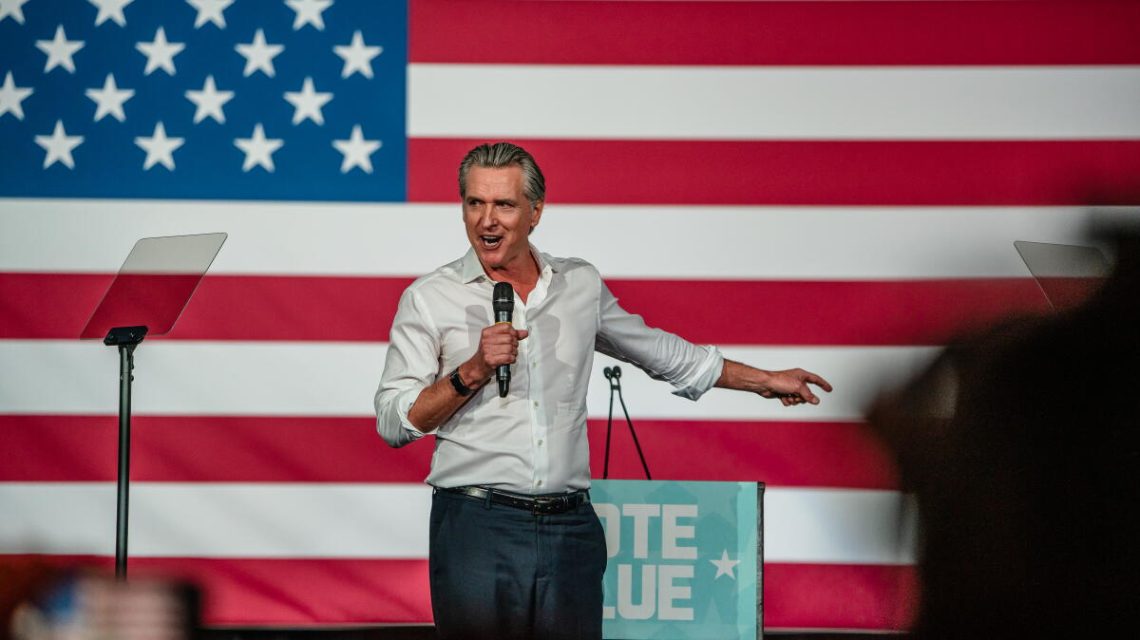
In 2018, while campaigning for the governorship of California, Gavin Newsom expressed a preference for bold action over mediocrity. Now, the two-term governor has demonstrated that commitment by offering clemency to all inmates sentenced to death in California. This decision, unfolding as speculation over his potential 2028 presidential bid grows, marks a defining moment in his leadership.
Newsom stated, “If my job is just to read the polls, you can have an AI chatbot as governor.” He emphasized that leadership entails making judgments and standing by principles rather than simply managing or responding to polling data. He aims to influence public opinion, not merely reflect it. This is consistent with his approach since his tenure as the mayor of San Francisco, when he allowed same-sex marriages in defiance of federal law.
“Leadership is not about stewardship. It’s about making change,” Newsom declared. This philosophy underpins his decision to address what he views as the inequity of the death penalty. Citing equal justice advocate Bryan Stevenson, Newsom highlighted the disparity in justice between the rich and guilty versus the poor and innocent.
Commuting the sentences of all 548 prisoners in California’s death row pushes the boundaries of his gubernatorial powers. Despite two voter rejections of initiatives to end the death penalty in 2012 and 2016, Newsom aims to redefine state policy. The California Constitution permits him to commute some sentences, while others require approval from the California Supreme Court.
Capital punishment remains legal in the state, allowing prosecutors to seek death sentences. Los Angeles County District Attorney Nathan Hochman emphasized the ongoing responsibility to evaluate such cases carefully. Sacramento County Sheriff Jim Cooper expressed his disapproval, citing the case of Luis Bracamontes, convicted of killing two law enforcement officers. He asserted that commutations dishonor the victims and their families.
“Leaders should pursue justice with courage and integrity,” stated Michael Hestrin, Riverside County District Attorney. Critics argue the move could align Newsom with Democratic voters, but others fear it positions him unfavorably with moderates and Republicans.
Polls, such as a Pew Research Center survey, indicate that two-thirds of national voters support the death penalty for murder convictions. Political analysts recognize Newsom’s positioning as aligning him with the Democratic base, a strategic consideration for a potential presidential run. Yet, some argue Newsom’s actions reflect a principled stance rather than political maneuvering.
Newsom had already issued a moratorium on executions early in his first term, citing the discriminatory nature of capital punishment. This moratorium prevents 45 executions, and San Quentin’s death chamber has been dismantled.
The decision aligns with future policies, as incoming Governor Xavier Becerra intends to maintain the moratorium. Newsom’s aides, including former senior advisor Daniel Zingale, affirm that the governor’s actions are not motivated by poll data. Zingale highlights that political leverage was not a consideration in Newsom’s decision-making process.
Without executions since 2006, practical implications in California are negligible. Newsom nonetheless chose to act decisively. He refrained from following advice to do nothing, accepting potential risks for future political endeavors. Governor-elect Becerra’s continuation of Newsom’s moratorium ensures that the decision to commute has broader implications for state policy.
Reflecting on his term, Newsom expressed a desire to avoid regret. He emphasizes his willingness to take risks, even if he becomes a target for political criticism. By prioritizing action over complacency, he solidifies his role as a proactive leader unafraid to make contentious decisions.
 Trump Dismisses Third Impeachment Prospects
 Custody Dispute Involving Rep. Max Miller Delayed
 Attorney General Addresses Post-Midterm Democratic Threats
 Senator Elizabeth Warren and the Future of Crypto Regulation
 Bipartisan Opportunities in Foreign Policy
 Political Shifts and Concerns Post-Midterms