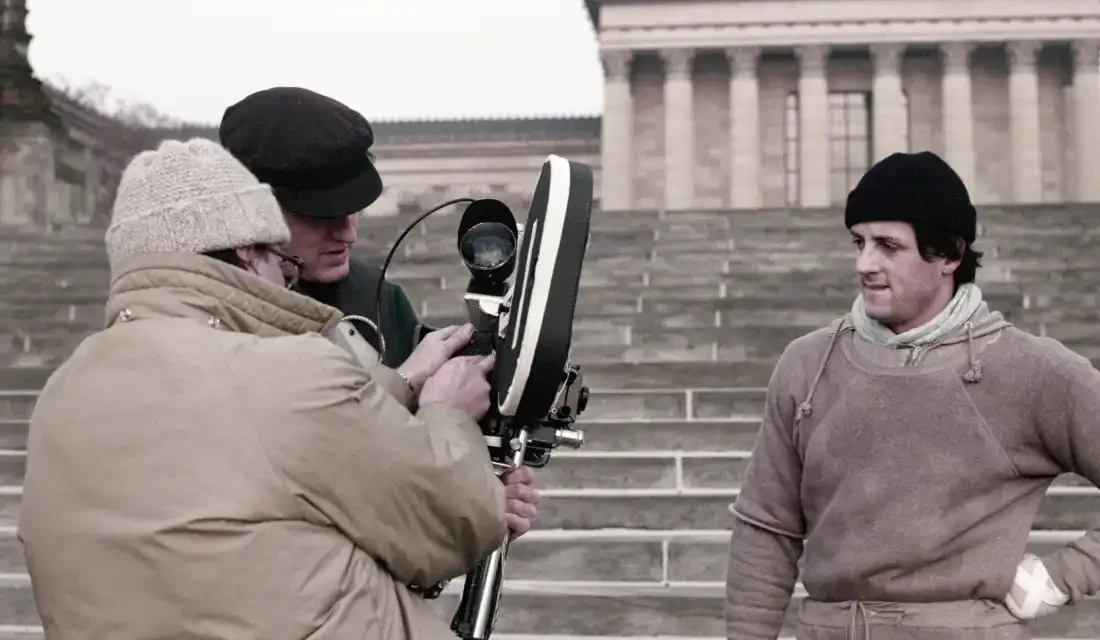
Garrett Brown, working with the Steadicam, played a crucial role in the making of the film Rocky. This film, an underdog story starring Sylvester Stallone, won the Best Picture Oscar in 1977. Its iconic scenes include Rocky Balboa training for a boxing championship, running through various landscapes and punching frozen meat. The climax happens when Rocky triumphs at the top of the Philadelphia Art Museum’s steps.
The new film I Play Rocky highlights Stallone’s process of writing and starring in the movie. It also shines a spotlight on Garrett Brown, the original cinematographer. Brown invented the Steadicam, a device still widely used today. During the filming of Rocky, Brown utilized this invention to capture smooth and dynamic shots, moving inside the boxing ring, navigating through a meat locker, and accompanying Rocky up the iconic steps.
Director Peter Farrelly states, “He’s not just holding a camera, he’s telling a story,” acknowledging how Brown’s smooth movements with the Steadicam allowed audiences to feel connected to the action. Brown’s efforts captured the exhilarating moment when Rocky reaches the stairs’ summit, a scene that still excites fans decades later.
“You have to be immune to embarrassment to try out inventions like that,” Brown remarks while describing his initial trials with the Steadicam.
The Steadicam operates with a harness, providing stabilization through a gimbal, ensuring smooth camera angles. Brown’s innovation won him an Oscar in 1978. Following this, he created the Skycam, Mobycam, Divecam, and other devices, significantly advancing cinematography.
Before his cinematic inventions, Brown was part of a musical duo in college, known as Brown and Dana. They recorded “It Was a Very Good Year” before Frank Sinatra’s famous version. However, after a car accident and the rise of the Beatles, Brown shifted to filmmaking, first producing videos for Sesame Street and pioneering new commercial shooting techniques.
One of his standout inventions for television was a “dog’s eye view” dolly, which provided a realistic beagle perspective. Frustrated with both large dollies and jerky handheld cameras, Brown locked himself in a hotel, sketching the blueprint for the Steadicam. His “30 impossible shots” around Philadelphia drew the interest of filmmakers. These shots include footage seen in I Play Rocky.
Brown’s work extends beyond Rocky. For Return of the Jedi, he captured a high-speed chase through a redwood forest. His expertise was utilized by Stanley Kubrick in The Shining and also in Indiana Jones and the Temple of Doom. Brown explains that the Steadicam mimics natural human vision, which is stabilized by our inner ear, creating smooth visuals while moving.
Brown emphasizes that the Steadicam requires skilled human operation, an element AI cannot realistically replicate.