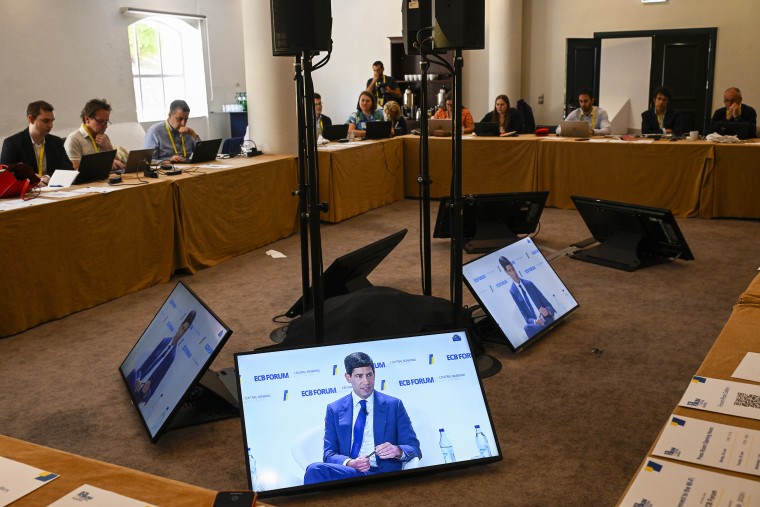
Federal Reserve Chairman Kevin Warsh highlighted recent declines in inflation risks but emphasized that the Federal Reserve has more work ahead to combat rising prices. Warsh noted the significant reduction in energy prices following a U.S.-Iran agreement to end an ongoing conflict, acknowledging that while prices have dipped, they remain slightly above pre-conflict levels.
American dissatisfaction with the economy is evident as inflation poses a concern. The Consumer Price Index indicated a 4.2% increase in May, the highest in years. Energy prices accounted for much of the inflation spike. Warsh also addressed artificial intelligence’s (AI) growing economic impact with an optimistic long-term view.
Warsh shared insights at a panel during the 2026 European Central Bank Forum on Central Banking in Sintra, Portugal. “The AI shock is leading to a boom in capital expenditures,” he stated. Warsh expressed confidence that these developments will soon affect supply, highlighting the Fed’s focus on monitoring these trends.
However, Warsh refrained from signaling potential interest rate changes, maintaining limited communication on Fed future plans. When asked about decisions related to President Donald Trump’s preferences, Warsh declared the Fed’s enduring independence, despite Trump’s calls to reduce key rates and criticism of Warsh’s predecessor, Jerome Powell. Both Warsh and Powell were appointed by Trump.
In the discussion alongside European Central Bank President Christine Lagarde and other central bankers, Lagarde agreed with Warsh on inflation perspectives. Despite the war with Iran, the European Central Bank raised rates, while the Fed opted to keep rates steady, focusing on energy’s inflation passthrough.
The Fed is particularly attentive to the AI industry. The demand for data centers from companies like Microsoft, Meta, and Amazon has driven up computer equipment and memory costs. As a result, prices for consumer electronics, including gaming consoles like PlayStation and Xbox, have risen. Apple recently increased prices on many products, excluding the iPhone and AirPods.
Responding to questions on AI’s potential long-term inflationary effects, Warsh recognized AI’s central role in policy discussions. He suggested the U.S. stands to benefit substantially from AI advancements, drawing parallels with prior innovations like the internet.
While AI’s potential to displace jobs raises concerns, Warsh believes prosperity will improve with more job opportunities. A study from Ramp supports this, revealing workforce expansions in companies investing heavily in AI.
Reaffirming the Fed’s commitment to price stability, Warsh reiterated that labor markets remain stable. He noted, “Prices are too high,” and reiterated the Fed’s mandate to ensure price stability. During Warsh’s first meeting as chairman, rates were held steady, contrary to some policymakers’ forecasts of future hikes. The Fed’s rate committee is slated to convene on July 28 and 29.