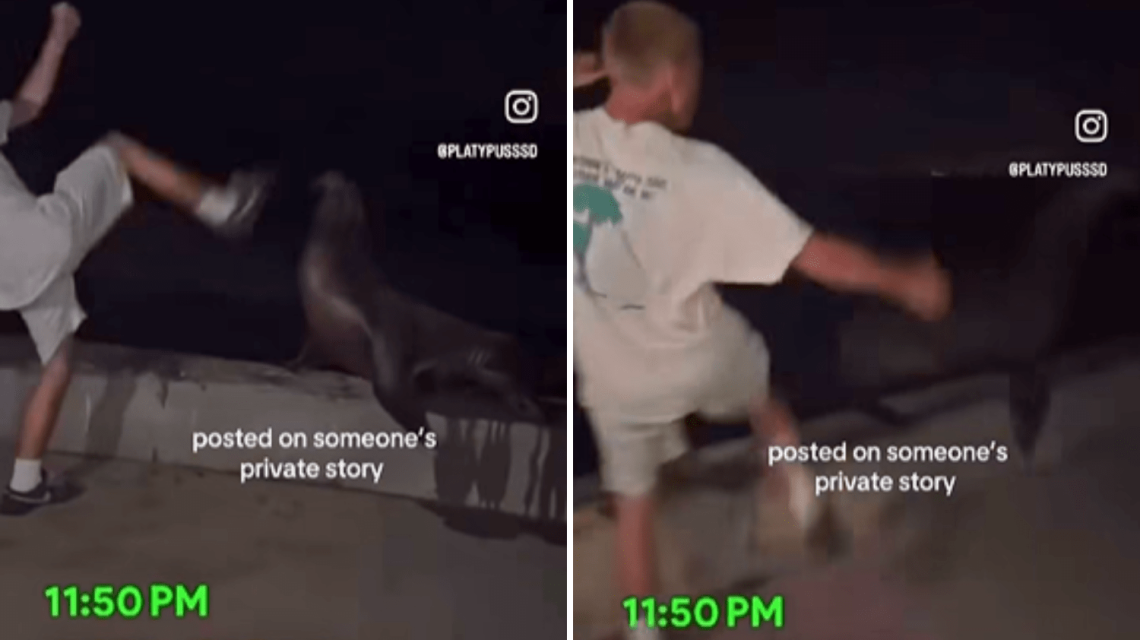
Federal authorities are examining a video featuring a man kicking a protected sea lion in California. The video, which became viral online, depicts actions that have caused substantial public outcry and initiated a federal inquiry. The incident reportedly occurred near La Jolla Cove in San Diego.
The footage, shared by the animal rights group PETA, shows an individual repeatedly kicking a sea lion resting near the shore, then following the animal as it tries to escape. Laughter from others is audible in the background. The National Oceanic and Atmospheric Administration (NOAA) confirmed an investigation by its Office of Law Enforcement.
“NOAA Fisheries’ Office of Law Enforcement is looking into reports of a video on social media showing an interaction between a person and a sea lion, allegedly at La Jolla Cove, California. In the video, it appears the individual is kicking the sea lion. This investigation is ongoing, and we cannot provide more details currently,” a NOAA spokesperson stated to Newsweek.
The man in the video remains unidentified, and no charges have been filed as of the recent update.
Potential Legal Consequences
Sea lions receive protection under the Marine Mammal Protection Act (MMPA). Any harassment, harm, pursuit, or interaction with sea lions can result in penalties and possible jail time. NOAA mentioned that anyone found intentionally kicking a sea lion could face both civil and criminal consequences.
Federal law prohibits harassment of marine mammals, with civil penalties up to $36,498 per violation. Willful violations could incur fines and up to a year in prison. California animal cruelty laws might introduce additional penalties, depending on the case details and if the animal suffered injuries.
The NOAA advised: “If you witness a possible Marine Mammal Protection Act violation, report it immediately to the NOAA Fisheries Office of Law Enforcement at (800) 853-1964. Providing detailed information is crucial for effective investigations.”
Calls for Criminal Charges
PETA has urged authorities to enforce criminal penalties against those responsible. They told Newsweek: “Assault is assault, regardless of the species. This abuser laughed while harassing a sea lion attempting to escape.”
The organization encourages the enforcement of criminal charges and recommends the individual be prohibited from contacting animals. They urge everyone to leave animals undisturbed and report any witnessed abuse.
San Diego’s Response
San Diego Mayor Todd Gloria condemned the act in a social media post, describing the footage as a “disgusting act of animal cruelty.” He instructed local law enforcement to review the video closely.
La Jolla Cove, recognized as a significant sea lion habitat in Southern California, faces ongoing issues regarding human interaction with its wildlife. Conservationists emphasize that frequent disturbances can affect breeding behaviors and mother-pup connections.
The Sierra Club’s Seal Society called for improved protection measures after several young sea lions were found deceased in the area. While NOAA acknowledges some mortality among sea lion pups annually, advocates worry that human interference exacerbates the stress on these animals.
Robyn Davidoff, chair of the Sierra Club’s Seal Society, told Newsweek: “This was a deliberate and repeated attack on a sea lion—protected under the Marine Mammal Protection Act. It constitutes a federal crime, with potential fines and jail time. We believe the perpetrator should be prosecuted.”
Davidoff emphasizes the importance of respecting wildlife, advising that people maintain a 50-foot distance and simply observe rather than engage.
Highlighting frequent issues with tourists crowding sea lions for photos, Davidoff points out that the attack recorded in the viral video is particularly egregious. She advocates for identifying the individual responsible and ensuring legal actions proceed.
“We wish for a continued investigation leading to the identification and prosecution of this person,” Davidoff stated. “Setting an example is essential to communicating that such behavior is unacceptable.”