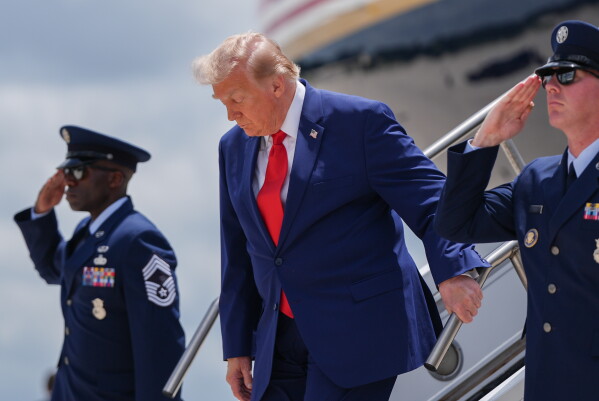
President Donald Trump highlighted the significance of the “Abraham Accords” during his recent visit to the Middle East. These accords were key in the 2020 agreements enhancing diplomatic ties between Israel and several Arab states. The term “Abraham” carries deep religious and cultural resonance, invoking a biblical patriarch revered as foundational in Christianity, Islam, and Judaism. These religions together include more than half the global population. While Abraham is often cited as a figure of unity among faiths, he can also be a source of division, with various groups claiming him as their authentic ancestor.
Everybody has tried to claim Abraham as their own, but in fact Abraham belongs to everybody.– Bruce Feiler
Bruce Feiler, author of “Abraham: A Journey to the Heart of Three Faiths,” observes that the struggle to claim Abraham’s legacy persists as it has throughout history. He asserts that the narrative and land must be shared to honor this legacy.
The Abraham Accords
The Abraham Accords, facilitated by US diplomacy, were agreements between Israel, the United Arab Emirates, Bahrain, Sudan, and Morocco signed in 2020. Trump’s administration aimed for these accords to create a foundation for future negotiations with other Muslim-majority nations, potentially including a lasting resolution in Gaza.
From Biblical Stories to Modern Headlines
Abraham’s story begins in the Book of Genesis as a man promised by God to become the ancestor of a great nation. God guides him to what is now Israel and the Palestinian territories. Abraham’s family dynamics are complex, with his sons Ishmael and Isaac, born to Hagar and Sarah, respectively. These narratives have deep significance across faiths.
Judaism, Christianity, and Islam each regard Abraham in unique ways:
- Judaism sees Isaac and his son Jacob as its forebears.
- Christianity views Abraham as a paragon of faith due to his readiness to obey God.
- Islam honors Ishmael, Abraham’s son with Hagar, as a prophet and ancestor of Muhammad.
Muslims believe the site where Abraham intended to sacrifice his son is within Jerusalem’s Dome of the Rock.
Abraham: A Symbol of Division and Unity
Throughout history, all three monotheistic religions have laid claim to Abraham’s legacy. These claims have fueled historical conflicts, such as the Crusades and modern terror. Yet, due to their reverence for him, Abraham is often utilized in efforts like the accords mediated by a largely Christian US between Israel and Arab states.
Efforts to foster religious dialogue frequently invoke the term “Abrahamic faiths.” The United Arab Emirates showcases this with its Abrahamic Family House, encompassing a church, mosque, and synagogue. In the US, the term strives for inclusivity by broadening interfaith discussion beyond the “Judeo-Christian” tradition.
The Importance of Context in Abraham’s Story
In a speech to the Israeli Knesset, Trump emphasized the Jewish tradition surrounding Abraham by referencing the “God of Abraham, Isaac, and Jacob.” His preference for the “Avraham Accords” echoes this tradition. Despite past policies, including calls to ban Muslims from the US, Trump praises Arab leaders who participated in these accords.
Feiler highlights the enduring complexity of Abraham’s legacy, encapsulated in narratives of familial tension and harmony. Despite desires to possess it entirely, the story of Abraham is a reminder of coexistence.
The Associated Press provides coverage on religion, supported by a collaboration with The Conversation US, funded by Lilly Endowment Inc. The AP remains the sole party responsible for the content.
 Gorillaz and Macklemore Respond to Controversy Over Israel-Palestine Statements
  Investigation into Lion Deaths in Tanzania
  Merz Stays Resolute Amid Electoral Shifts in Germany
  U.S.-Iran Relations and Diplomacy at Upcoming U.N. Assembly
  US-China Relations Under Scrutiny: Expert Warns of Escalating Tensions
  Extradition of Suspects in Haitian President’s Assassination