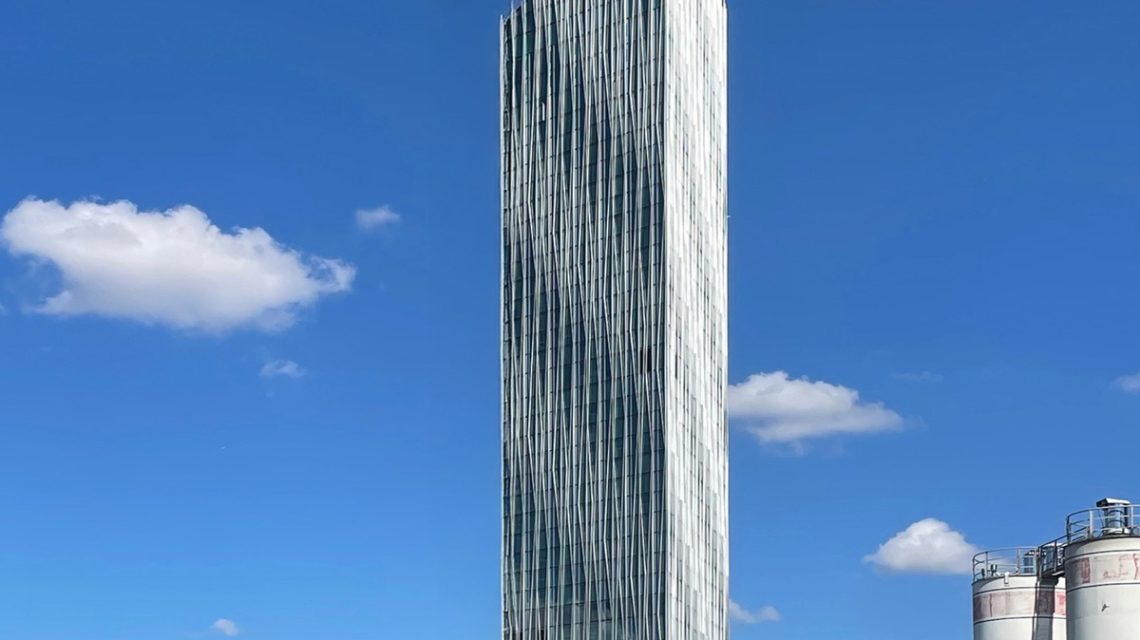
Berlin is preparing for a significant milestone in its architectural journey with the completion of the Estrel Tower. Standing at 577 feet (176 meters), this mixed-use building will become the tallest nontechnical structure in Germany’s capital and its first true skyscraper. Skyscrapers typically rise above 150 meters (around 492 feet), as defined by the Council on Vertical Urbanism, making Estrel Tower Berlin’s inaugural structure of this kind.
Set to open to the public by late 2026, the tower will host a hotel, workspace, gallery, restaurant, and bar. This design aims to create a new urban destination within Berlin’s Neukölln district, according to its creators. Designed by Berlin-based firm Barkow Leibinger, this project represents a significant shift for a city known for low-rise buildings and stringent height restrictions.
Berlin’s latest architectural achievement comes amidst a broader debate. Many architects and preservation advocates emphasize adapting existing buildings instead of constructing new ones. Sustainability discussions increasingly highlight the importance of retaining the carbon already embedded in older structures and extending their lifespan through renovation.
Gordon Gill, the architect for what will be the world’s tallest building, Jeddah Tower, told Newsweek that there are opportunities for innovation in enhancing existing buildings’ sustainability and efficiency. Several architects have expressed concerns that Germany risks losing historic character if it prioritizes new constructions over preserving historical structures.
Sustainable and Urban Development Insights
Frank Barkow, founder of Barkow Leibinger, notes that with careful design, skyscrapers can contribute to a sustainable urban future. He stated that while high-rises might have a larger initial carbon footprint, they offer long-term benefits through compact development, efficient land use, and multifunctionality within a single structure.
A Singular ‘Beacon for the City’
“Berlin has historically adhered to a 22-meter cornice height, except for church spires,” Barkow remarked. “We intended for Estrel to stand alone as a tower amidst lower buildings adapting to historical context.”
Unlike cities like New York or Frankfurt with entire districts of tall buildings, the Estrel Tower serves as a standalone landmark or a ‘lighthouse’ for Berlin. The project complements the existing Estrel Hotel across the street, with the tower and hotel forming a ‘new gateway to the city.’ The design includes lower structures surrounding the main tower, which together create a cohesive development.
The innovative design relies heavily on geometric forms. The location, not being in a historic district, allowed the architects to experiment with shapes, likening their approach to a Tangram puzzle. The resulting composition involves a dynamic interaction between various forms and the surrounding urban landscape.
Challenges in Sustainability and Construction
The tower features a striking façade with metal fins for solar shading, smart glazing, and operable windows. It includes low-carbon energy sources, water-retention systems, and a green roof. The design maximizes daylight and minimizes energy use, targeting LEED Platinum certification, the highest awarded by the U.S. Green Building Council.
One major challenge was logistics. Constructing a project of this scale required pouring thousands of tons of concrete, with a foundation slab of about 9.8 feet thick. To address this, components like the façade and atrium roof were prefabricated, enabling simultaneous construction phases.
Regarding criticism about tall buildings’ carbon footprints, Barkow acknowledged short-term disadvantages but emphasized long-term energy efficiency and compactness compared to urban sprawl. The height offers flexibility with floor plates and circulation cores supporting varied uses over time.
A New Era for Tall Buildings in Berlin?
Whether the Estrel Tower will be an isolated project or signal a new trend remains uncertain. Barkow suggests it could be the start of a broader shift, offering diversity and mixed-use development crucial for Berlin’s future. He believes the city can maintain its historical scale while embracing new heights.