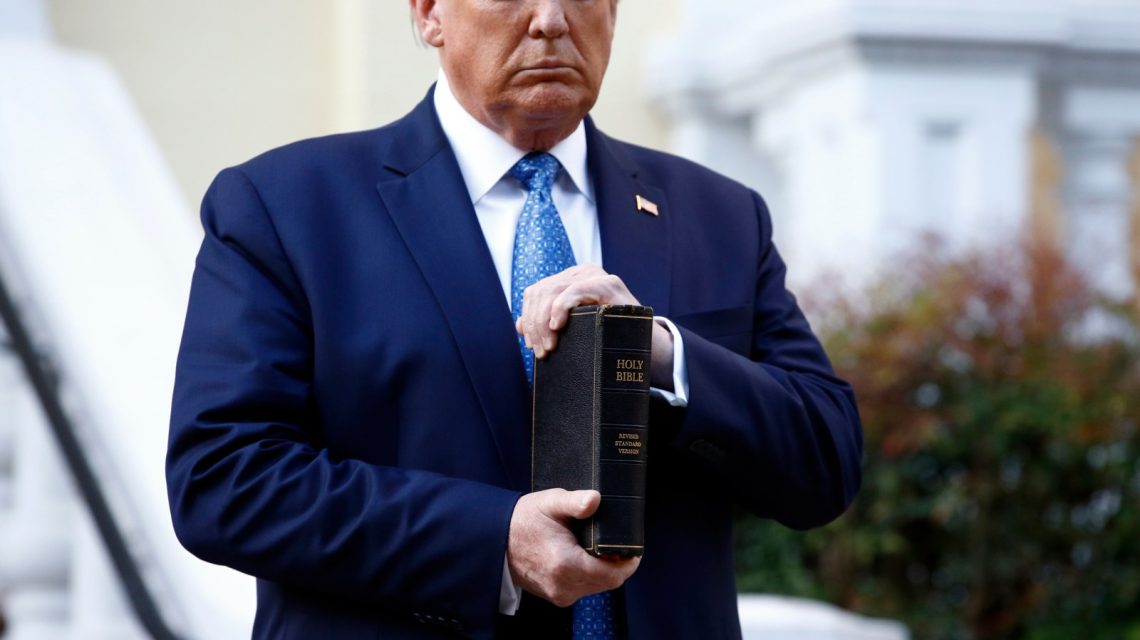
Analysis by Newsweek indicates that President Donald Trump’s approval ratings have shown contrasting trends among two major Christian demographics this year. Approval among born-again Protestants has consistently risen, while it has decreased among Roman Catholics. Five national polls conducted by Marquette Law School reveal an increase in approval from 56% in January to 61% in July among born-again Protestants. Meanwhile, Catholic approval dropped from 54% to 45% over the same period, with a significant decline between April and May. As a result, Trump experienced a net approval rating of +22 among born-again Protestants in July, compared to -10 among Catholics, marking a 32-point differential.
The decline in Catholic support occurred amidst public tensions between Trump and Pope Leo XIV concerning the war with Iran and immigration policies. Despite both sides minimizing their disagreements, Pope Leo consistently advocated for peace and empathy towards migrants. Trump countered the Pope’s stance on these issues.
Although the polls do not directly link these disputes to the decline in approval, they coincide with a noticeable divide between Catholics and Trump’s core support base of born-again Protestants.
When asked for a comment by Newsweek, White House spokesperson Taylor Rogers stated, “There has never been a greater president for Christian Americans than President Trump, and his strong record proves it. President Trump ended the weaponization of the federal government against people of faith, proudly defended and expanded our religious rights, pardoned pro-life activists, stopped the chemical mutilation of our nation’s children, and protected parents’ rights.” She continued criticizing Democrats for their approach to religious rights.
Poll Results
The differences in opinion between born-again Protestants and Catholics became evident after April. Among born-again Protestants, Trump’s approval rose from 56% in January to 61% in July. Meanwhile, Catholic approval declined from 54% in January to 45% by July. The approval trend was consistent among mainline Protestants at 47% from January to July.
Nationally, Trump’s approval decreased from 42% in January to 38% in May and June, before rising to 40% in July. The increase among born-again Protestants contrasted with the overall national trend, with the decline among Catholics being more pronounced than the overall change.
The Marquette Law School polls surveyed between 1,002 and 1,514 adults, with margins of error from ±2.7 to 3.5 percentage points. New samples were used each time rather than tracking the same respondents.
Trump’s Conflict With the Pope
Trump’s variance in approval among Christian groups followed his public conflict with Pope Leo XIV. Trump’s immigration policies were criticized by the Pope and other Catholic leaders. Tensions increased following the U.S. involvement in the Iran war, where Pope Leo called for peace and questioned the war’s justification.
Trump’s use of an AI-generated Christ-like image of himself intensified the criticism; he later clarified he viewed the image differently. Political significance is linked to these disputes due to Pope Leo’s popularity among American Catholics.
A survey by the Public Religion Research Institute in May showed 56% of Americans viewed Pope Leo favorably, versus 34% for Trump. The Pope retained broad popularity across most religious groups, except among white evangelical Protestants.
The Importance of Catholic Voters
Catholic voters are pivotal for Republicans due to their sizeable presence and less predictable voting behavior compared to born-again Protestants. Catholics represented 20% of voters and 22% of Trump’s coalition in the 2024 presidential election, with Trump securing 55% of Catholic votes. The Catholic political division contrasts with Trump’s evangelical base, where support was more cohesive.
Even minor shifts in Catholic opinion can have notable impacts in competitive regions, especially in light of the close race for congressional control. Democrats are eyeing 58 GOP-held districts, including pivotal swing states, aiming to reclaim the House majority. Trump’s prior midterm election in 2018 saw Republicans lose 40 House seats.
Trump’s approval, though not directly linked to congressional support, continues to influence Christian voters who praise his conservative agenda on issues like abortion and religious liberties.
Despite opposition from some church authorities on immigration and foreign policies, Trump’s policies resonate with many Christian voters. In 2024, he received 62% of Protestant and 55% of Catholic votes, with Christians comprising 79% of his supporters, according to Pew Research Center.
Contact Newsweek editors for this story: Matthew Robinson and Robert Greenall.
 Election Details for Illinois Voters: Importance of Participation and Key Information
  Court Rules Against Third-Country Deportation Policy
  Trump Administration Bars News Networks from White House
  Lawsuit Filed Over Preeclampsia Death in Texas Amid Abortion Ban Controversy
  Cook County’s Loan Program Assists Suburban Agencies Amid Property Tax Delays
  Freddy Cazares: Navigating the Limbo of Immigration Detainment and Uncertain Release