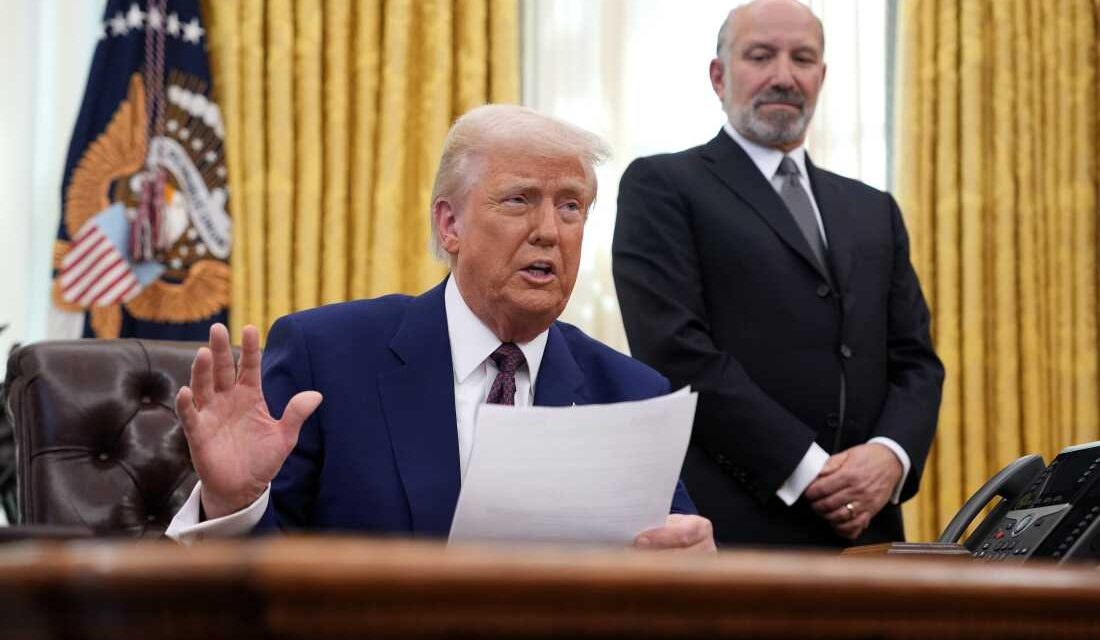
President Trump, accompanied by Commerce Secretary Howard Lutnick, addressed the media from the Oval Office in 2025. They discussed a contentious Census Bureau report, which Trump uses to support claims of illegal voting by non-U.S. citizens. The report, linked to a Trump-aligned think tank, has stirred debate.
Trump shared on social media that the Census Bureau’s analysis claims “over 24,000 Noncitizens voted illegally” in the 2020 presidential election. Additionally, he asserts this number will increase after examining 32 million more voter records. The report relies on a 2020 voter file and other federal records; however, experts question its methodology and findings.
Spokespeople for the bureau, the America First Policy Institute, and the White House did not respond to NPR’s requests for comment.
The report involves individuals associated with the America First Policy Institute, initiated by officials from Trump’s first administration. AFPI highlighted the analysis on social media, promoting election transparency. Despite this, Trump continues unsubstantiated allegations of voter fraud, urging Republican allies to impose voting restrictions.
Recent figures released by the Trump administration use contested methodologies to quantify noncitizen voting in federal races. Data shows this issue is rare. Last month’s announcement by the Department of Homeland Security identified 250,000 noncitizens on voter rolls in several states, but the calculations remain undisclosed, drawing skepticism from local election officials.
Election experts criticize the latest Census Bureau report. David Becker of the Center for Election Innovation & Research remarks, “Census data cannot reliably be matched to voter data,” further stating that the noncitizen voting numbers are too insignificant to alter the 2020 election outcome. Michael Morse, from the University of Pennsylvania’s law school, highlights issues with the lack of unique identifiers and outdated records, questioning the report’s transparency.
Former Census Bureau employees express concern. Misty Heggeness, whose work is cited in the report, notes the absence of an author, which is uncommon for the agency. Amy O’Hara, formerly directing the bureau’s Center for Administrative Records Research and Applications, points out the risks of mismatched data inflating noncitizen voter numbers. O’Hara also questions the bureau’s claim of unique capability in identifying election fraud.
Following workforce reductions during the Trump administration, experts warn of the agency’s credibility being compromised. The upcoming 2030 census may lead to another political and legal battle. O’Hara stresses the importance of Census Bureau transparency for public trust and participation.
Heggeness advises vigilance, as more reports might follow. She emphasizes the challenges the public faces in trusting data from the administration, noting the report’s lack of sources and methodological details as a reason to question its validity.
 San Diego County Ends ICE Training Contract
  Individuals Granted Clemency by Trump Face New Charges
  Byron Donalds Wins GOP Nomination for Florida Governor
  Angie Nixon’s Upset Win in Florida’s Democratic Senate Primary
  Georgia Senate Race: Ossoff Leads Collins Amid Political Strategies
  Former Fauci Advisor David Morens Pleads Guilty in Record Evasion Scheme