China Decoded is an insightful newsletter by Newsweek, delving into China’s expanding influence on the global stage. It provides a comprehensive understanding of Beijing’s strategies and implications for the United States and its allies.
Written by seasoned journalists such as Didi Kirsten Tatlow and John Feng, the newsletter goes beyond typical news headlines. Didi Kirsten Tatlow specializes in Chinese politics and security, while John Feng covers China’s domestic and international policies.
Printing the Future
One of China’s strategic approaches involves its Communist Party economic planners targeting emerging technologies and acquiring them through various means. They provide substantial subsidies and industrial support, which surpass those in other countries.
“China’s growing dominance in 3D printing is turning a manufacturing revolution into a question of economic and national security,” explain David Gardáš, Michal Thim, and Filip Urban in their study titled Blueprinting the Future: Mitigating the Risks of Chinese Hegemony in Additive Manufacturing published by the Czech think tank Sinopsis.
3D printing, or additive manufacturing (AM), creates objects from digital models by adding material layer-by-layer. This technology is vital in defense, disaster response, and crisis situations, as highlighted in the study.
China’s dominance raises questions about fairness and global dependency. The country spent 4.4% of its GDP supporting industrial policies in 2023, which includes subsidies, tax benefits, and more. This level of spending is significantly higher compared to other economies.
The Strategic Industry of Additive Manufacturing
AM has been integrated into China’s military-civil fusion system, merging military and non-military expertise. It was classified as a strategic industry after decades of industrial policy incorporation.
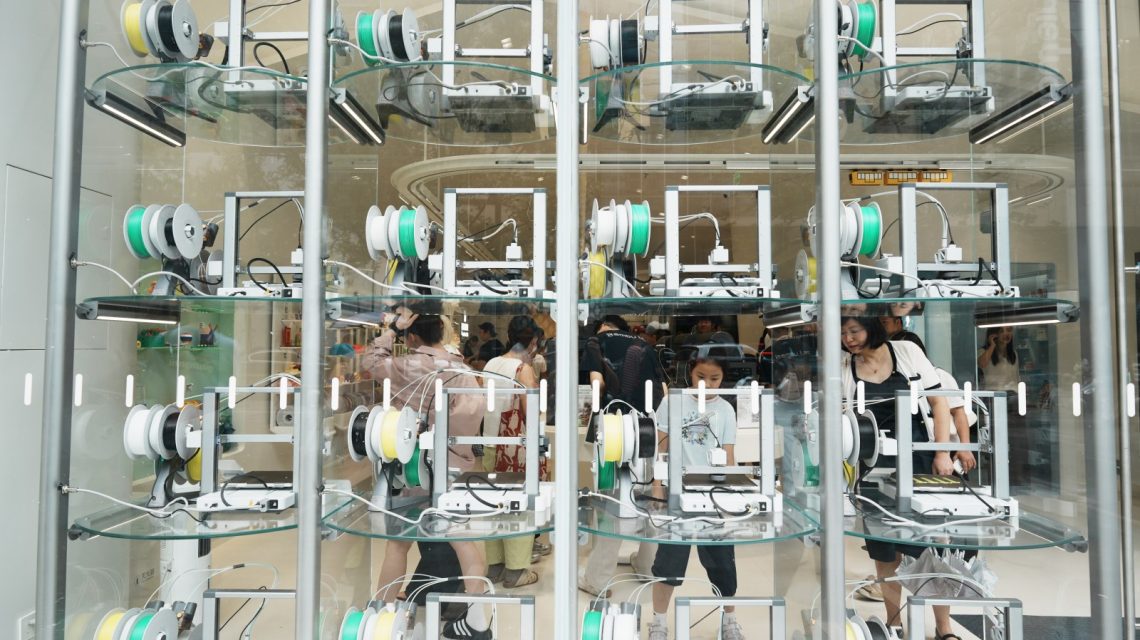
Production is rapidly increasing in China and globally. Leading companies like Bambu Lab and Xi’an Bright Laser Technologies contribute to China’s AM industry, including the defense giant Norinco Group.
The war in Ukraine exemplified AM’s usefulness in producing drones and components quickly. Bambu Lab printers were reportedly used both in Ukraine and the British army.
The industry’s ecosystem in China spans from desktop 3D printers to metal and polymer components. This ecosystem poses risks related to intellectual property loss, technology transfer, and data security.
Western Concerns and Recommendations
Chinese AM companies benefit from non-market measures like localization and state support, which distorts competition and limits foreign companies’ access to the Chinese market.
The authors of the study offer seven recommendations to address these concerns:
- Classify AM systems as sensitive technology.
- Implement targeted export controls and safeguards.
- Coordinate technology-security measures with allies to reduce risks.
- Invest in competitive open innovation ecosystems.
- Support domestic and allied R&D and technical education.
The recommendations focus on protecting technology, collaborating with friendly nations, and improving domestic capabilities.
Understanding the Impact of China’s AM Industry
China’s vast manufacturing sector has created global dependency by design. The country’s AM industry was valued at 70 billion Chinese yuan, or nearly $10.5 billion, by the Chinese government in January.
China’s top 3D printing companies shipped around 40% of all AM devices globally last year, especially in the consumer sector.
Historically, AM started as a method for rapid prototyping but has evolved to use high-grade materials for aerospace, defense, and medical industries.
Though China leads in output, the United States still holds the top spot in terms of market value in AM. The AM industry’s global market value is projected to grow to $168.9 billion by 2033.
Industry researchers categorize 3D printing equipment into four price tiers: Entry-level, Professional, Midrange, and Industrial. The U.S.-Israeli firm Stratasys has the largest market revenue share, while Germany’s EOS is second.
China primarily ships desktop machines that use plastic, while Western companies dominate the high-value sectors. Nonetheless, China is positioned to compete in these sectors shortly with its matured manufacturing strategies.
John Feng provides these insights as Newsweek’s China Editor based in Taichung, Taiwan.
 Confusion Surrounds Starlink Restrictions in Ukraine
  Congress Divided Over AI Policies Ahead of Elections
  Supreme Court Considers Digital Privacy in Salazar v. Paramount Global
  Assigning Responsibility for AI-Generated Errors
  Dr. Rachel Brem on Advancements in Breast Cancer Detection
  Selecting the Best Makita Drill for Your Needs