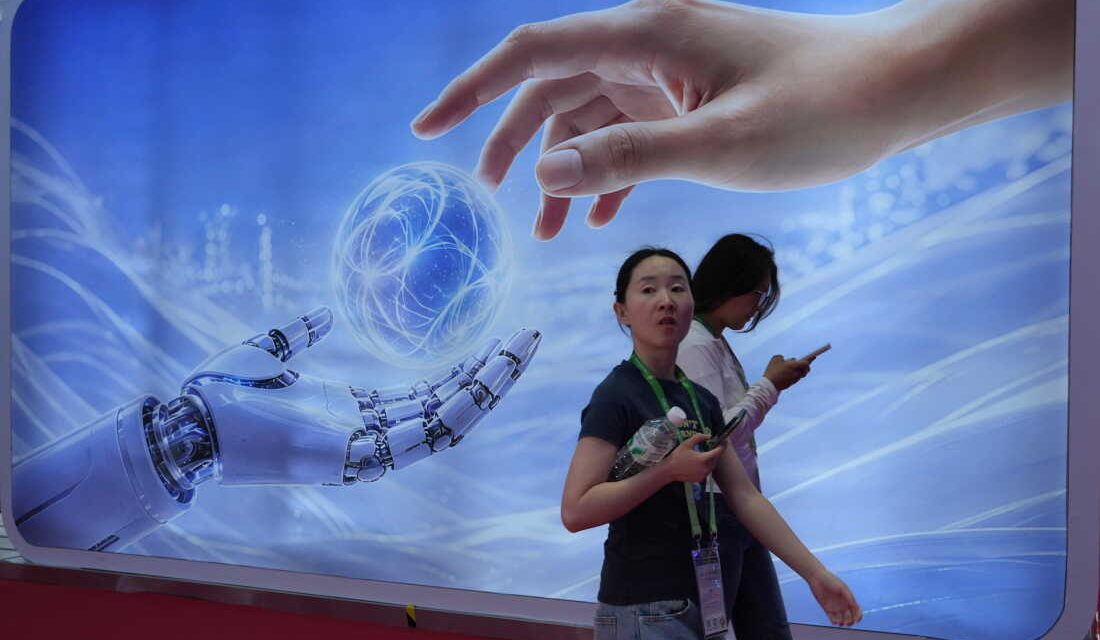
Visitors at the China International Supply Chain Expo in Beijing engaged with a display on artificial intelligence and a human hand. This display, part of the expo on June 22, 2026, highlighted the current focus on AI developments. Meanwhile, China’s Ministry of Foreign Affairs addressed a recent call for limiting China’s AI advancements.
Anthropic CEO Dario Amodei recently urged for continued restrictions on exporting advanced AI chips and equipment to China. He emphasized that China’s leadership in AI would threaten global stability. Amodei stated that international cooperation, including with China, was essential for regulating AI development.
Responding to Amodei’s comments, Chinese Foreign Affairs spokesperson Guo Jiakun called for collaboration. He stated that “fearmongering and competition” would only hinder global AI governance. Instead, he advocated for countries to work together toward fair AI development.
U.S. President Donald Trump, meanwhile, downplayed slowing the country’s AI development despite Amodei’s warnings. Trump emphasized the American lead in AI and said that winning AI leadership globally would bring substantial advantages.
Upcoming Discussions on AI Governance
An upcoming meeting between President Trump and Chinese leader Xi Jinping is expected to address AI governance. China’s powerful AI models, often cost-effective yet equally competitive, have positioned the country as a pivotal player. Xi has advocated for a global AI governance framework, urging the Global South’s involvement.
The Chinese Ministry of State Security has called for accelerated measures to manage AI security risks. These developments emphasize Beijing’s commitment to establishing robust AI governance.
Editorial Reactions From China
China’s state-run Global Times newspaper responded to Amodei’s essay, describing it as an attempt to “contain” China. The editorial argued that the essay contained provisions targeting China, likening it to a “Cold War playbook.”
This critique followed a cybersecurity advisory involving U.S. agencies, which claimed malicious efforts by Chinese developers to extract capabilities from U.S. AI models. China’s Commerce Ministry refuted these claims, viewing them as efforts to enforce a monopoly over the AI sector.
Lizzi C. Lee from the Asia Society Policy Institute commented on the tensions. Both nations desire technological advancements but worry about each other’s influence. Lee questioned how cooperation could proceed if the U.S. continues to restrict China’s access to cutting-edge technology.
 White House Approves F-35 Sales to Saudi Arabia Amidst Regional Tensions
  Inside the Secret Deals Powering the President’s Push to Deport Migrants to Countries Not Their Own
  Navigating the Challenges of Third-Country Deportations
  Midair Altercation on Bangladesh to London Flight
  AI and the Changing Nature of Google Searches
  Ukraine Missile and Drone Barrage Hits Russia Amidst Elections