Alterations at Arlington National Cemetery
The Trump administration has edited language describing the Confederate Memorial at Arlington National Cemetery. The changes removed references to the “nostalgic, mythologized vision of the Confederacy” and “highly sanitized depictions of slavery.” A Washington Post report noted these edits on both a cemetery marker and a Department of Defense webpage. The removed language had previously addressed the “Lost Cause” narrative, which romanticizes the antebellum South while minimizing slavery’s role in the Civil War.
The “Lost Cause” narrative suggests Confederate soldiers fought mainly for states’ rights, not slavery, and portrays slavery as relatively benign. The edits come ahead of plans to reinstall the Confederate Memorial at Arlington in 2027, after its removal in 2023 by a congressional mandate targeting Confederate symbols on military properties.
“It never should have been taken down by woke lemmings. Unlike the left, we don’t believe in erasing American history—we honor it,” remarked Secretary of Defense Pete Hegseth on social media.
Attempts to reach the White House and Arlington National Cemetery for comments were made by Newsweek.
Understanding the Confederate Memorial
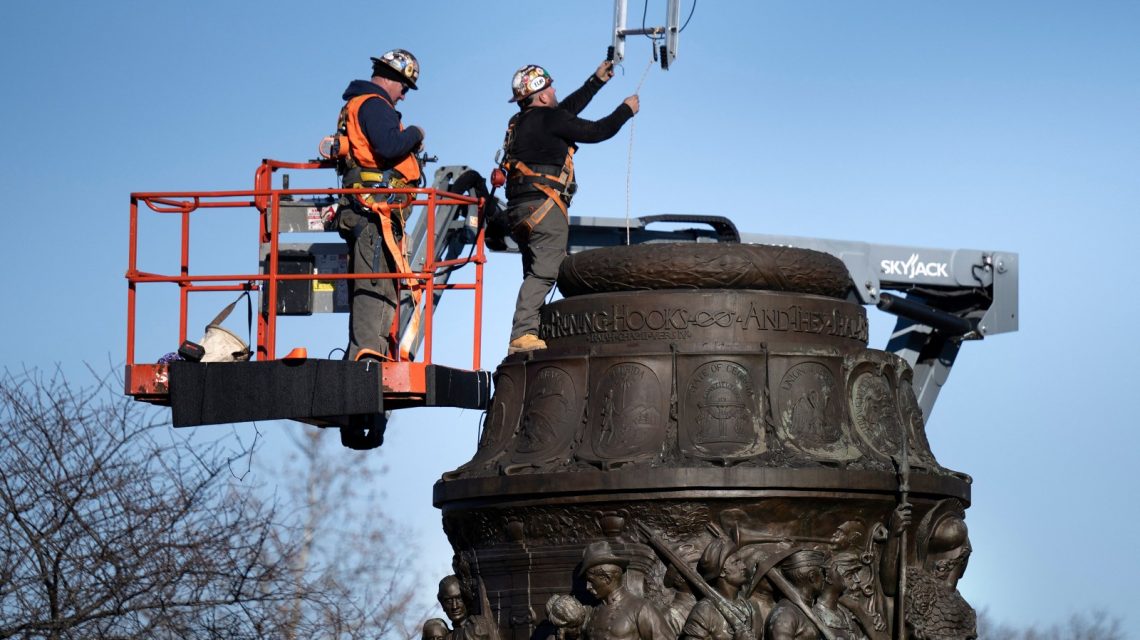
The Confederate Memorial is a 32-foot-tall monument that stood in Arlington National Cemetery for over a century before its removal in 2023. Unveiled in 1914, it featured a bronze statue on a granite base, honoring Confederate soldiers from the Civil War.
The monument includes figures of Black individuals depicted as Confederate supporters. The United Daughters of the Confederacy commissioned the statue from former Confederate soldier and artist Moses Jacob Ezekiel. He claimed the memorial corrected “lies” told by the North.
In 2020, during renewed civil rights and racial justice discussions, Arlington National Cemetery added a plaque noting the “highly sanitized depictions of slavery.”
Removal of the Confederate Memorial
In 2021, Congress formed a bipartisan commission in response to national protests after George Floyd’s murder. The commission examined military honors of the Confederacy and suggested changes, including removing the Confederate Memorial.
The Department of Defense accepted these recommendations, and the monument was relocated in December 2023 during the Biden administration. The Sons of Confederate Veterans opposed the move, filing lawsuits against the removal.
The memorial is currently stored at a Department of Defense facility in Virginia. The Trump administration announced in August 2025 plans to return the memorial to Arlington Cemetery by 2027.
Language Removed and Retained
The removed content featured detailed descriptions of the monument and its controversial elements. Archived content noted:
“The elaborately designed monument offers a nostalgic, mythologized vision of the Confederacy, including highly sanitized depictions of slavery. Standing on a 32-foot-tall pedestal, a bronze, classical female figure, crowned with olive leaves, represents the American South. She holds a laurel wreath, a plow stock, and a pruning hook, with a Biblical inscription at her feet…
Two of these figures are portrayed as African American: an enslaved woman depicted as a ‘Mammy,’ holding the infant child of a white officer, and an enslaved man following his owner to war…
This narrative of the Lost Cause, which romanticized the pre-Civil War South and denied the horrors of slavery, fueled white backlash against Reconstruction…
What remains is a brief mention of the sculptor:
Moses Jacob Ezekiel, a Confederate veteran and the first Jewish graduate of Virginia Military Institute, designed the Confederate Memorial in 1914.
Ezekiel was buried at the base of his work in 1921, alongside three other Confederate soldiers. The monument “offers an opportunity for visitors to reflect on the history and meanings of the Civil War, slavery, and the relationship between military service, citizenship, and race in America.” Similar edits have occurred at the former monument site.
Other Revisions by the Administration
Since Trump’s return to the presidency, his administration has revised content at other federal sites on topics such as slavery, racism, and immigration, claiming they cast the U.S. in an excessively negative light. These sites include:
- Bunker Hill Monument (Boston): Removed quotes on slavery, immigration, and anti-war activism.
- President’s House (Philadelphia): Removed exhibits on enslaved people owned by George Washington, later restored by court order.
- Francis G. Newlands Memorial Fountain (Washington, D.C.): Removed a sign about former senator Newlands’ support for white supremacist policies.
- Fort Sumter National Historical Park (South Carolina): Removed signs on environmental threats to the site.
- Fort Pulaski National Monument (Georgia): Planned removal of a display showing the famous Civil War-era photograph “The Scourged Back.”
- Selma-to-Montgomery National Historic Trail (Alabama): Reviewed and possibly revised dozens of interpretive signs related to the 1965 voting-rights march.
Critics argue these changes remove crucial historical context; the administration states they aim to provide a balanced historical account.
 The Impact of Arts and Closure on Democracy
  U.S. Ambassador Comments on Iran War Duration Amid Political Concerns
  US-China Relations Under Scrutiny: Expert Warns of Escalating Tensions
  No Timeline for End of Iran Conflict
  German Chancellor Merz Vows to Pursue Reforms Despite Election Setbacks
  The Technology Rivalry: Trump’s Meeting with Xi and the AI Ecosystem Clash