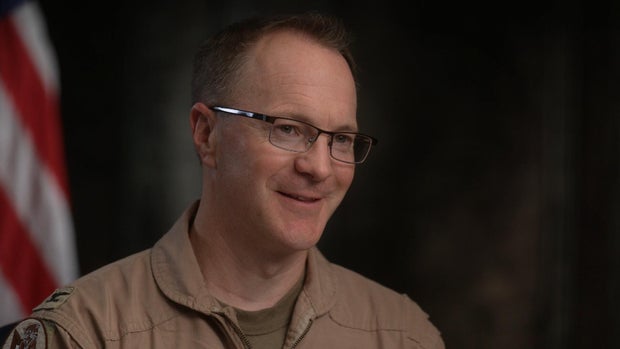
In April, five weeks into a contentious and costly conflict, an American fighter jet was downed over Iran, leading to two aviators being stranded in hostile territory. The pilot and the weapons systems officer on the F-15E, referred to by their call signs Alpha and Bravo for security reasons, ejected when their jet faced a missile strike. Their positions, miles apart in Iran’s rugged desert, set the stage for a monumental rescue mission.
Swift Actions by Alpha
Bravo shared his account in an interview with 60 Minutes’ Norah O’Donnell. He described the missile’s impact on their jet as feeling like a “freight train.” Bravo credited Alpha’s rapid response for their survival, noting, “We did everything to save our aircraft. When that was no longer possible, we ejected over the center of Iran.”
Bravo expressed eternal gratitude to Alpha for executing the ejection procedure, stating, “I will be thankful, to my dying day, for Alpha saving our lives.” The crew’s escape was orchestrated to delay ejection slightly, ensuring a safe distance post-landing.
The Role of Airmen and Equipment
Bravo commended the efforts of airmen and the quality of their survival equipment, highlighting how equipment exceeded expectations despite missile-inflicted damage. “The ejection seat’s performance surpassed design specs, a testament to the professionalism of the airmen,” he remarked.
A Terrifying Descent
Following ejection, Bravo discovered his parachute was damaged, recalling, “Seeing no parachute was terrifying.” He prayed for help and methodically attempted to rectify the issue, free-falling at an estimated speed between 70 and 100 mph. Despite sustaining severe injuries, Bravo attributed his survival to divine intervention, acknowledging, “It was a miracle that prevented catastrophic injuries.”
Navigating Hostility
The ejection marked the beginning of a grueling escape from pursuing Iranian forces. U.S. military sources reveal that the search closed to within several hundred meters of Bravo. He focused on concealment and evasion, prioritizing escape over immediate communication. Bravo climbed a steep 7,000-foot ridgeline despite his injuries, embodying a “warrior ethos.”
Rescue and Return
After 48 arduous hours, U.S. forces arrived for the rescue amidst mounting Iranian troops. “It was one of the greatest moments of my life,” said Bravo, choosing to keep his rescuers’ words private. He simply told them, “Let’s go.”
Upon returning to the makeshift airstrip, the rescue aircraft’s gear got stuck in the desert sands. A covert U.S. Air Force team orchestrated the extraction of Bravo and over 90 special operators. The U.S. military then bombed their grounded aircraft, preventing enemy capture. Bravo asserted his unwavering trust in U.S. military initiatives, adding, “I have great faith in my creator and in the U.S. forces.”
 U.S. Strategic Goals Remain Unmet Amid Prolonged Conflict
  New Photos Reveal Damage from Iranian Strikes in the Middle East
  Assassin of Chilean Diplomat Orlando Letelier Faces Deportation 50 Years After Assassination
  Gorillaz and Macklemore Respond to Controversy Over Israel-Palestine Statements
  Investigation into Lion Deaths in Tanzania
  Merz Stays Resolute Amid Electoral Shifts in Germany