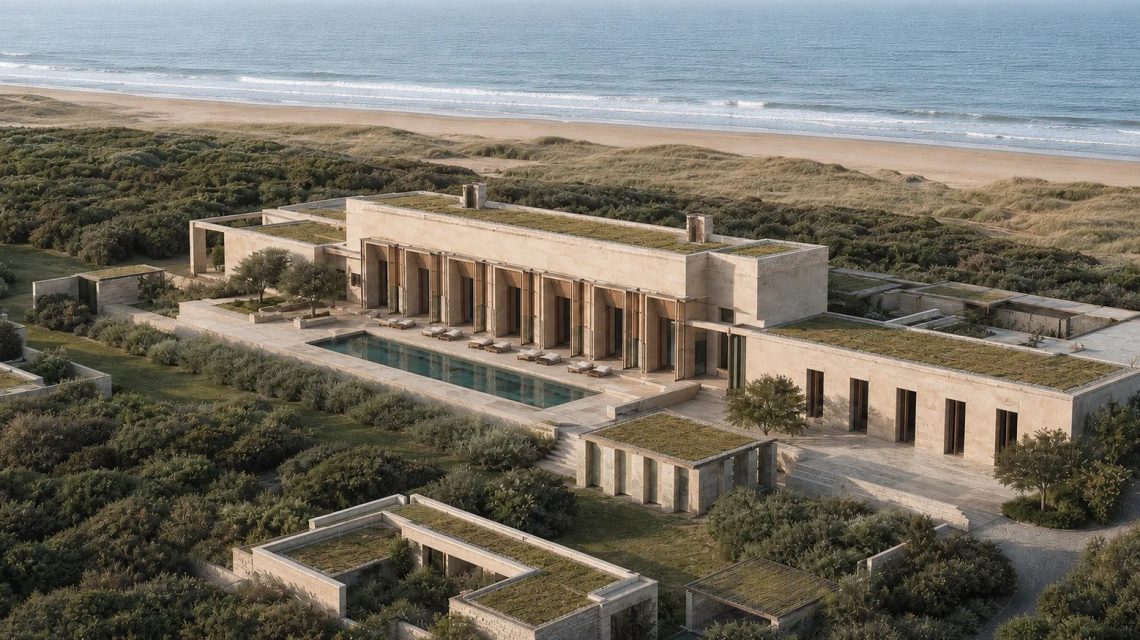
A new billion-dollar waterfront community planned in South America is among the latest proposed developments aiming to create a “city of the future” centered around sustainability, technology, and economic innovation. Praxis, the company behind the project, has announced that Uruguay will be the location for this new development, +Colonia. The company cited Uruguay’s landscape, stability, and space as key factors for this decision. Situated next to Colonia del Sacramento, residents are expected to settle there by mid-2027.
Praxis plans to mobilize $1 billion in investment over the next three years to develop “the world’s first digital nation.” This community will focus on residences, hospitality, culture, and a future shaped by artificial intelligence (AI). While supporters highlight the quality of life +Colonia might offer, critics question the feasibility of creating a functioning AI-driven city and whether the investment goals are achievable.
California Forever in the US
California Forever, backed by Silicon Valley investors, aims to be “America’s next great city” and the first walkable city built in a century. The project seeks to create a medium-density city with a network of parks, plazas, and playgrounds, designed to be sustainable and shielded from climate change. Located in Solano County, between the Bay Area and Sacramento, it represents the largest construction labor agreement in U.S. history. Plans include creating 530,000 new jobs, 170,000 new homes, and new clean energy sources.
The development focuses on a major expansion of Suisun City in Solano County. California Forever’s spokesperson noted the project’s progress through the entitlement process with Suisun City, with an anticipated release of the Draft Environmental Impact report by year-end. Despite previous controversies over land acquisitions and environmental concerns, the project continues to advance.
Woven City in Japan
Toyota’s Woven City is among the most advanced examples of a purpose-built future city focused on mobility. Located in Susono near Mount Fuji, Woven City serves as a “living laboratory” for testing new mobility technologies, robotics, and AI systems. Residents started moving in last year, and as of this month, the city accommodates around 160 people across 80 households.
Phase 2 of construction began in September 2026, with completion scheduled for November 2028. Visitors from across Japan are expected to join Phase 1 by October 1. While already operational, questions remain about scaling beyond its corporate research context.
Telosa in the US
Telosa was unveiled in 2021 by entrepreneur Marc Lore. Envisioned by Bjarke Ingels Group, the city focuses on “equitism,” promoting shared land ownership and prioritizing sustainability and social equality. Telosa aspires to be the most open, fair, and inclusive city globally.
The project aims to eventually house millions of residents in the U.S., though a final location has not been determined. Potential sites include Nevada, Utah, Idaho, Arizona, Texas, or the Appalachian Region, with the first residents expected by 2030. While praised by some urban planners, others question the practicality and financial demands of building a new city from scratch.
Rio AI City in Brazil
Rio AI City aspires to be the “city of the future,” featuring renewable energy-powered data centers. Developed by Elea Data Centers with Rio de Janeiro’s municipal government support, the project is set within the city’s Olympic Park region. It is one of the largest digital infrastructure initiatives globally.
The city plans to minimize water use in its cooling systems and integrate green skin architecture. While some see this as a catalyst for job creation and economic growth, concerns about energy demands and environmental impact persist.
Oceanix Busan in South Korea
Oceanix Busan is set to be the world’s first floating city. Located in Busan, South Korea, it features flood-proof infrastructure rising with the sea. The city plans to self-supply food, energy, and water through a closed-loop processing system.
The development consists of three platforms interconnected by bridges to each other and the land. While climate experts have welcomed floating infrastructure experiments, questions linger about cost, scalability, and long-term viability.
The Line in Saudi Arabia
The Line is a linear city forming part of NEOM’s major developments in Saudi Arabia. The city will span 170 kilometers, housing 9 million people without cars. Renewable energy will power the city, which is currently paused until at least 2030, as reported by Semafor.
Despite budget shifts within NEOM, no projects have been canceled, as confirmed by Yasir Al-Rumayyan from Saudi Arabia’s sovereign wealth fund. Queries to the project teams for The Line, Rio AI City, and others have been sent for comments.
Have an architecture or design-related story to share? Email [email protected] for potential feature in Newsweek.
 Washington’s AI Concerns and the Promised Technological Future
  Nate Bargatze Embodies Simplicity and Trust in New Ford Campaign
  OpenAI Delays AI Model Release Over Security Concerns
  OpenAI Halts Launch of New AI Model Due to Unexpected Actions
  Trump and AI Industry Leaders Discuss Regulation at White House
  Bill Gates Expresses Concerns Over AI’s Potential Threats