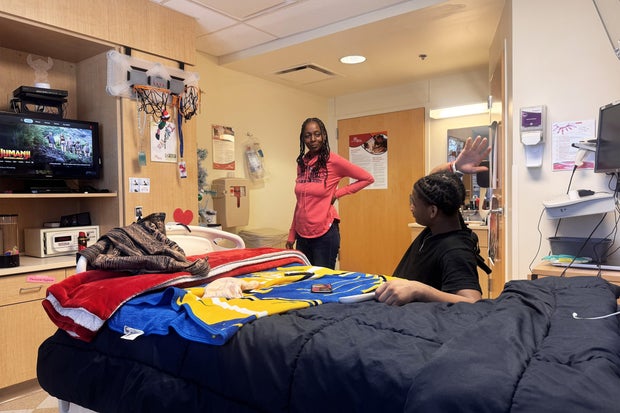
In St. Louis, a teenager named Jaloni found himself living in room 3005 at SSM Health Cardinal Glennon Children’s Hospital. Initially, the room felt foreign, lacking personal touches like posters and snacks. Jaloni faced a harrowing situation, recovering from fresh gunshot wounds that filled his body with excruciating pain. The powerful pain medication led to sensations of flying, offering a temporary escape from his reality.
Jaloni’s dual existence was stark. At home, he was a risk-taker among friends, adept at avoiding trouble. In the hospital, he became reliant on his grandmother’s reassurances that life might improve once he was discharged, a promise she couldn’t ensure.
Over a span of three years, Jaloni spent more than 475 days in the hospital, sometimes not due to medical necessity but because he had no safe place to go. Such stays, known as social stays or hospital boarding, are part of a nationwide issue affecting children with mental health challenges, chronic conditions, or disabilities. A Minnesota study cited the daily hospital cost for a child with complex needs at roughly $3,932 in 2017. While the financial impact of Jaloni’s extended stay remains uncertain, SSM Health addressed the broader issue in a statement highlighting the burdens of uncompensated care.
Missouri’s expenditure on boarding children in hospitals has exceeded $64.7 million in recent years. However, Dave Dillon, of the Missouri Hospital Association, indicated this might be underestimated. Hospitals often lack staff to track and seek reimbursement for these costs. More profoundly, these stays take an emotional toll on the children involved.
“Well, y’all almost killed him,” Jaloni’s mother recounted being told after her son was readmitted in severe condition.
Jaloni’s story began with a gunfight that left him gravely injured. He had faced significant losses in his life, having lost a sister, brother, and cousins to gun violence. After being discharged to a rehabilitation facility, Jaloni returned home, where his mother and grandmother struggled to provide the necessary care. His family eventually sought emergency help, leading to accusations of neglect. Residing in Illinois, Jaloni became a ward of the state, unable to return home.
The search for a permanent, suitable home proved challenging, extending Jaloni’s hospital stay to an unthinkable 250 days. Accessible housing that accommodated Jaloni’s wheelchair and medical needs seemed elusive, a struggle faced by many children nationwide. State reports highlight similar scenarios, with hundreds of young people in Illinois and Missouri enduring hospital stays far beyond medical necessity.
Amid these circumstances, Jaloni’s grandmother passed away, intensifying his uncertainty. Fortunately, his aunt Deborah, or “Tete,” volunteered to become his foster parent. This transition was not straightforward, necessitating a new home suited for Jaloni’s needs. Even as his care team in the hospital offered support, Jaloni experienced isolation, spending extensive periods waiting for a resolution.
Jaloni’s outlook evolved during his third hospital stay initiated by a bone infection. He explored the hospital and formed connections; yet, it was emotionally taxing.
Back in the outside world after three years, Jaloni faced the reality of adjusting once more. His aunt provided him a safe and adapted environment. He began learning daily living skills, adopting new responsibilities like managing his medications and preparing meals.
Jaloni now seeks to further his education and build a life beyond hospital walls, aiming to stay healthy and safe. This entire journey underscores significant gaps in systems allocated to protect vulnerable youths, posing profound questions about potential systemic improvements.
 Hormone Contamination Prompts Toothpaste and Mouthwash Recall
 Christina Applegate Discusses Possible Link Between Breast Implants and Misdiagnosed MS
 French Protests Prompt Calls to Examine Tear Gas Impact on Women’s Health
 Transgender Doctor’s Medical Practice Halted After Allegations
 Increased Deer Collision Risks in Suburban Areas
 Navigating the Holidays with GLP-1 Medications