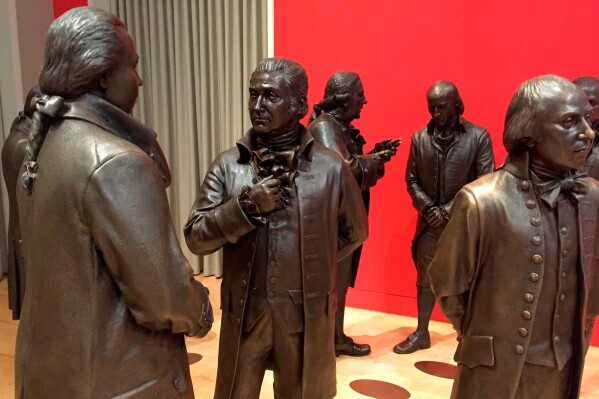
Historian Gregg Frazer addresses the founding of the United States and religion’s role in it, often facing disinterest from audiences. Frazer, a professor at The Master’s University, argues the founders did not establish a Christian republic. Key founders either dismissed main Christian doctrines or remained ambiguous enough to fuel ongoing debates. For Frazer, Christian audiences find this underwhelming. He also asserts the founders were not merely rationalist deists or anti-religious skeptics, which disappoints those advocating a strong separation of church and state. Most founders practiced some form of religion.
The discussion intensifies as the 250th anniversary of the Declaration of Independence approaches. Some Christian activists reignite claims of a Christian founding. President Donald Trump supports this view, promoting events like ‘America Prays,’ involving numerous Christian individuals and organizations. Defense Secretary Pete Hegseth and others have publicly supported the claim of America as a Christian nation.
Opponents of this view argue against it. The group Americans United for Separation of Church and State states that most historians agree America was not founded as a Christian nation. They caution against efforts to redefine the country with a Christian Nationalist perspective. A 2022 Pew Research Center report found that six out of ten U.S. adults believe the founders intended America to be a Christian nation.
John Fea, author of ‘Was America Founded as a Christian Nation?’ states that people seek a usable past to back political or cultural agendas. This selective use of history can overshadow its complexities. For example, public prayers at historic events are often highlighted, yet significant political and economic factors were central to the country’s independence.
Mark David Hall, another historian, argues for Christianity’s strong impact on the founding. He acknowledges that while some core founders did not hold traditional beliefs, many did, and this shaped their thoughts on governance. Hall cites the attention to human dignity and the system of checks and balances as influenced by Christian teachings. Despite early opposition, some Presidents and Congresses issued proclamations for prayer and thanksgiving, indicating they saw religion as integral to public life.
The U.S. Constitution mentions no specific religion beyond the date and forbids religious tests for officeholders. The First Amendment guarantees religious freedom and prohibits a national religion. Supreme Court decisions later applied this amendment to states, referring to Jefferson’s metaphor of a ‘wall of separation between church and state.’ Courts continue to address this separation concerning school prayer, healthcare, labor law, and other areas.
Frazer argues that neither the Bible nor religious tenets are referenced as foundational principles in the Constitution or the Federalist Papers. Enlightenment ideas about equality, accountable government, and freedom influenced the founders. The Declaration of Independence contains religious language, like references to the ‘Creator,’ appealing to a broad audience. Founders like Thomas Jefferson used terms agreeable to various religious and philosophical followers.
America’s religious history is complex. Questioning the founders’ intentions about a Christian nation leads to debates about their identity and timing. The founding could refer to early colonial settlements, with Massachusetts Bay and Virginia charters citing Gospel spread as a goal. However, these colonies also pursued economic goals and varied in religious nature, sometimes persecuting minorities, prompting resistance.
Before the American Revolution, the Great Awakening revived evangelical fervor. Despite this, church membership and attendance fell over the 18th century. Protestantism remained predominant, yet it encompassed a range of beliefs. Many elite founders, influenced by rationalism and Freemasonry, shaped the Declaration and Constitution. While some, like John Jay, were devout Christians, others like Jefferson, Franklin, and John Adams held deistic views.
Contrary to common belief, most founders were non-deists. Frazer describes them as ‘theistic rationalists,’ believing in an active God. For example, George Washington saw divine providence in his survival and America’s success. Even skeptics valued religion for fostering virtuous citizens. Franklin supported both churches and a synagogue, reflecting diverse religious support.
Frazer warns that the Christian America narrative risks harming both church and state. Misrepresenting ideas as inherently Christian blurs the understanding of true Christian beliefs. At lectures, he offers a flyer detailing reasons why this view could damage Christianity’s integrity.
The Associated Press covers this topic in collaboration with The Conversation US, backed by Lily Endowment Inc., without influence over this content.
 Michigan Senate Race Sees Influences from Soros-Linked Funding
  Trump Seeks Diplomatic Success at the U.N. Amid Challenges
  North Carolina Senate Race Influenced by Abortion Policy Messaging
  Trump Pressures Republicans on Filibuster Threat
  Rep. Golden Endorses Rep. Lawler for Re-election
  Public Perception and Political Impact of Data Centers