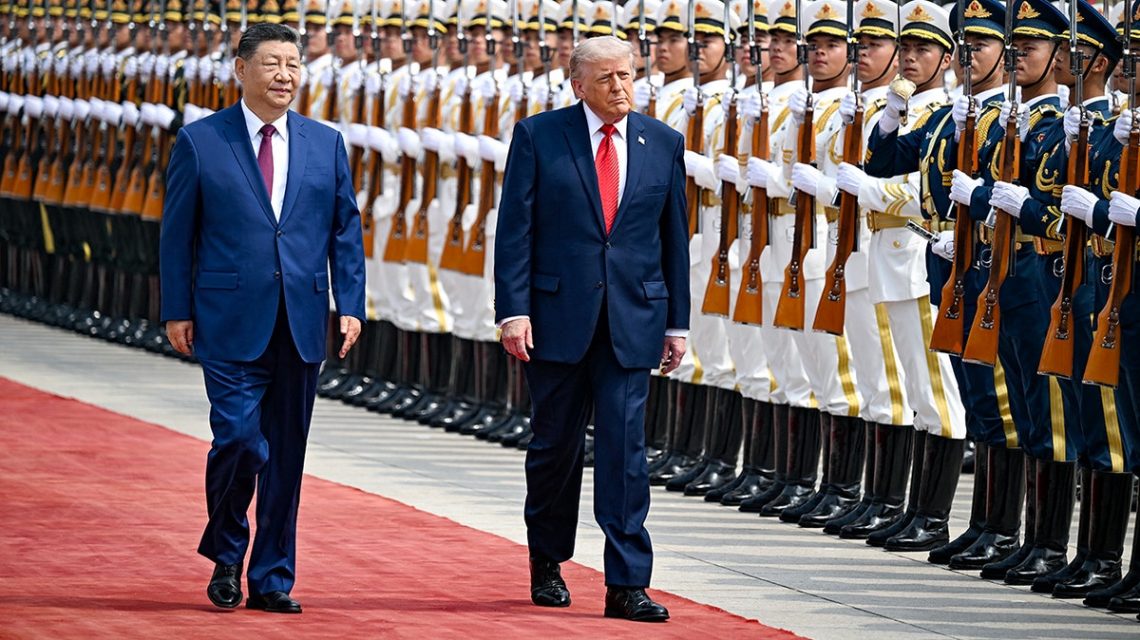
President Donald Trump returned from Beijing with renewed trade discussions with Chinese President Xi Jinping. However, the summit left unresolved critical issues, particularly regarding Taiwan’s position in U.S.-China relations.
Enes Kanter Freedom, former NBA star and human-rights activist, highlighted Taiwan’s significance in the global technology landscape during an interview with Fox News Digital. He emphasized, “Taiwan is the center of the global technology race. Understanding Taiwan is crucial for grasping the future of AI dominance, economic power, and national security.” According to Freedom, Taiwan remains central to America’s competitive stance against China’s geopolitical challenges.
Strength Through Leadership
Freedom asserted, “President Trump has consistently conveyed that peace is maintained through strength.” He believes strong American leadership, strategic clarity, and a credible deterrent are vital for stability in the Taiwan Strait. This approach deters authoritarian regimes from miscalculations, thus preserving peace.
“I believe maintaining stability in the Taiwan Strait requires strong American leadership, strategic clarity, and a credible deterrent.” – Enes Kanter Freedom
However, the summit did not yield any breakthroughs regarding Taiwan. As Taiwan seeks U.S. weapons to defend against potential threats, Trump’s pending arms package decision is closely watched by both Beijing and Taipei.
A senior White House official revealed that Trump would soon decide on the arms package, following his $11.1 billion arms sale to Taiwan in December 2025. This aligns with longstanding U.S. policy since the 1950s. In his first term, Trump approved more arms sales to Taiwan than any other U.S. president. His second term continued this trend, surpassing the arms sales during President Biden’s tenure.
AI and Economic Rivalry
During the summit, Trump was accompanied by top American tech CEOs and AI executives. This underscored the growing economic and geopolitical rivalry between the U.S. and China over artificial intelligence. Taiwan’s role in this competition is pivotal, given its semiconductor production. Semiconductors, coined as “the new oil,” are integral to technological advancement and AI investment.
Taiwan Semiconductor Manufacturing Co. is crucial for global semiconductor manufacturing, serving major companies like Apple, Nvidia, AMD, and Qualcomm. Ian Samson from Fidelity International called this the “oligopolistic nature” of leading semiconductor manufacturers.
Military Pressure and Regional Stability
Recently, China enhanced military pressure on Taiwan through extensive air and naval operations. This tension was reflected when a Chinese Foreign Affairs spokesperson stated, “Safeguarding peace and stability across the Taiwan Strait is the biggest common denominator between China and the U.S.”
Freedom plans to visit Taiwan in October to organize basketball camps. He intends to showcase Taiwan’s democratic resilience against external intimidation. His visit aims to garner global attention toward the issues faced by Uyghurs, Hong Kongers, Tibetans, and Taiwanese amid increasing Chinese tensions.
He remarked, “My biggest goal during this trip is to document everything and share with the world. Taiwan represents a vibrant, democratic society refusing intimidation,” highlighting the ongoing struggle for regional peace.
 Critics Slam Dan Scavino for AI-Generated Video After State Dinner
  Concerns Over Trump’s Government-Paid Political Ads
  British Authorities Arrest Suspects in Alleged Terror Plot Near Military Base
  Navigating Global Challenges: Trump’s Legacy and Crisis Management
  Analyzing Oregon’s Wildfire Crisis and Its Implications
  Kansas Senate Race: Hamilton Criticized for Climate Views