The Thanksgiving holiday often marks a peak time for travel. Yet, many young adults now find themselves swapping lengthy flights for a short walk back to their parents’ houses. Realtor.com reports that regions with traditionally affordable housing are where numerous young adults are returning to live with their families.
Shift in Living Arrangements
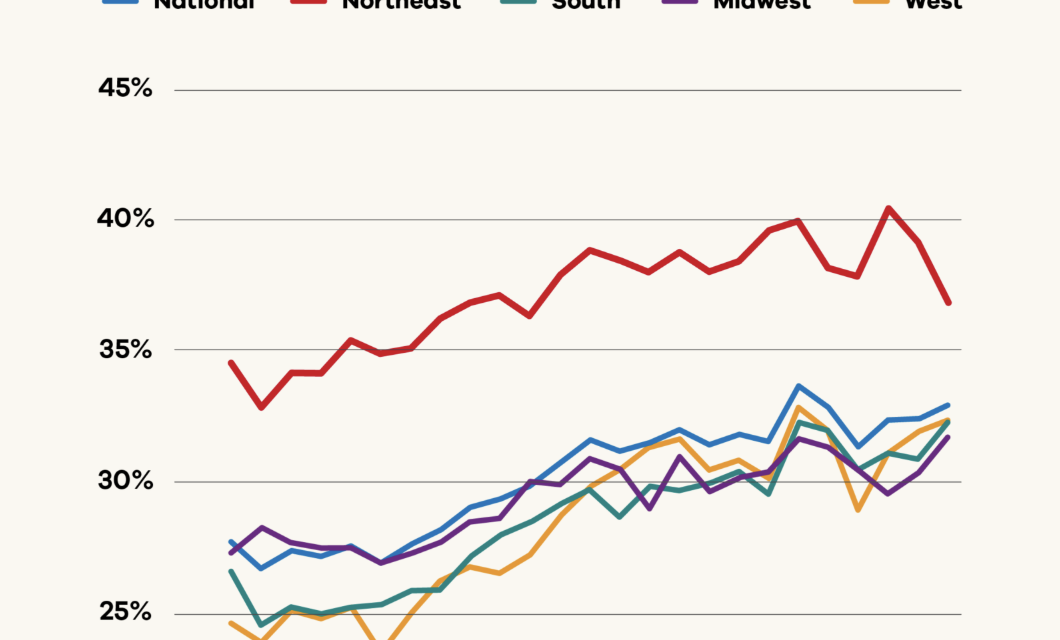
The percentage of young adults aged 18 to 34 living with their parents has risen notably. In the South and the Midwest, the share increased by 1.4 percentage points in 2025, reaching 32.3% and 31.7% respectively. Meanwhile, the Northeast saw a decrease of 2.3 points, dropping to 36.9%, the lowest since 2010. Hannah Jones, a senior economist at Realtor.com, highlighted that this trend is becoming common in regions previously considered more affordable.
National Statistics
Realtor.com revealed that in the previous year, a record 25.2 million young adults, approximately one-third, resided with their parents. This phenomenon is widespread across various regions. Beyond the young, older adults and parents are also considering shared living arrangements. Research by Geoffrey Sanzenbacher from Boston College illustrates that the percentage of 25- to 34-year-olds hosting their parents has increased from 1.6% in 1996 to 4% by 2025.
Family Living Dynamics
About 22% of Americans were part of multigenerational households in 2024, a significant rise from 13% in 1970. The Pew Research Center found financial issues to be the main driver, influencing 40% of these familial decisions. The National Association of Realtors reported that 14% of homebuyers purchased multigenerational homes in the last year. Reasons include caring for elderly parents (30%), saving money (23%), adult children who have never left home (19%), and adult children returning home (18%).
Home Market Trends
Some families are investing in long-term shared living solutions. In the Bay Area, there is growing interest in homes with accessory dwelling units, providing proximity and independence for young adults. Realtor.com noted that properties designed for multigenerational living in San Antonio attracted 65.2% more interest than typical listings in 2025, though these were priced 69% higher on average.
Challenges in Affordable Housing
Despite an increase in housing availability, young adults particularly struggle to afford homes. In places like San Antonio, although active listings have risen by over 40% since pre-pandemic times, young adults still face hurdles due to high prices and interest rates. Hannah Jones pointed out that market growth mainly benefits those with higher incomes, leaving entry-level households with limited options.
 Significant Events on November 25 in Chicago History
 Six Die in Mississippi Plane Crash
 Call for Action Against ICE Involvement at Seattle-Tacoma International Airport
 U.S. Army Prepares for Controlled Detonation of Lead Azide in Iowa
 New FAA Staffing Rule Aims to Enhance Air Traffic Control Efficiency
 Tragic Collision Involving Citi Bike Rider and SUV in Manhattan