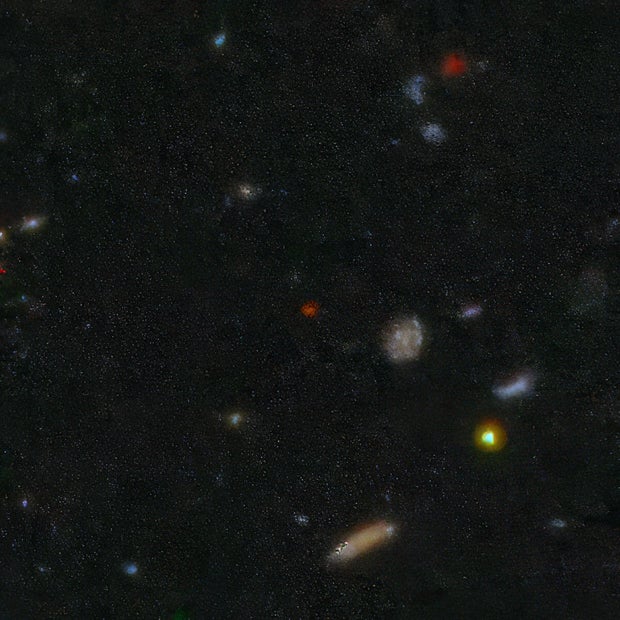
Cape Canaveral, Fla. — Scientists have identified the farthest quasar known, which marks an important development in understanding the early universe. The quasar features a slow-consuming black hole at its core and dates back nearly to the universe’s inception.
This discovery shows the quasar formed 630 million years after the Big Bang, as reported by a team led by German scientists. Quasars are luminous objects powered by black holes at the centers of galaxies, and this quasar represents an early phase in the cosmos’ 13.8-billion-year existence, surpassing previous records significantly.
An image released by the European Space Agency’s Euclid telescope on November 24, 2026, highlights this quasar. It is visible as the red dot at the center of the image.
“This time the leap in cosmic time is huge!” stated Julien Wolf from the European Southern Observatory, who led the research.
Wolf noted that past discoveries pushed our understanding back by 15 million years or less each. This latest find moves the timeline by nearly 40 million years, marking the most significant progress in nearly ten years.
The quasar discovery resulted from the examination of millions of observations by the Euclid telescope, launched in 2023. Euclid aims to study galaxies to help understand dark matter and dark energy, key components influencing the universe’s expansion.
Identifying a quasar so early in the universe’s history is rare. This particular quasar, despite its massive black hole, consumes matter relatively slowly. Scientists are observing this object as it was 13.1 billion years ago, roughly 5% of the universe’s current age.
Wolf nicknamed the quasar Dun Aonghasa after a prehistoric stone fort in Ireland’s Aran Islands, inspired by a personal visit. The fort symbolizes a frontier promising vast exploration, much like the quasar.
The findings were confirmed by observations from the Hubble and Webb space telescopes, among others. The Webb telescope determined that the quasar’s black hole has a mass equivalent to 360 million suns, a notable size for such an early cosmic time.
Results of the study have been published in the journal Astronomy & Astrophysics. Wolf remarked that Dun Aonghasa gives a revised timeline for the early universe, with its black hole already massive 630 million years post-Big Bang. How it grew so large remains a question.
Wolf acknowledged the possibility of discovering even older quasars soon, though when remains uncertain. “Honestly, the record could fall again in a few months or it could stand for years,” Wolf commented.
 Silicon Valley’s Pursuit of the ‘Perfect Baby’ and Autism Screening
 Ownership Issues of St. Anthony Falls Cutoff Wall
 Archaeologist Uncovers Roman Fort and Solves Medieval Skeleton Mystery
 NIH’s Foreign Animal Research Funding Criticized for Safety Failures
 Deep-Water Shark Encounter During Ocean Research
 Lab Results Date Noah’s Ark Wood to 4,300 Years Ago