Mississippi had not elected a new Democrat to the U.S. Senate since 1947. However, things changed when Sen. Cindy Hyde-Smith, commenting on high beef prices, remarked that Mississippians have “so many proteins to choose from.” Her opponent, Scott Colom, capitalized on her remark with a 28-second ad saying, “Pick another protein? Sheee-it, I’d rather pick another senator instead.” Colom emerged victorious.
Democrats secured significant wins in Texas as well, capturing a Senate seat and the governor’s office. James Talarico defeated Ken Paxton, and Gina Hinojosa ousted Gov. Greg Abbott. In Alaska, Mary Peltola’s victory over Sen. Dan Sullivan, confirmed on Nov. 17, gave Democrats a 56-44 Senate majority. Peltola highlighted the frustrations Alaskans faced with rising fuel prices and other expenses.
The 2025 off-year elections reflected voters’ anger about “affordability,” leading to pivotal changes like Zohran Mamdani becoming a popular political figure. Throughout the year, officials advised the public to adjust to prices. Agriculture Secretary Brooke Rollins suggested alternatives to beef, such as chicken or salmon, while Chevron executive Andy Walz advised less driving as gas prices rose due to the Iran war. President Donald Trump described the gas price hike as “a small price to pay.”
The rich pulling away from everyone else became widely accepted.
Economist Heather Long, chief economist for Navy Federal Credit Union, previously wrote about the “K-shaped economy,” where the affluent segment distances itself from others. Her insights, initially met with skepticism, became accepted amidst the current economic climate.
The E-shaped economy
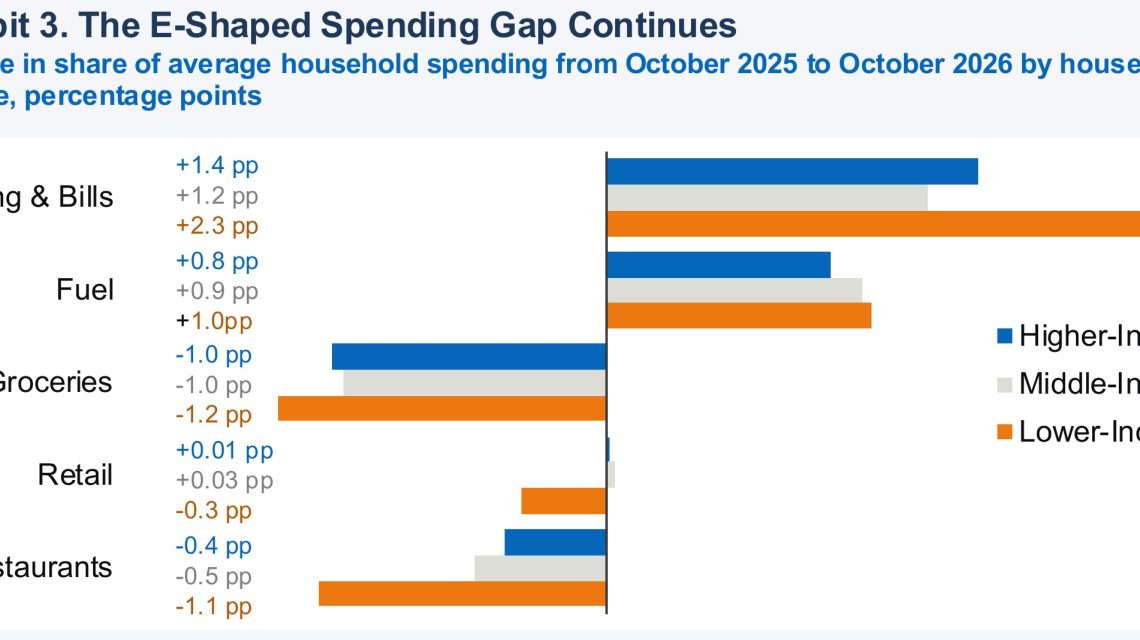
Long now describes the system as an “E-shaped economy.” She explained that the top third of households spends nearly twice as much as the bottom two-thirds, having increased their monthly expenditure by $234 compared to $73 for others. “The top third has a tier of their own, not hugely affected by inflation,” she said. Adjusted for inflation, their spending remains flat, dropping just 0.2% since January.
A new gap is forming below the top tier. “This year, there’s a more pronounced difference between the middle and the bottom,” she noted. The increase in gas prices especially impacts the lowest-income consumers. Middle-income families are also adapting by cutting back spending, often on food, to manage their budget. Their inflation-adjusted spending has decreased by 1% since January.
Long points out that the bottom third has been struggling for some time, with their real spending down 1.7% since January. Housing and bills now consume 2.3 more percentage points of their budget compared to the middle-income households’ 1.2 points. They have cut restaurants by 1.1 points and are the only group significantly reducing retail spending, labeled as “the sad surprise” by Long.
There’s a psychological tax to deciding what to cut.
Released on Nov. 23, Navy Federal’s report reviewed about 6 million members and found households spent $140 more each month compared to the previous year. Most of this went toward increased housing, bills, and gas. However, grocery and restaurant spending declined.
Navy Federal also noticed for the first time that members are borrowing to cover rising bills. This trend aligns with a CBS News exit poll indicating the economy as voters’ crucial issue, with many reporting their financial situation has worsened.
Navy Federal analyzed data not captured by CPI, like property taxes and insurance. They noted mortgage-related bills, in particular, explaining some have been borrowing to cover unexpected tax hikes. Voters reacted by passing measures on Nov. 3 targeting these increases, such as Florida’s $250,000 homestead exemption.
Where You Shop Reflects Economic Status
Shifts in grocery spending habits demonstrate economic division. Data indicates a move toward discount and warehouse stores across income brackets, but the affluent have also cut back some food expenses. Long highlighted that behavior during the Great Recession was similar across all financial classes.
Borrowing is now the next red flag.
Long expresses concern over rising credit-card debt and personal loan usage despite Wall Street’s optimistic tone. Average gas prices fell, providing some relief, enhancing the financial situation for many families. Long foresees potential future issues with rising health insurance premiums for 2027. She emphasizes how “the grocery store politics” spells out the economic reality today.