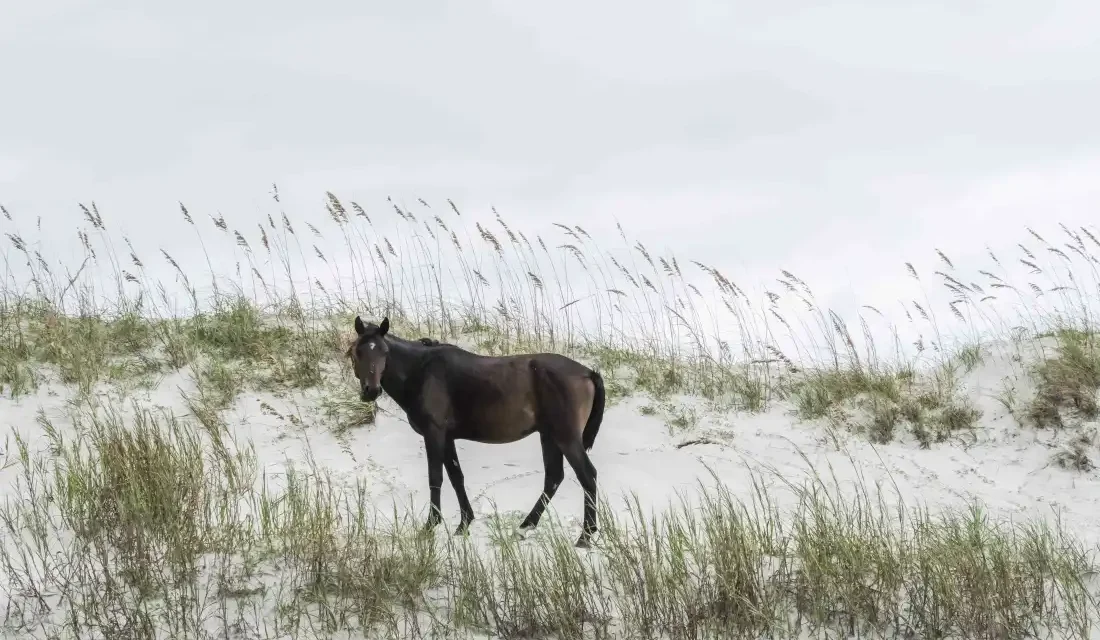
Cumberland Island, Georgia is home to freely roaming wild horses, feral hogs, and deer. This diverse 18-mile barrier island along the Atlantic coast features salt marshes, maritime forests, and an untouched beach accessible only by ferry.
Since 1972, the National Park Service has managed Cumberland Island National Seashore. This includes 9,800 acres of land preserved in a primitive state. The island is rich in history, with Native American artifacts, Spanish mission remains, antebellum plantation ruins, and homes built by Thomas Carnegie and Lucy Carnegie.
The Carnegie descendants still occupy parts of the island privately. The National Park Service has proposed a land swap with them to allow new construction. This has led to a clash between stakeholders with different visions for preserving the island.
The seashore shall be permanently preserved in its primitive state.
Park superintendent Melissa Trenchik supports the proposal, giving media tours under live oak trees overlooking salt marshes. The plan involves transferring parkland to the Carnegie descendants for eight new private homes. The idea is to consolidate private ownership on the west side and protect the Atlantic beachside from development.
With over 12,500 public comments, some critics see this as a move towards privatizing public lands. Joseph Manning of Defenders of Wildlife claims, “We’re swapping for McMansions,” pointing to the 15,000 square footage allowance for new homes.
Barclay McFadden, a Carnegie descendant, emphasizes their long-term connection to the island, mentioning their family cemetery. He argues that their stewardship has prevented development like golf courses. His cousin, Jamie Ferguson, views the land swap as a way to maintain family heritage. He highlights the island’s historical sites, such as “The Chimneys,” significant for its connection to the enslaved community.
Naturalist Carol Ruckdeschel opposes the proposal, fearing it signifies increased development. Having lived on the island for over 50 years, she values its natural state. She conducts weekly surveys, documenting wildlife and ecological changes.
Ruckdeschel criticizes the plan to increase daily visitors to 700, believing that more homes and activity disrupt the island’s primitive wilderness. She envisions the land returning to nature, a place where human impact fades away.
 North Siders Debate Over Proposed Electrical Substation
 Rethinking Flood Risk in Residential Areas
 Increasing Wildfire Risks and Strategies for Protection
 Community Activist Reshapes Local Politics in Prince George’s County
 John Denver’s Legacy: A Conservation Triumph in Colorado
 AI Technology Aims to Boost Honey Production Amid Bee Colony Challenges