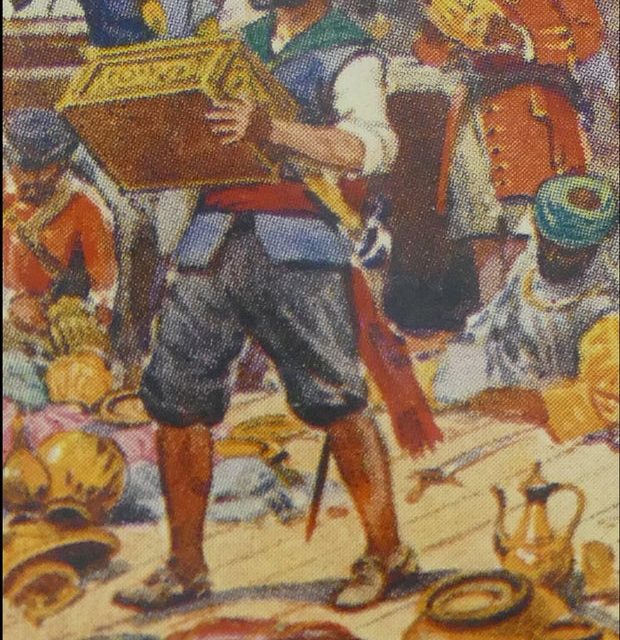
An amateur historian has uncovered new evidence in the longstanding mystery surrounding a notorious pirate who raided a royal Indian treasure ship centuries ago. This discovery implicates a co-conspirator familiar to many New Yorkers.
Five years ago, James Bailey gained attention for discovering ancient coins tied to English pirate Capt. Henry Every. Now, colonial-era documents suggest that the “King of the Pirates” and his crew were aided by Thomas Jones, namesake of Jones Beach, New York’s most visited state park.
“Millions visit this beach without knowing its ties to arguably the biggest heist in piracy history,” Bailey remarked.
Since his major discovery, Bailey has delved into documents to further explore the bloody 1695 raid on the Ganj-i-Sawai in the Red Sea and the question of Every’s fate. The pirate crew reportedly tortured, killed, and raped many aboard the royal ship, resulting in global outrage and the first worldwide manhunt. While some pirates were caught and executed, many, including Every, vanished and are thought to have fled to Europe and America.
Documents featuring depositions from Every’s allies suggest that Jones was recruited as a “wheelman,” assisting the pirates in evading authorities after absconding with millions in gold and silver. Additional documents reveal that New York’s governor investigated Jones years later, when he had transformed into a prosperous whaling operator on Long Island’s barrier beach, now bearing his name.
Bailey’s research, intended for publication, reveals a part of Jones’ dubious past previously only hinted at in local history, said John Hanc, author of “Jones Beach: An Illustrated History.” Before moving to the American colonies, Jones served in the English military, initially residing in Rhode Island before becoming a prominent New York businessman and landowner. Jones owned extensive land on early Long Island, then mostly rural.
Persistent rumors about his initial fortune endured long after his 1713 death. His deteriorated mansion was reputedly haunted before its early 1800s demolition, and his grave was often desecrated by robbers chasing buried treasure before relocation to a church cemetery.
In 1906, a family history by Jones’ descendant dismissed piracy claims as “slander” and “fiction.”
Beyond Rumors: The Pirate-Privateer Connection
Historians argue it’s plausible Jones engaged in piracy. After initially working as a privateer, a crown-authorized commercial ship raider, Jones lost his status post-war, said Meagan Schulman, a Fordham University doctoral candidate specialized in 17th-century piracy.
When conflict ceased, those continuing raids became known as pirates. Schulman mentioned privateers were pirates “just sponsored by a government or patron,” acknowledging Jones might be labeled a pirate by some, though he likely did not view himself as such.
Documents indicate Jones briefly returned to Rhode Island after helping Every evade capture. In 1696, property records show his father-in-law, Thomas Townsend, gifted him land on Long Island’s south shore, allowing a fresh start amid authorities hunting for pirate-friendly New England accomplices.
Bailey reports that Jones established a homestead and family on Long Island. Yet, his pirate past lingered. Documents from Richard Coote, New York’s colonial governor, reveal attempts to uproot piracy led him to Jones in a barrel of money’s transfer from the city to Long Island, ending at Jones’ residence. Jones, termed by the governor “formerly a pirate,” denied knowledge of the barrel.
Piracy’s Role in Colonial Wealth
While Bailey’s findings intrigue, they aren’t conclusive, cautions Richard Blakemore, a University of Reading maritime history professor uninvolved with Bailey. The commonality of the name Thomas Jones warrants caution. However, Jones’ alleged ties to Every underscore how piracy enriched numerous prominent Northeast families, according to Kevin McDonald, Loyola Marymount University history professor who authored a colonial-era piracy book but wasn’t involved in Bailey’s work.
“Contrary to popular depictions of outcast pirates, evidence suggests early British colonies were deeply connected to piracy, socially and economically,” Blakemore and McDonald agree.
 Dave Chappelle: Comedian and Controversy
 Diwali Celebrations Illuminate Tradition and Unity
 Diwali: A Celebration of Light and Tradition
 A Decade After Leonard Cohen’s Passing: His Lasting Impact
 Controversy Surrounds National Anthem Performance at Warriors’ Pride Night
 John Denver’s Legacy: A Conservation Triumph in Colorado