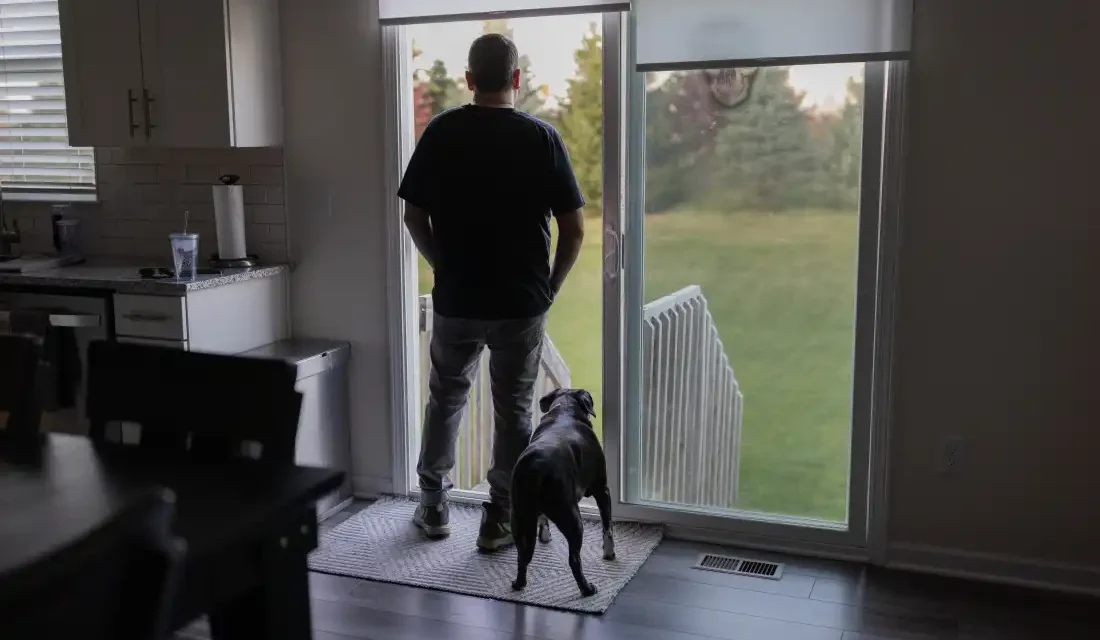
Scott Boyd, an Army veteran, stands in his home near Columbus, Ohio, with his dog, Jessi. A recent loan modification raised his VA home loan payment by nearly $1,200 monthly. Due to his work in military intelligence, he requested that NPR not show his face in photographs.
Thousands of military veterans with VA-backed mortgages have faced greater monthly payments since the Trump administration shut down a program aimed at providing low-interest loans. An NPR investigation revealed that over 15,000 veterans experienced monthly payment increases of at least $150 after loan modifications. More than 700 veterans faced payment hikes of $1,000 or more.
Lenders typically offer loan modifications to help homeowners catch up on missed payments, often by altering loan terms to lower or maintain payment amounts. However, after the VA program’s closure, 63% of veterans who received loan modifications faced increased payments. This contrasts sharply with the 2% increase seen in loans guaranteed by Fannie Mae and Freddie Mac, covering most U.S. mortgages.
“This is the height of insanity,”
remarked Rep. Mark Takano, the ranking member of the House Veterans’ Affairs Committee. Veterans, already in financial distress, face further struggles.
Boyd, at 16, saw the military as a way to support his family after his father’s death. Starting in the infantry and later serving in Army intelligence, he eventually pursued a tech career post-2002. Boyd purchased his home with a VA loan at a favorable interest rate. However, a combination of job loss due to a layoff and PTSD-related issues led Boyd to fall behind on mortgage payments. Seeking treatment at the Dayton VA hospital, the delay intensified his financial woes.
VA loans, unlike others, had no viable option as the Veterans Affairs Servicing Purchase (VASP) program, which rolled missed payments into a new low-interest mortgage, was shut down without an immediate replacement. Boyd’s lender initially reassured him about VA’s assistance program. However, the shutdown of VASP left veterans like Boyd with higher-cost loan modifications.
Before its withdrawal, VASP had been assisting numerous veterans who struggled with loan payments. The absence of this program saw loan modifications under much steeper rates, aligning with general market trends of around 7%. Consequently, veterans have been burdened with soaring monthly payments and extended loan terms. For Boyd, this means a loan payment increase of nearly $1,200 monthly and an extended 40-year loan term.
Critics warned the Trump administration against ending VASP without a substitute. They cautioned that without options, veterans faced foreclosures with detrimental loan terms. “If I’m going from 2.75 to 6.75 … it seemed ridiculous,”
Boyd expressed. The consequences of these policy changes materialized quickly, underscoring the industry’s warnings.
The decision to end VASP came as the House Veterans’ Affairs Committee, influenced by House Republicans, vocalized concerns about the program’s taxpayer implications. Those in favor of halting VASP argued that its continuation risked VA’s broader home loan program. However, industry leaders and housing advocates emphasized the absence of alternatives, warning of inevitable financial burdens for veterans.
While some congressional members moved toward establishing a replacement program, the VA’s Partial Claim Program (PCP) took significant time to develop and implement. Although PCP was envisioned to allow veterans to defer missed payments without altering existing mortgage terms, delays left many veterans like Boyd trapped in unfavorable loan conditions.
Despite its launch, the PCP has not yet provided relief to veterans locked into unfavorable terms during the interim period. Foreclosures on VA loans have reportedly reached a ten-year high post-VASP, prompting concern from housing experts and calls for government intervention.
Efforts are underway to address these challenges, with legislation and advocacy from congressional members suggesting possible solutions. Rep. Takano insists on the VA’s capacity to reintroduce veterans into low-cost loans, if pursued by Congress.
Scott Boyd continues to manage these heightened mortgage payments, despite the situation’s impact on his household. The home, initially a symbol of stability for his family, has become a source of financial strain.
Boyd expressed deep disappointment in the circumstances he now faces, reflecting on his service and the stark reality of his options. “I really felt hurt more than anything. I felt so defeated,”
he shared, considering his contributions to the country and the limitations encountered within the VA’s system.
 Oil Company Earnings Spark Voter Discontent Pre-Election
 Unremarkable Troy Jackson Faces Challenges in Maine Senate Race
 Carolyn Hax Advises on Managing Relationship Resentment
 Challenges in Polling the Kansas Senate Race
 Gov. JB Pritzker’s Path to a Third Term
 Florida’s Amendment 3: A Complex Decision for Voters