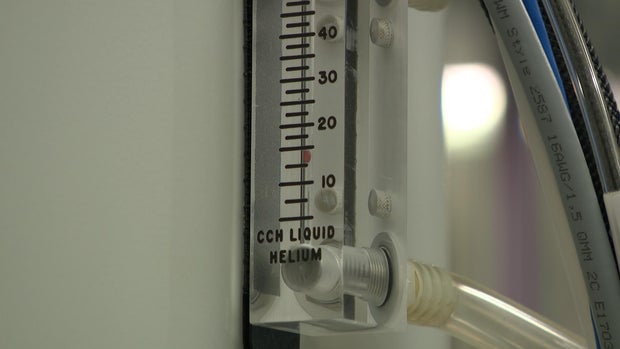
The global helium supply faces a critical shortage due to geopolitical disruptions. Seven months after Iranian strikes targeted a Qatari gas facility and the subsequent closure of the Strait of Hormuz, industries worldwide are grappling with the consequences.
Significance of Helium
Often mistaken as trivial, helium is vital for various technologies beyond party balloons and altered voices. Without this finite resource, the production of smartphones, cars, MRI machines, rockets, and missiles would be impossible. Helium needs careful handling during extraction and transportation, requiring extreme cold temperatures of 452 degrees below zero Fahrenheit during transit.
“Once released into the atmosphere, helium is gone,” said Cliff Cain, president of a helium exploration company.
Cain warns that helium’s supply chain is concentrated in a few countries, making it susceptible to disruptions. Key producers include Algeria, Poland, Russia, Qatar, and the United States, with Qatar and the U.S. being predominant.
Impact of Geopolitical Events
The closure of the Strait of Hormuz in February immobilized a significant portion of the world’s helium supply in the Persian Gulf. Iranian strikes in March targeted Ras Laffan, Qatar’s major natural gas facility, further disrupting supply chains. This facility is crucial for helium production, but it may require at least three years for full restoration.
The U.S. has attempted to meet global demand, reportedly increasing helium exports by 70% since the conflict began. However, the U.S. cannot sustain this indefinitely, particularly as the conflict prolongs. Helium spot prices have tripled since the war started, affecting supply and demand dynamics.
“If you can tell me what’s going to happen in the Strait of Hormuz in the future, I can predict the helium industry’s trajectory,” remarked Rich Brooke, a former executive at Air Liquide.
Helium’s Role in Modern Warfare
The Pentagon has requested defense contractors to enhance weapon production capacities, which requires helium. Helium is essential in developing fiber optics, munitions, and electronics integral to missiles and other modern warfare technologies.
“Without helium, making war becomes even more difficult,” Cain emphasized.
Scientific and Industrial Applications
Helium is extensively used in scientific research, particularly at the University of Chicago. Research includes developing treatments for breast cancer, immunotherapies, and Alzheimer’s disease. Joe Sachleben explains how his lab maintains nuclear magnetic resonance machines by using helium to stabilize magnets at extremely low temperatures.
“There’s no substitute, no workaround for helium,” Sachleben stated.
The semiconductor industry consumes a fifth of the world’s helium. Surya Iyer, President of Polar Semiconductors, highlights helium’s indispensability in semiconductor manufacturing. Helium participates in numerous production steps, with Polar Semiconductors planning a significant expansion to meet increasing demand fueled by AI and electrification.
Managing the Shortage
Companies like Polar Semiconductors attempt to manage reserves by collaborating with multiple suppliers. Despite these efforts, they face rationing and allocation challenges. Sachleben’s lab is forced to prioritize which machines to continue operating under restricted helium supplies.
With geopolitical tensions ongoing, Sachleben expresses skepticism about a favorable resolution that would promptly restore helium supply chains.
“It’ll take time for things to normalize even after the conflict ends,” he suggested.
 Congressman Gallagher Urges FBI to Combat Illegal Marijuana Operations in Northern California
 Proximity to Green Spaces Linked to Reduced Dementia Risk in Older Adults
 Halloween Weather Forecast Predicts Chilly Conditions and Possible Snow
 Memphis City Council Votes on Data Center Development Moratorium
 U.S. Greenhouse Gas Emissions Surge Amid Global Climate Concerns
 Severe Weather Threat in Arizona and Southern California Explained