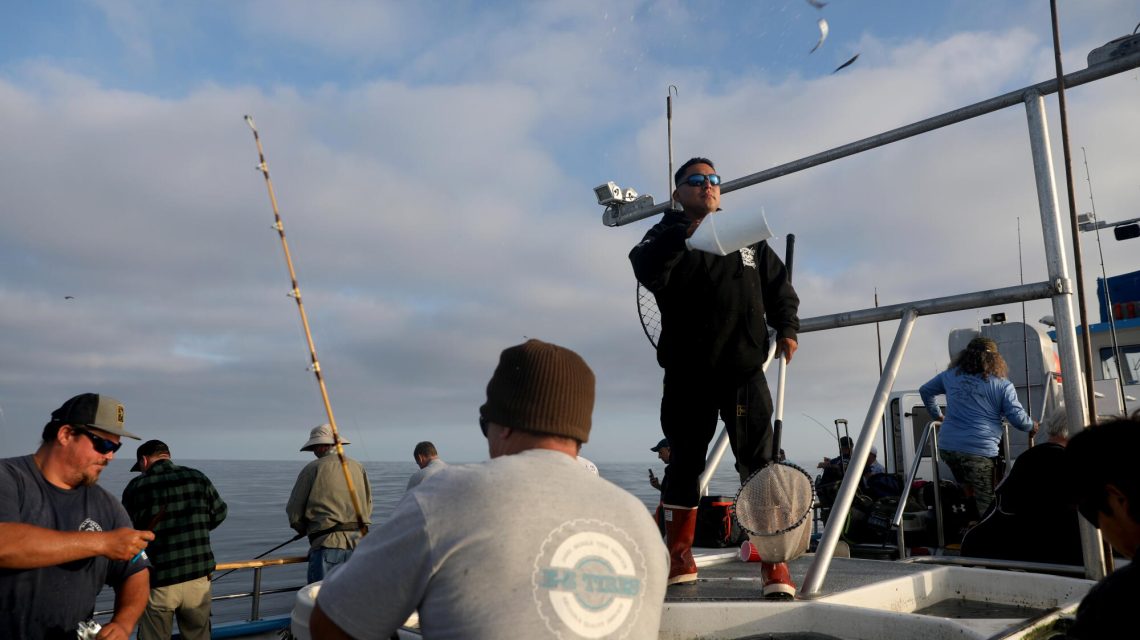
Captain Brandon Erdo guided the 95-foot Dana Pride towards a promising area miles off the Orange County coast one Wednesday morning. The vessel was nearly full, with 37 of 40 available angler spots occupied. Many had heard via social media about the exceptional fishing opportunities spurred by the super El Niño and wanted to partake.
“Start the bait, Eric,” Erdo instructed over the speaker system as a deckhand tossed a scoop of anchovies into the water, their shimmer falling onto the deck and anglers’ shoulders. Veteran fisherman Chuck Freeman soon declared, “First fish!” while reeling in a roughly 2-foot-long bullet tuna—a notable catch considering his 47 years of Pacific fishing.
Moments later, Freeman caught another tuna, tossing it onto the deck where their tails flicked, marking it with blood. Marine experts indicate that the current super El Niño conditions in the Pacific have warmed a water blob that appeared earlier this year off California’s coast. These conditions are drawing species uncommon to the region, such as the bullet tuna typically found in the Indian and Atlantic oceans or near Hawaii and the central Pacific. Beachgoers and amateur anglers from Orange County to Malibu report sightings of unusual sea life including whales, hammerhead sharks, devil rays, and wahoos.
“We’re witnessing species that should be in Cabo San Lucas presently,” noted Owyn Snodgrass, a fish biologist at the National Oceanic and Atmospheric Administration. “The ecosystem is undergoing a complete shift.”
For fishing companies, this phenomenon is boosting business. Tuna and other prized species are abundant in U.S. waters, numbers not seen for some years. Marlin fishing numbers have reached historic highs, exceeding figures not seen since 1990.
Increased Catch but Complex Reality
David Koligian was surrounded by fishing rods aboard the Dana Pride. Despite evidence of unusual sea life close to California since the past significant El Niño about ten years ago, there is a curious decrease in actual catches compared to expectations, for reasons scientists have yet to fully decipher.
Initial excitement aboard the Dana Pride following Freeman’s success dissipated quickly. “Who wants a bullet tuna?” a deckhand called out, bagging one for a ready angler. Anglers noted bullet tuna don’t keep well, making them less desirable even in their native waters.
Captain Erdo directed everyone to reel in lines to move to a new spot. Customers waited for another catch under a quiet spell. In the wheelhouse, Erdo, with feet beside blood-stained monitors, utilized binoculars to search waters for signs of fish presence. Potential indicators included kelp attracting small fish, larger fish meals, birds diving in, or disturbed water hinting at surface fish.
A sonar scanned 500 feet around for life while another scanned directly beneath. Early, Erdo followed a dolphin pod performing acrobatics near the boat.
“Looking good so far,” commented Jacob Rubio after losing but chasing bullet tuna initially.
Data from sportfishingreport.com shows last year’s Dana Wharf Sportfishing and Whale Watching boats, like Dana Pride, caught only two yellowfin tuna, according to owner Donna Kalez. This year, over 5,800 have been netted along with more than 150 mahi-mahi, typically found in tropical waters.
Comparison with Past Warm Years
In the past major warm water years of 2014 and 2015, unusually warm waters fostered a significant catch of nearly 10,000 yellowfin tuna. According to fisheries scientist Lyall Bellquist, catches are good but not experiencing a vast spike anticipated from El Niño given his review of the state’s fishing vessel data.
Potential discrepancies arise from differing marine heat wave characteristics, explains Andrew Leising, a NOAA research oceanographer. The 2014 to 2015 heat wave known as “the blob” disrupted the food chain, affecting industry catches significantly, yet did not mobilize anticipated rainfall.
By late September 2014, catches included 101,610 yellowfin tuna, and 9,200 skipjack tuna off California. Similar periods in 2015 recorded 88,590 yellowfin and 17,950 skipjack tuna. This year, anglers caught 10,980 yellowfin and 2,440 skipjack tuna by September.
Economic and Oceanographic Factors
Bellquist suggests reduced catches may stem from decreased offshore angling due to economic reasons and altered ocean factors compared to 2015.
A preliminary fish catch analysis supports fewer anglers taking trips this year—25% less than 2015. Oceanographic elements significantly vary from the previous “blob” years and the ongoing heat wave, he outlined.
Erdo expressed how oversold the El Niño event could be compared to actual outcomes. “It was hyped up so much.”
California Department of Fish and Wildlife data reflect disparity between online hype versus actual fishing results, indicated Elizabeth Hellmers, a senior environmental scientist. “Exaggeration is part of the fishing culture,” she observed.
Catch Finally On
By 12:40 p.m., Erdo found a strategic spot beside floating kelp and other boats, reviving catch activity. Yellowfin tuna emerged visible beneath clearer waters. Anglers were advised to lower lures to match fish depths at 40-50 feet.
The catch waned as fish turned to consuming tuna crabs, drawn by the warm waters.
By day’s end, Dana Pride’s haul amounted to 120 bullet tuna, 17 yellowfin tuna, three skipjack tuna, and one mahi-mahi. Freeman and his son garnered a yellowfin, while Rubio and his son managed several bullet tuna lacking yellowfin.
“Not an epic day by any means,” Erdo announced as anglers finished, preparing to disembark, mentioning potential steady fish counts to capitalize on.
 Exploring Effective Methods for Reheating Pizza
  Strategies to Reclaim Focus in the Digital Age
  Taste of Naperville Brings Culinary Delights to the City
  Impact of the Chicago Marathon on Local Businesses
  Affordable Home Coffee Options with Maxwell House K-Cups
  Partner’s GLP-1 Use Spurs Financial and Dietary Concerns