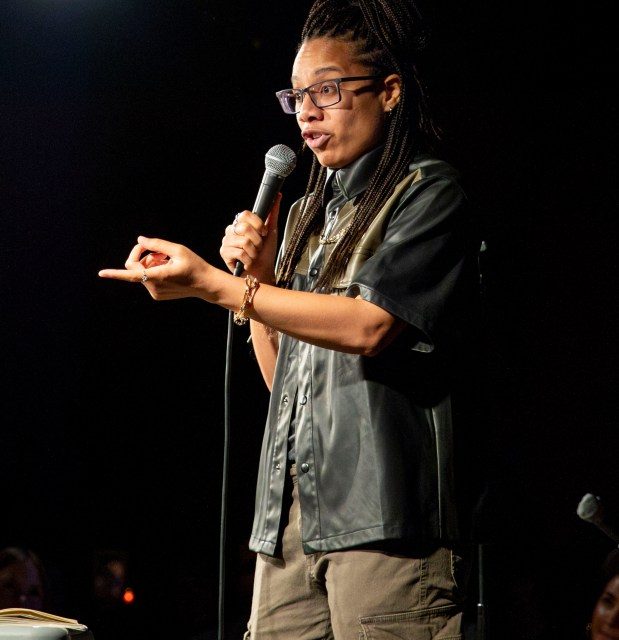
Letonia Copeland-Hardin knows that building audience trust is crucial. As a postdoctoral researcher at the University of Chicago, she frequently engages with communities to explore the link between pollution and cancer risks. Similarly, as a stand-up comedian, she connects with audiences each time she performs. Currently, she merges these two worlds by imparting her comedic skills to fellow researchers.
Alongside colleagues Myeshia Shelby and Kelsie Huff, Copeland-Hardin developed the workshop ‘Reading and Working the Room.’ This free curriculum teaches scientists to use performance techniques to better connect with the communities they study. Copeland-Hardin was passionate about comedy from a young age. She even listed it as her dream job in a school yearbook when she was nine. Yet, she only began performing in 2019, after nearly a decade in research.
“I started comedy to cope with a lot of the stress and isolation that I felt in graduate school,” Copeland-Hardin shared.
While her careers seem unrelated, ‘Reading and Working the Room’ illustrates their connection. Copeland-Hardin’s research is community-engaged, prioritizing collaboration with local residents on equal terms. She stresses the importance of building trust, especially with communities historically mistreated by scientists.
Copeland-Hardin, also known as LT on stage, participated in the Future of Comedy Showcase at The Lincoln Lodge in Chicago. Her performances blend humor and science, easing audiences into complex topics. For example, by asking familiar questions like, ‘Y’all are familiar with Froot Loops, right?’ she transforms monologues into dialogues. This prepares audiences for more complex ideas, such as dissecting a fruit fly’s brain, ensuring they remain engaged and receptive.
The workshop aims to help researchers adopt techniques like trust-building to address a crucial gap in scientific communication. Researchers often excel in academic circles but struggle to engage the general public. The curriculum clarifies that while not all research discussions require humor, using these engagement strategies can rebuild trust and enhance data clarity.
‘Reading and Working the Room’ is accessible as a self-study curriculum. Interested individuals can download the materials from zenodo.org, including slides and a facilitator’s guide. The project received initial funding from Research!America to address public engagement gaps in science training.
Copeland-Hardin emphasized, “As scientists, it is our responsibility to share our information with the public.”
Ultimately, Copeland-Hardin’s motivation in both fields is to connect. Whether engaging a comedy audience or collaborating with a community—or even dissecting a fruit fly—she finds fulfillment in making those connections.