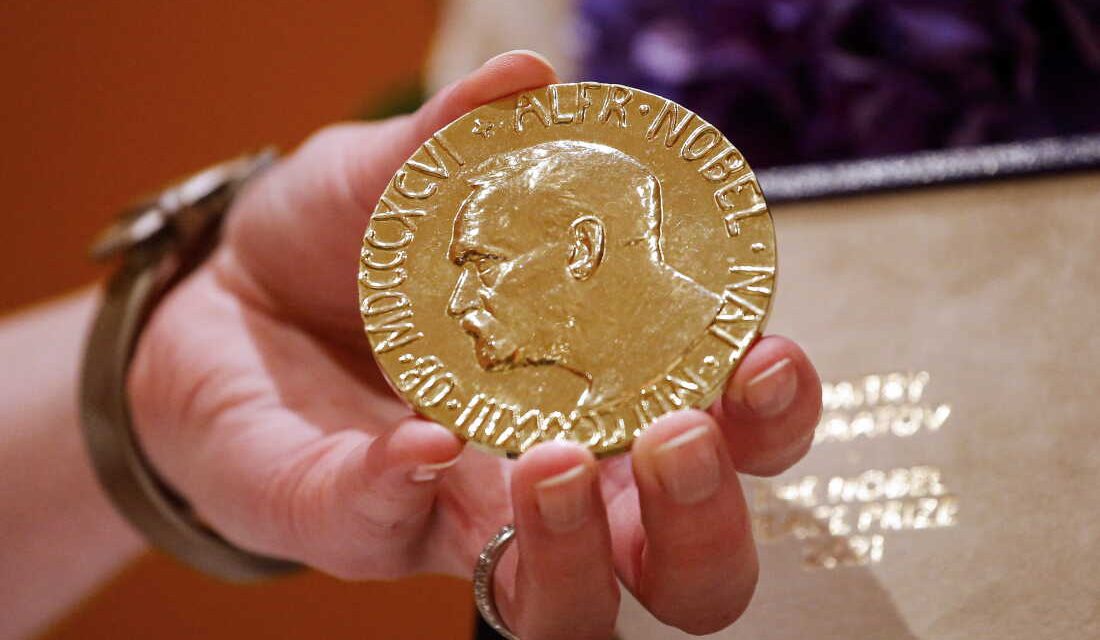
A woman holds Russian journalist Dmitry Muratov’s 2021 Nobel Peace Prize medal in New York, 2022, as captured in a photograph by Kena Betancur/AFP via Getty Images.
The anticipation builds as the economics world eagerly awaits the announcement of the 2026 Nobel Prize in Economics. The winner remains unknown for now, with the announcement scheduled for Monday. We’ll be covering the news in the Planet Money newsletter and The Indicator podcast.
Leading up to the announcement, it’s ideal to reflect on previous groundbreaking economic research that could one day earn recognition. There’s a growing interest in guessing who might receive the prestigious Nobel honor. Officially, the prize is called the Sveriges Riksbank Prize in Economic Sciences in Memory of Alfred Nobel, created by Sweden’s central bank in 1968. This differs from the original prizes established by Alfred Nobel’s will.
The selection of a Nobel laureate involves many considerations. Typically, winners are older, allowing sufficient time for their work’s impact to be assessed. Sometimes, the selected research resonates with contemporary public sentiment. Often, it involves technical work advancing economists’ ability to analyze the world.
Prediction Markets and Their Role
One popular method for predicting outcomes is by using markets. Economists appreciate how markets aggregate scattered insights into a single figure: the price. This concept was famously articulated by economist Friedrich von Hayek, who secured a Nobel Prize in 1974. These prices can sometimes provide hints about what lies ahead.
While stock markets can reflect a collective belief about a company’s future, prediction markets have recently gained traction. In these markets, individuals bet on specific outcomes, such as Nobel Prize winners. However, the prediction market for the 2026 Nobel in Economics is notably small, with only $11,000 in trading volume compared to the extensive $670 million seen for the 2024 presidential election on Kalshi’s platform. This relatively small scale reflects less collective insight, leaning more on isolated bets by enthusiastic participants.
Leading Contenders for the Nobel Prize
Despite the limitations of the prediction market’s size, it offers a springboard for considering some notable economic figures and their work:
- Ariel Pakes: An expert in industrial organization at Harvard University, Pakes has significantly influenced how mergers and competition are analyzed within industries. His co-developed method, BLP, remains a valuable asset for antitrust regulators.
- Susan Athey: As the economics of technology professor at Stanford, Athey stands out for integrating machine learning into economic research. Her contributions span across digital innovation, markets, and addressing discrimination in economics.
- Robert Barro: Known for his insights into how expectations shape economic responses, Barro’s development of the “Ricardian equivalence” theory examines nuanced fiscal policy implications.
Besides these top contenders observed in the prediction market, other notable economists include:
- Thomas Piketty and Emmanuel Saez: Recognized for their transformative work on inequality.
- Raj Chetty: Widely studied for his work on economic mobility in the U.S.
- David Autor: His research focuses on how technology and trade influence labor markets.
- Janet Currie: Investigates the role of childhood conditions on long-term economic success.
The rankings and opinions from the Kalshi market, while not exhaustive, offer a glimpse into the field’s diverse possibilities. The economics community and followers of the Nobel Prize eagerly look forward to the announcement, mindful that neither experts nor prediction markets can yet provide absolute predictions. For more analysis and insights after the event, subscribe to our Planet Money newsletter on NPR’s website.