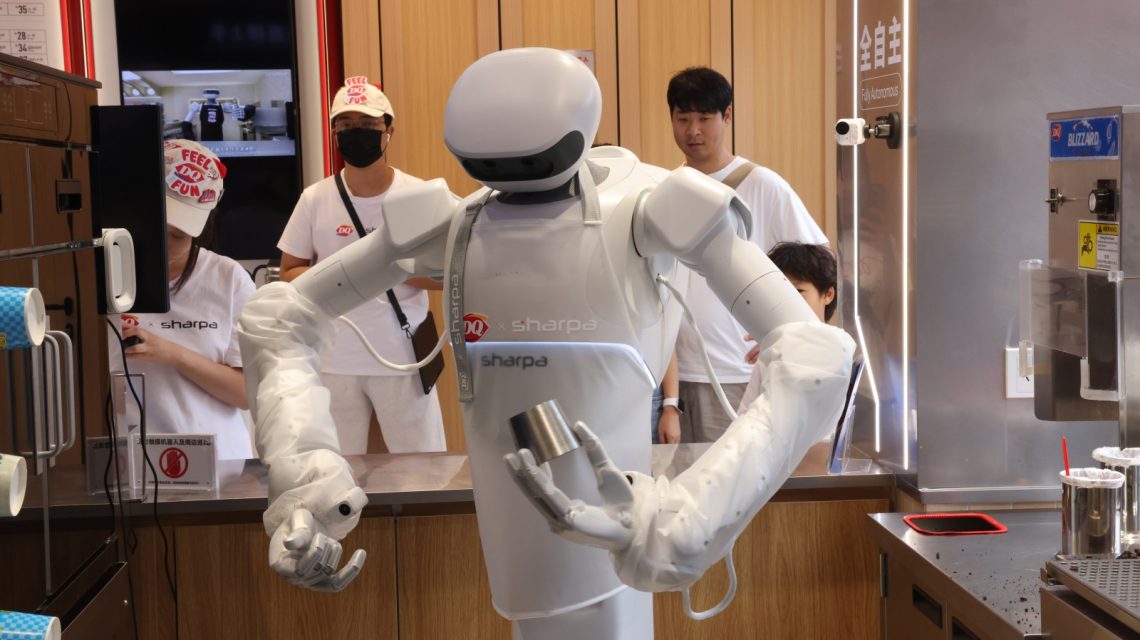
The restaurant landscape has long been transformed by technology, with touch screens guiding the customer experience from entry to order completion. Yet a shift is occurring; artificial intelligence (AI) and technology are stepping back as some major restaurant chains reinvigorate the value of human interaction.
Rediscovering Human Connection
McDonald’s, Burger King, Wendy’s, and Starbucks are now focusing on hospitality and customer experience, pivoting from automated systems such as kiosks and apps. Burger King recently revealed that some customers in its AI-driven drive-through trials chose to drive away rather than converse with a bot. This shift can be viewed as a recognition of human service becoming essential once more.
McDonald’s Strategy: Blending AI and Human Interaction
McDonald’s has showcased its new strategy, McDonald’s > NEXT, emphasizing both AI and human hospitality. This strategy includes the deployment of ArchIQ, a generative-AI-enabled system aimed at enhancing efficiency, while also promoting a “People > NEXT” pillar for improved human interaction. The intertwining of AI capabilities and personal touch underscores the renewed focus on hospitality.
“The machine and the smile are arriving together.”
The experiment with automation has highlighted the distinction between predictable tasks apt for AI and the qualitative aspects of hospitality that require human input. AI organizes tasks but cannot replace the unique awareness that defines hospitality.
AI’s Informational Power Versus Human Insight
AI excels in gathering information, but it lacks the ability to perceive real-time changes. Charan Nukathoti, creator of Savor Scout, an AI restaurant-discovery service, notes that AI can process comprehensive data but returns to human input when unpredictable elements arise—like allergies.
Nukathoti emphasizes that AI can interpret menus, yet it cannot identify shifts like shared fryers or new kitchen management. This reinforces the need for human service when unpredictability demands nuanced responses.
Starbucks’s Human-Centric Approach
Starbucks is embracing this shift by investing in AI while enhancing human interactions. Its Green Apron Service focuses on personal customer engagement, and technology aids, such as Green Dot Assist and Smart Queue, support operation logistics. These tools operate in the background to simplify processes for employees, avoiding intrusiveness.
The Balancing Act: Technology and Human Touch
Dan Jin from Rochester Institute of Technology highlights the balance between automated and human roles. Successful automation depends on defining tasks suitable for technology and those requiring human understanding.
Predictable tasks fit automation well, but complex issues demand human empathy and problem-solving.
“A guest wants more than a fast response; they seek understanding and resolution.”
Automation’s Role: Streamlining Experience, Not Replacing It
Automation offers benefits such as ease of use and efficiency but must not overshadow human service. Features like kiosks enable customers to browse without interrupting others. AI forecasts demand, easing employee workloads.
McDonald’s is refining its hospitality strategy alongside efficiency improvements, aiming for significant gains. Burger King continues AI trials but allows customers easy access to human interaction, disrupting the notion that all must be automated.
Looking Forward: A New Restaurant Experience
The future of restaurants will see increased automation coexisting with heightened human service. AI will handle logistics under the surface, while human employees provide judgment, recognition, and problem solving.
Nukathoti advocates for AI directing customers efficiently to human assistance when necessary—bringing technology to an old yet valuable role.
“The best AI experience may actually be one that gets you to the right human faster.”
The restaurant industry’s evolving approach promises a strange combination of automation complimenting human service rather than overshadowing it.