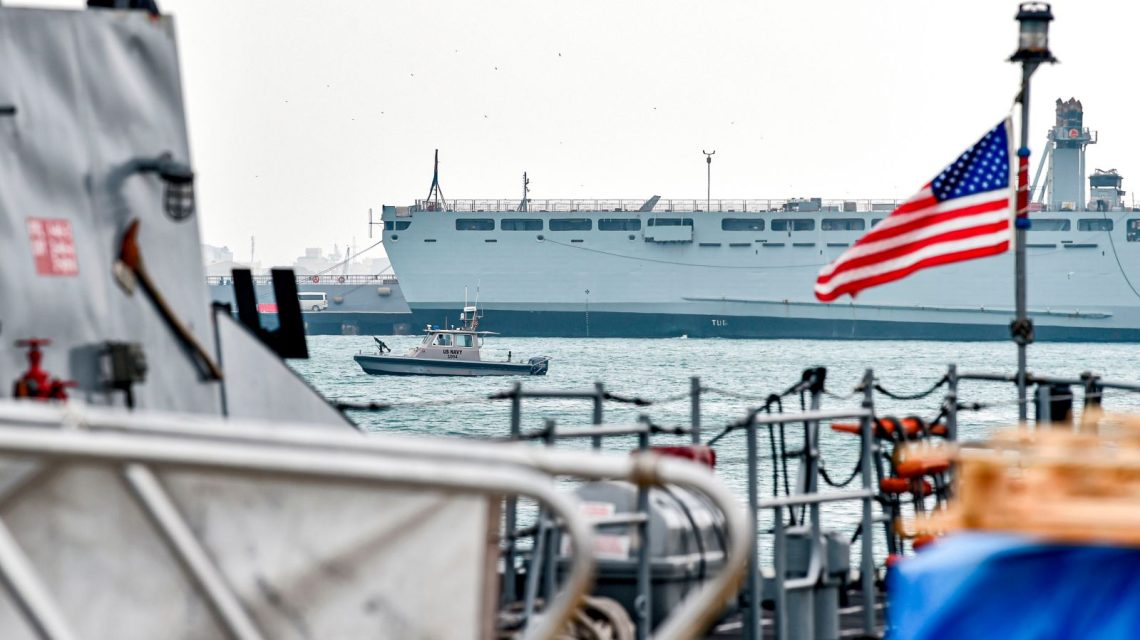
The US Navy base in Bahrain suffered severe damage after being targeted by Iranian strikes, as acknowledged by Acting Navy Secretary Hung Cao. This admission marks a rare high-level disclosure of damage to the headquarters of the US Fifth Fleet and may raise concerns about US military capabilities in the Middle East. Initially, the Pentagon claimed the February 28 strikes at the start of the Iran war had minimal impact on operations. However, Cao described the situation as Iran having ‘blown the hell out of Bahrain.’
The Pentagon refrained from commenting on intelligence-related matters. Retired US Vice Admiral Robert Murrett noted that regaining full operational capacity in Bahrain will take time. The attack on the base was part of Iran’s retaliation after a joint US-Israeli strike on Iran that same day. Several targets were hit, including the Juffair district where the base is located.
The Wall Street Journal
reports satellite imagery and service members’ accounts showed extensive damage to the command center and multiple buildings within the base. The Pentagon initially did not acknowledge this damage. According to Murrett, Bahrain’s importance for naval operations cannot be overstated. He emphasized that Iran’s strategy involved targeting military installations across the Middle East, with the base in Bahrain being a priority.
Iranian Foreign Minister Seyed Abbas Araghchi reacted to Cao’s remarks by boasting about the impact of the strikes, stating that Iran’s forces had indeed severely damaged the base and other US installations.
Impact on US Operations
The Naval Support Activity Bahrain is crucial for US Fifth Fleet operations and logistics in the Gulf. The damage has led to doubts about the base’s previous capabilities. Admiral Daryl Caudle indicated it would be some time before operations could resume at full capacity.
Retired Navy Captain John Cordle highlighted the tactical and strategic implications of the damage. He noted that relocating supply hubs would complicate future maritime operations. Cao mentioned a task force assessing the necessity of repairing the base for continued US presence in the region.
Operations involving the USS Abraham Lincoln aircraft carrier have been affected, extending its deployment and raising concerns about the crew’s well-being. The crew recently had shore leave in Thailand before returning to the US. Murrett commented on the logistical challenges now faced by these operations.
Other Affected US Bases
Approximately 50,000 US troops were in the Middle East when the Iran war began. Iranian missile and drone attacks have led to the dispersion of personnel. By March’s end, at least 11 US bases were damaged, including Al Dhafra Air Base in the UAE and Ali Al-Salem Air Base in Kuwait. The Islamic Revolutionary Guard Corps claimed missile strikes on US forces at Al-Azraq base in Jordan.
For more detailed reporting, contact Newsweek editors Federica Bindi and Tony Phillips.
 Inside the Secret Deals Powering the President’s Push to Deport Migrants to Countries Not Their Own
  Navigating the Challenges of Third-Country Deportations
  Midair Altercation on Bangladesh to London Flight
  Ukraine Missile and Drone Barrage Hits Russia Amidst Elections
  U.S. Strategic Goals Remain Unmet Amid Prolonged Conflict
  New Photos Reveal Damage from Iranian Strikes in the Middle East