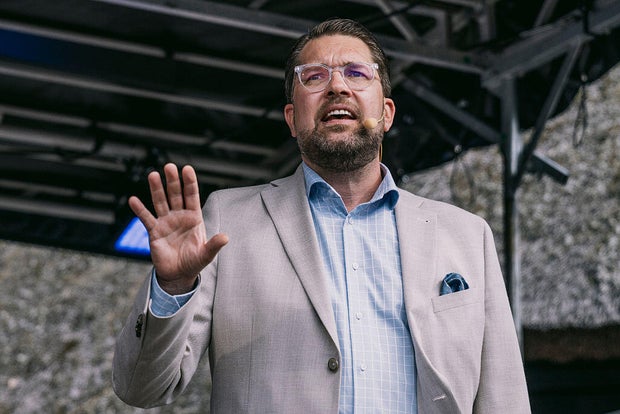
Sweden prepares for a crucial election that could change its political landscape deeply. This election follows a trend across Europe where right-wing populist parties grow more popular. Swedish voters will choose between a center-right coalition led by Prime Minister Ulf Kristersson and a center-left bloc led by Magdalena Andersson from the Social Democrats.
The Sweden Democrats, a right-wing populist party, could enter government for the first time. Although rooted in extreme-right circles, the party has gradually moved toward mainstream politics over the years. Since its entry into parliament in 2010, it has become Sweden’s second-largest party by 2022 and supported Kristersson’s minority government without official cabinet positions.
Kristersson now seeks a majority government, with plans to offer ministerial posts to the Sweden Democrats if his coalition wins. The election tests public willingness to accept a party that was previously shunned by the mainstream as part of the executive government.
“There has been a shift of focus, which has gone from the true political challenges to who is going to sit in the government,” said Professor Andreas Önnerfors from Linnaeus University.
Polling shows the race is tight, with the center-left coalition slightly ahead with 50.8% compared to 47.6% for the right coalition.
From Fringe to Mainstream
For years, mainstream Swedish parties avoided cooperation with the Sweden Democrats due to their extremist roots. Former leaders assured promises of non-cooperation as late as 2018. The Sweden Democrats have acknowledged connections in their past with radical movements. However, the party has shifted its image under Jimmie Åkesson’s leadership since 2005. The strategy involved expelling extremists, moderating its image, and broadening its appeal.
The Sweden Democrats promote policies like deporting illegal immigrants, tightening citizenship laws, and limiting social benefits to citizens. Their success partly lies in combining traditional right-wing positions with policies appealing to working-class voters.
“They have merged typical right-wing positions with typical Labour or Social Democratic positions — social security and benefits and things like that. That makes sense among ordinary people,” Önnerfors added.
Immigration and Crime as Voter Concerns
Swedish politics has increasingly focused on tougher immigration and crime policies. These issues reflect significant societal changes and voter perceptions. The largest party, the Social Democrats, also mirrored this shift, moving toward a more restrictive stance.
During the 2015 European migration crisis, Sweden processed approximately 163,000 asylum applications, one of Europe’s highest per-capita rates. Integration issues, segregation, and rising crime became central national concerns. Sweden’s approach to immigration has since tightened significantly.
Government data shows asylum immigration at its lowest since 1985. Official statistics indicate a reduction in gang violence, with shootings dropping from 391 in 2022 to 158 in 2025.
“Immigration and dissatisfaction with integration remain important explanations, but their support is also linked to concerns about crime and a broader dissatisfaction with established parties,” Professor Niklas Bolin from Mid Sweden University noted.
Support for the Sweden Democrats is pronounced among men, working-class voters, and those outside large cities. For Sweden, known for its low crime, generous welfare, and liberal immigration policies, this election tests how politics have evolved, and whether a formerly marginalized party is ready for governance.
 Media Outlets Sue After White House Ban
  American Public Opinion on Press Freedom
  Media Lawsuit Against Trump Administration for White House Ban
  The Cost of Challenging Beijing
  Analyzing Midterm Elections and Party Dynamics
  Allan Lichtman’s Framework for Assessing Presidential Greatness