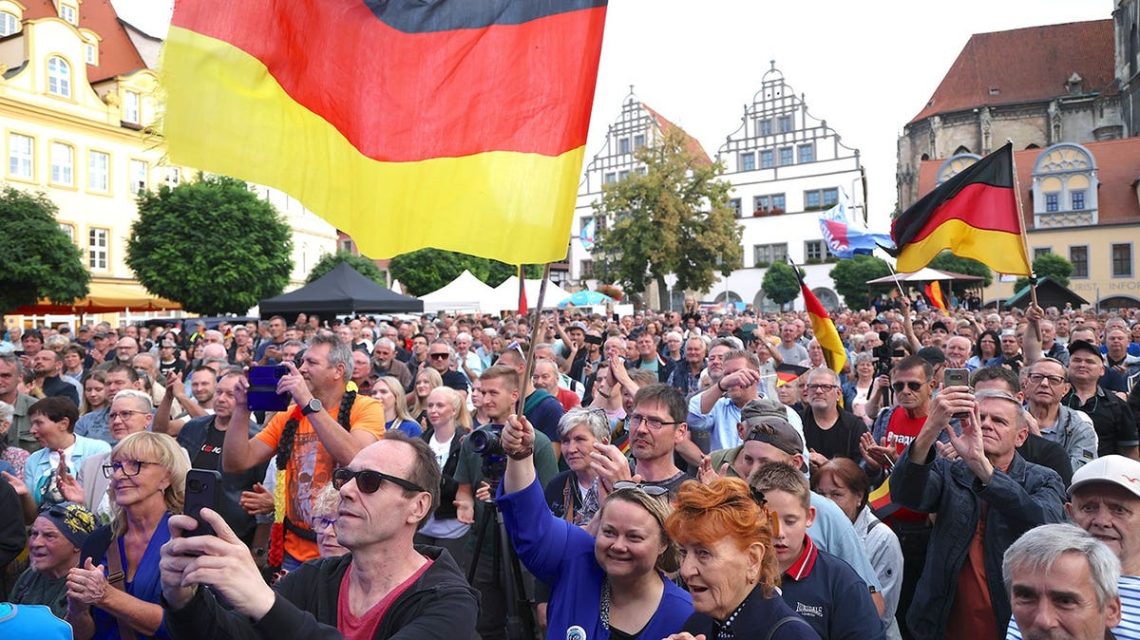
Political dynamics in Germany’s eastern region are witnessing a significant change. The Alternative for Germany (AfD) party is poised to achieve a major victory in the upcoming state elections in Saxony-Anhalt. This shift is prominent among working-class and young voters.
The AfD is often highlighted for its controversial stance. Criticized for its pro-Russia views, it’s labeled as a right-wing extremist entity by Germany’s domestic intelligence. Its expected triumph marks a departure from the traditional dominance of the Social Democratic Party (SPD) and the Christian Democratic Union/Christian Social Union (CDU/CSU).
“The significance of Saxony-Anhalt lies in the fact that the AfD is not merely aspiring to power but is on the verge of achieving it,” remarked Daniel Schatz, a foreign policy expert.
Ulrich Siegmund, the AfD’s prominent candidate, has propelled the party to 43% in state polls. An outright win would allow them to form a state government, a historic first for the party.
Though smaller parties have led coalitions, since 1949, no party outside the SPD or CDU/CSU has held a single-party majority in a German Landtag.
Janek Treiber, a political researcher, notes that AfD’s victory could symbolize a major political change, impacting the long-standing power of traditional parties. He cautions about the broader implications beyond immediate policy changes.
Schatz describes the AfD as a nationalist, anti-immigration party. It focuses on tighter immigration controls, a strong national identity, less focus on the green agenda, and a softer stance on Russia.
An AfD win would challenge Germany’s political ‘Brandmauer,’ a resistance among other parties to collaborate with them. Currently, the AfD is the second-largest party in Germany’s Bundestag.
Alice Weidel, AfD’s co-chair, has expressed the need for stringent border controls and questioned the status of Syrian refugees in Germany, indicating plans for deportation should they not leave voluntarily.
Saxony-Anhalt’s election results will be pivotal, with subsequent elections in Mecklenburg-Western Pomerania and Berlin soon after.
In 2025, Germany’s BfV classified the AfD as a right-wing extremist group, though a German court intervened, citing insufficient evidence for a wholesale extremist label.
Chancellor Friedrich Merz warned about the potential negative impact on international investments if the AfD gains power. Despite this, Ulrich Siegmund remains a popular candidate, with significant social media influence.
A CSIS report highlights Siegmund’s respectable public persona, combining radical ideas with community engagement, promoting the AfD’s ‘us vs. them’ narrative.
Polling data ahead of Saxony-Anhalt’s vote shows AfD leading, benefiting from Germany’s unique electoral system. Voter turnout and second ballot results play a critical role in seat allocation, potentially allowing a 43% vote share to secure an outright majority.
The CSIS report notes the complex relationship AfD voters have with the party’s extremist views, especially with strong support from voters aged 18-25. Economic factors such as rising costs and unemployment sway younger voters towards the AfD.
As Saxony-Anhalt votes, attention also turns to Mecklenburg-Western Pomerania and Berlin soon voting, with AfD showing strength in the former.
Despite mainly having support from former East Germany, the AfD has representation in 14 state legislatures and holds seats in the European Parliament.
 The War on Poverty: A Lesson on Intentions and Outcomes
  Reporters Blocked from White House by Trump Administration
  Universities Should Reject Political Influence on Research Funding
  Trump’s Approach to China: Trade Dynamics and Challenges
  Media Outlets Sue After White House Ban
  American Public Opinion on Press Freedom