Seeing fans with their phones out during a tennis match would have been unusual a decade ago. At the U.S. Open this year, the digital world is becoming entwined with tennis as live AI insights are reshaping the tournament experience.
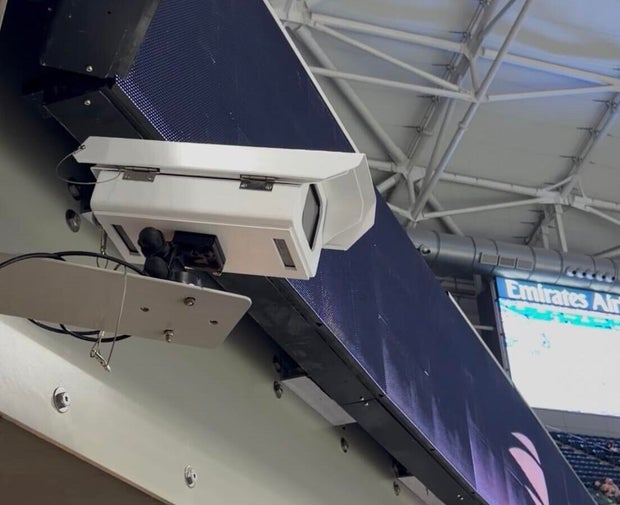
During Coco Gauff’s match against Zeynep Sönmez of Turkey, AI-generated analysis provided continuous updates through the U.S. Open app. The app tracked key moments, predicted each player’s likelihood to win, and introduced a new metric called “serve quality.” Cameras positioned around Arthur Ashe Stadium in Queens, New York, captured data on players’ limb movements.
These cameras collect details like ball trajectory, racket position, and players’ limb movements, focusing on aspects like elbow and knee flexion and wrist flex velocity. IBM’s Watsonx software processes this data to evaluate serve efficiency, accuracy, and consistency, presenting a score out of 100 visible to users post-match. Gauff’s serves were noted for her “controlled racket preparation and deep knee bend during her setup,” according to the serve quality summary.
Tyler Sidell, IBM’s technical program director for sports and entertainment partnerships, mentioned that over a billion data points will be generated by the tournament’s end. He stated that these data-driven experiences aim to spark conversations among fans. “Sports are unpredictable. You can analyze all the data, but anything can happen on the court,” Sidell remarked. “It’s about providing insight while letting the matches unfold.”
These AI insights benefit not only fans, who number around 14 million according to IBM, but also players. Jessica Pegula, who advanced to the fourth round of the U.S. Open, uses AI to identify patterns in opponents’ serves before facing them. “Tennis involves a lot of problem solving on the court and patterns, with serve being a significant factor,” she explained. “It’s the one controllable shot in tennis.” Pegula noted the importance of trusting her instincts, stating, “Analytics help but sometimes strategies change. You have to feel prepared going into a match.”
The “likelihood to win” feature has been a digital staple at the U.S. Open for about six years. Now, fans can track real-time fluctuations in players’ odds during matches. This feature evaluates trusted media sources and recent performances. Gauff had a 72% predicted win rate, which increased as she gained momentum in the first set.
Another AI-powered feature, “key moments,” provides brief analysis as games unfold. During Gauff’s match, it noted, “Gauff has three opportunities to win the match, with Sonmez needing a heroic response.” A dramatic fluctuation occurred when men’s No. 1 seed Alexander Zverev faced Lorenzo Sonego from Italy in a match that stretched into the early morning. Zverev had an 87% likelihood of winning initially, but Sonego’s chance rose to 93% by the fourth set. Zverev made a dramatic comeback as chances flipped.
The app includes “Match Chat,” an AI-powered assistant that answers questions about players, matches, and venue information. For example, when asked about the Honey Deuce cocktail, it instantly provided bar locations and asked if users wanted the nearest one to their gate.
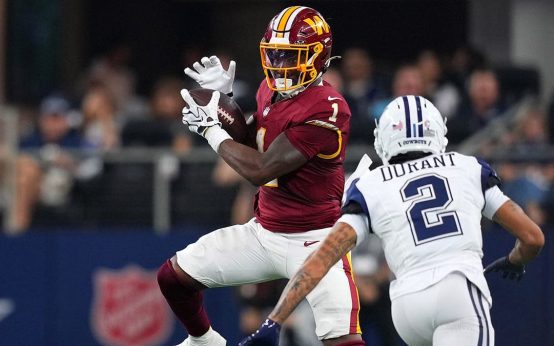 Dallas Cowboys Defeat Washington Commanders Amid Player Injury
  Chicago Cubs’ Alex Bregman Suffers Facial Injury from Foul Ball
 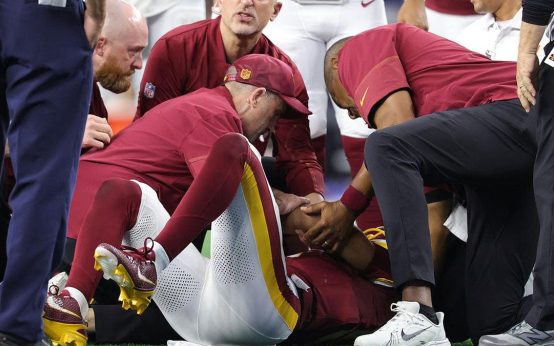 Washington Commanders Face Major Setback as QB Jayden Daniels Suffers Elbow Injury
 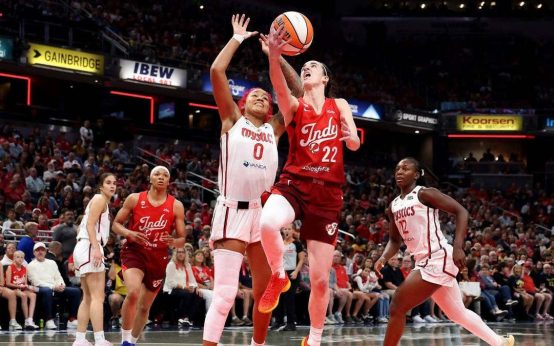 Indiana Fever’s Struggles Against Washington Mystics
  New York Jets Fall to Green Bay Packers After Fourth-Quarter Collapse
 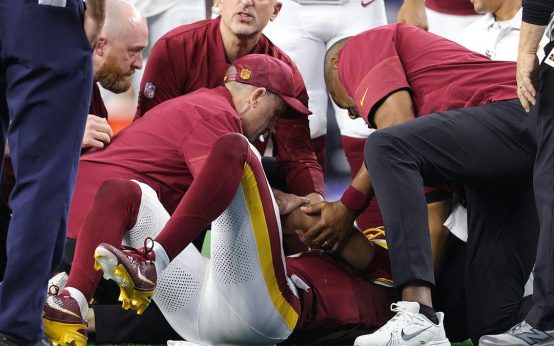 Washington Commanders’ Jayden Daniels Faces Potentially Season-Defining Elbow Injury