The U.S. Navy unveiled a new extra-long-range missile designed to intercept enemy aircraft at considerable distances. This development aims to safeguard American fighter jets and aircraft carriers by keeping threats at bay.
Designated the AIM-424 LRAAM and nicknamed “MALICE,” the missile was announced on Aug. 22. This advanced weapon is intended to be launched from jets to engage enemy aircraft or drones over extensive ranges.
Pilots will now have the capacity to detect adversaries on radar and launch missiles from remote distances, neutralizing targets before enemy proximity threatens their safety. This capability is expected to enhance pilot survivability significantly.
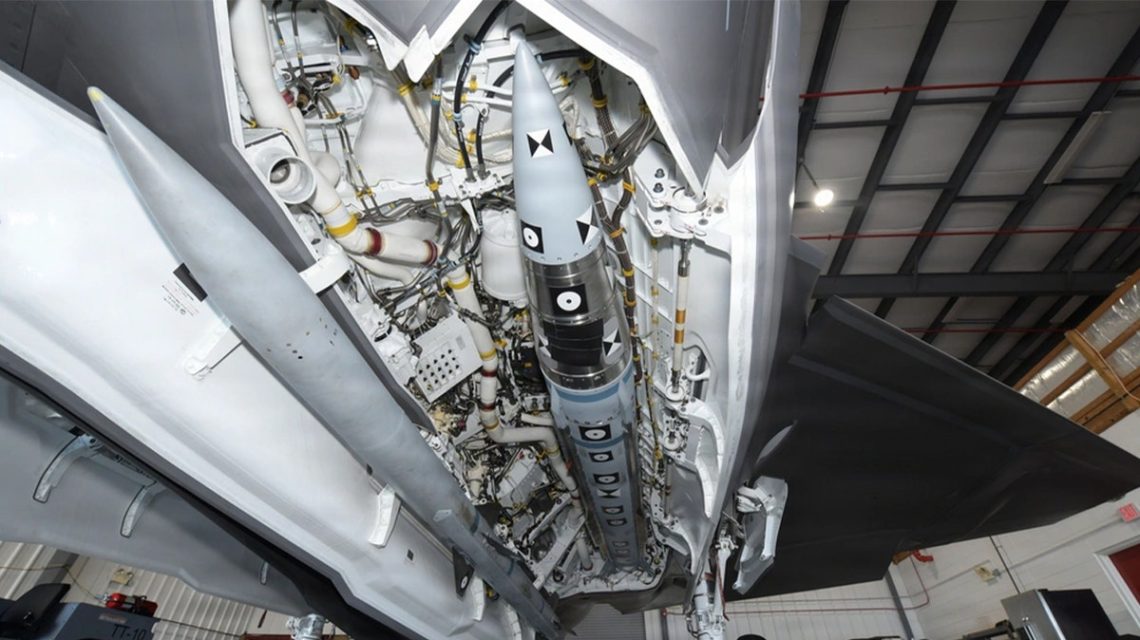
An AIM-424 Long Range Air-to-Air Missile (LRAAM) is mounted in the internal weapons bay of an F-35C with an AIM-120 Advanced Medium Range Air-to-Air Missile (AMRAAM) on the weapon bay door. (U.S. Navy File Photo)
The Navy emphasized that the LRAAM maintains its “first look, first shot, first kill advantage,” granting aviators greater reach, survivability, and tactical flexibility in aerial engagements. Officials said it boosts the range, lethality, and combat efficacy for Marine and Naval aviation forces.
The missile features a range exceeding 250 nautical miles, equating to roughly 287 statute miles. This extensive reach allows jets to protect fleets from well over the horizon.
At 13.5 feet long and weighing 1,500 pounds, the AIM-424 is notably larger and heavier than standard medium-range air-to-air missiles, such as the AIM-120 AMRAAM, which weighs around 335 pounds. This reflects the robust propulsion system required for extended range deployment.
FILE — Two F/A-18 Super Hornets launch from the flight deck of the U.S. Navy Nimitz-class aircraft carrier USS Abraham Lincoln. Officials recently tested the new AIM-424 LRAAM missile on F/A-18 Super Hornets. (U.S. Navy/Handout via Reuters)
The missile employs a blast-fragmentation warhead, capable of detonating near its target to damage or destroy via dispersed fragments. This reduces the necessity for direct hits.
Compatibility extends across multiple aircraft generations, encompassing fourth and fifth-generation fighters, as well as future sixth-generation models.
The LRAAM is developed by Raytheon, a key defense contractor for the U.S. military.
Bonny Chu, a writer for Fox News Digital, contributed to the reporting.
 Hispanic Rights Group Advocates Against Deportation of Shooting Witness
  NYC Mayor and Trump Clash Over Media Access
  FAA Issues Ground Stops Due to Equipment Failure
  Judge Experienced in White House Press Access Case
  Hunter Charged in Accidental Shooting of Woman Mistaken for Deer
  Media Outlets Sue After White House Ban