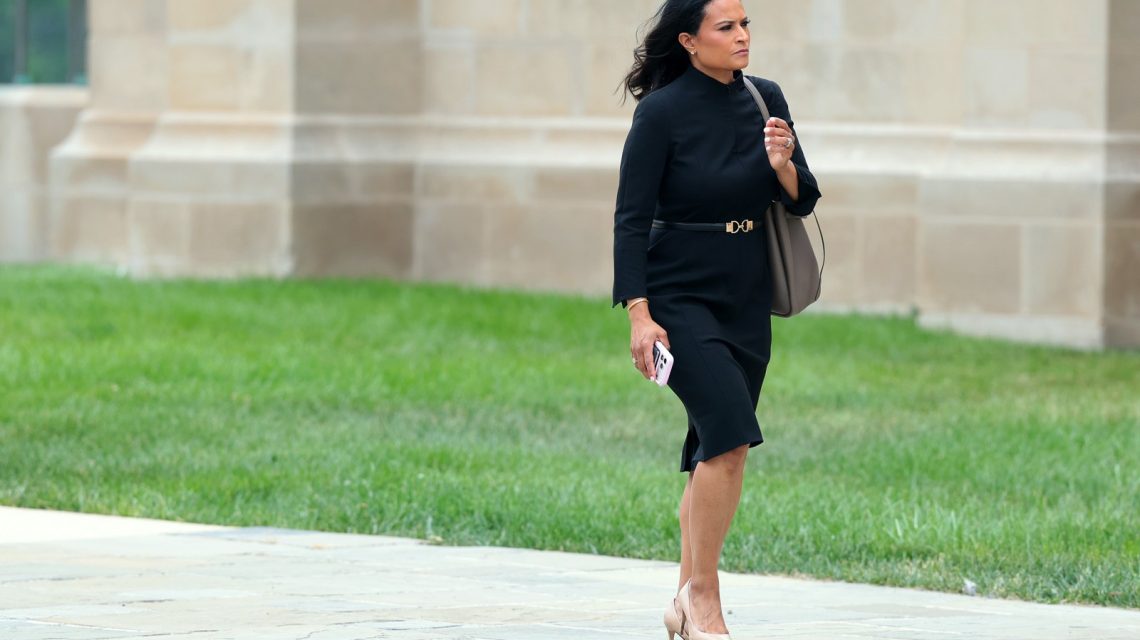
President Donald Trump has expressed strong disapproval towards TV journalist Kristen Welker and the ‘radical left’ news media. He challenges their portrayal of his endorsement record as being less successful than he claims.
Trump took to social media platform Truth Social to denounce Welker, who moderates NBC News’ Meet the Press, for suggesting mixed results on his endorsement record in recent elections. Trump argues that his endorsement record is historically strong and even accuses Welker of ‘purposeful inaccuracy.’ He suggested Welker should face consequences from the Federal Communications Commission (FCC).
‘Kristen Welker, the Unpopular ‘Hostess’ of the once great Meet the Press, now considered Meet the Fake Press, just stated that Donald Trump has ‘mixed results’ on his Endorsements of Candidates, when the recent WINS of Darline Graham and Mike Mazzei, stand at 100 percent for the U.S. Senate, and 98 percent for the U.S. House,’ Trump posted.
The FCC, an independent regulator for broadcast and other networks, has been perceived as increasingly politicized during Trump’s term, with Brendan Carr as head.
Analyzing Trump’s Endorsement Record
Ballotpedia tracks Trump’s endorsements. During his first term (2017-2021), Trump had 305 endorsements, while in 2026 alone, he endorsed 312 primary candidates, achieving a 97% success rate by early July.
Historically, Trump fared better in primaries than general elections. In 2018, his primary success rate was 95% compared to 59% in general elections. By 2019, these shifted to 80% and 67% respectively. In 2020, Trump’s primary success rate reached 97% against 79% in general elections.
In 2021, although he made fewer endorsements (just five), he maintained a 100% success rate. By 2022, he endorsed 241 primary candidates with 93% success and 254 general election candidates, achieving an 84% success rate.
During 2023, primary success fell to 67%, the lowest of both terms, whereas general election success climbed to 80%. By 2024, his success rates rose to 96% in primaries and 89% in general elections.
In 2025, endorsing nine candidates for primaries and general elections, he achieved 100% and 43% success, respectively. By August this year, Trump endorsed 313 primary candidates, experiencing a 96% success rate, while general elections are still ongoing.
Despite some setbacks, Trump remains influential in Republican primaries. Recently, his endorsements in Alabama and Wisconsin saw success but faced defeats in Minnesota and South Carolina. In Florida, Alaskan, and Wyoming races, Trump-backed candidates won, but the Florida congressional primary saw losses, indicating mixed results.
How Trump’s Endorsements Compare
Compared to other presidents like Joe Biden or Barack Obama, Trump’s endorsement activity is distinct. Biden endorsed fewer candidates, whereas Obama made a significant number of endorsements post-presidency. In 2016, Obama endorsed 150 candidates, showcasing significant involvement.
Trump’s prolific nature of endorsements stands out even amid historical tracking unlike previous administrations. However, certain limits to his influence in statewide elections remain visible.
Mixed Results in Endorsement Power
Justin Vaughn, a political science professor, states Trump is the most impactful endorser nationwide. But, gubernatorial races often reduce his influence due to local issues outweighing presidential endorsements.
Boleslaw Z. Kabala, another political science expert, explains Trump’s influence, noting victories and losses show the complexity of campaign dynamics. Despite some candidates winning against his endorsees, few succeed by opposing him directly. Trump’s endorsement still holds substantial weight.
 A Mother’s Tragic Journey Under Abortion Ban
  U.S. Strategic Goals Remain Unmet Amid Prolonged Conflict
  The Impact of Arts and Closure on Democracy
  U.S. Ambassador Comments on Iran War Duration Amid Political Concerns
  US-China Relations Under Scrutiny: Expert Warns of Escalating Tensions
  No Timeline for End of Iran Conflict