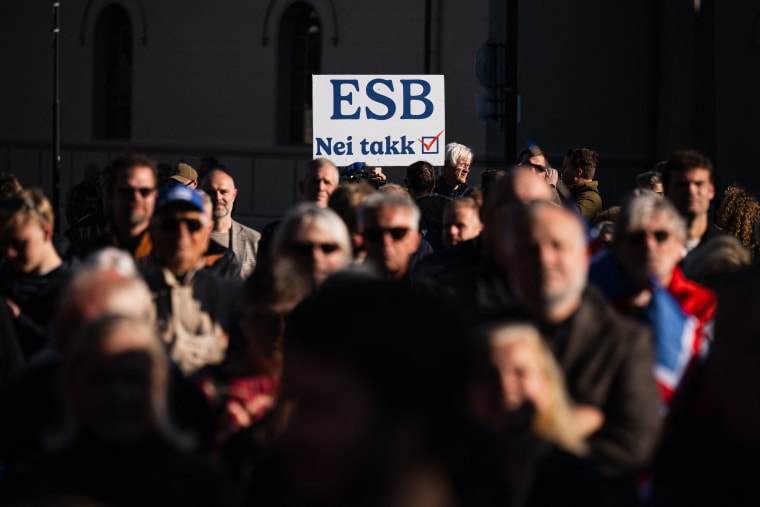
Reykjavik, Iceland — On Saturday, Icelanders participated in a vote to decide whether to reopen membership negotiations with the European Union. Citizens are divided, with discussions centered around living costs, security, sovereignty, and control over fishing waters. The outcome remains uncertain.
A Gallup poll from Friday indicated a slight majority against reopening negotiations, contrasting earlier polls showing a marginal lead for supporters of talks. Proponents argue that joining the EU might alleviate high interest rates and provide greater security in light of global tensions, notably the Ukraine conflict and former U.S. President Donald Trump’s comments regarding Greenland.
Opponents, however, believe EU membership might jeopardize sovereignty and fishing rights. Iceland’s former President, Ólafur Ragnar Grímsson, expressed his opposition on social media, framing the vote as a significant historical moment.
A supporter of the ‘No’ campaign holds a placard during a rally in Reykjavik on Aug. 27.
Should the vote favor re-engaging with the EU, it would only initiate discussions with Brussels. A subsequent referendum on actual membership would occur years later.
Background and Context
The European Union includes 27 nations, forming one of the largest trading blocs. Iceland, alongside Norway and Switzerland, has long remained outside the EU, while the UK exited following a 2016 vote. Iceland first applied to join the EU in 2009 during a financial crisis that severely impacted its economy. Talks halted in 2013 under a Eurosceptic administration.
Geopolitical Considerations
Geopolitical challenges have revived the debate in Iceland, where this issue has persisted for decades. Foreign Minister Thorgerdur Katrin Gunnarsdottir, a ‘yes’ supporter, emphasized the need for smaller nations to assess their positions in an uncertain global landscape.
The international order that supported our security and prosperity is under strain. Small nations must carefully consider their alliances,
said Gunnarsdottir.
Economic Concerns and Inflation
In Iceland, the discussion has fixated on interest rates, fishing rights, and living costs rather than security alone. The country faces persistently high inflation, leading to expensive mortgages. Those favoring a ‘yes’ believe EU membership and possibly adopting the euro could offer economic relief. Iceland’s central bank rate is 8.00%, while the European Central Bank’s rate is 2.25%.
Vilhjalmur Hilmarsson, chief economist at Viska, one of Iceland’s largest labor unions, remarked, It might not solve Iceland’s structural issues, but it could be a catalyst for a healthier economy.
However, opposition leader Guðrún Hafsteinsdóttir argues the economic justification is overstated, emphasizing Iceland’s responsibility to resolve internal issues.
Fishing Rights Dispute
Under EU rules, fishing quotas hinge on historical fishing patterns. Some assert this could maintain Iceland’s control over its waters, as no EU nation has fished there for decades. Yet opponents remain skeptical. Hafsteinsdóttir pointed out potential short-term promises from the EU that might not hold long-term.
A foreign ministry memo estimates accession talks could commence by 2026’s end and last 18 to 24 months, contingent on the vote’s outcome. Iceland must also conduct a general election by November 2028, introducing additional political uncertainty to the timeline.
Polling stations throughout this nation of about 400,000 people are slated to close by 6 p.m. ET.
 U.S. Strategic Goals Remain Unmet Amid Prolonged Conflict
  New Photos Reveal Damage from Iranian Strikes in the Middle East
  Assassin of Chilean Diplomat Orlando Letelier Faces Deportation 50 Years After Assassination
  Gorillaz and Macklemore Respond to Controversy Over Israel-Palestine Statements
  Investigation into Lion Deaths in Tanzania
  Merz Stays Resolute Amid Electoral Shifts in Germany