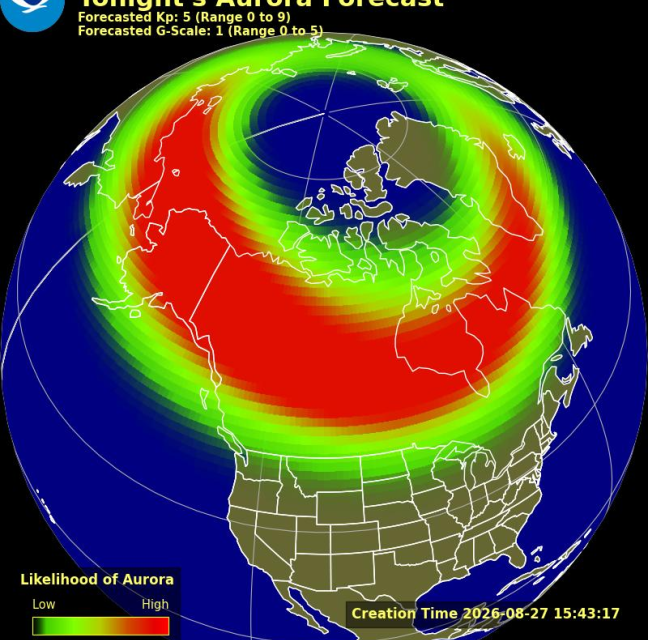
This week, sky watchers have the chance to observe both a blood moon lunar eclipse and the northern lights. The northern lights, or aurora borealis, appear when solar material collides with Earth’s atmosphere.
The sun recently emitted material that might trigger the aurora. The National Weather Service’s Space Weather Prediction Center (SWPC) issued geomagnetic storm watches from Thursday through Saturday due to anticipated solar winds and coronal mass ejections.
Forecasts from the SWPC indicate conditions might peak at moderate G2 level Thursday evening, between 8 p.m. and 11 p.m. EDT. Such storms can bring the northern lights visible as far south as New York and Idaho.
The SWPC forecasts suggest the best viewing chances are in Canada and Alaska. For U.S. areas close to the Canadian border, the aurora might be faint and only visible along the northern horizon.
While conditions might wane by Friday morning, they could strengthen again in the evening hours. The outlook for Friday remains similar to Thursday’s.
The forecast does not extend beyond 11 p.m. EDT Saturday. It’s uncertain if conditions will improve or diminish, as predicting solar material interactions with Earth’s atmosphere remains complex.
To increase viewing chances, face the northern horizon. New digital cameras on smartphones might capture auroras better than the human eye.
Copyright 2026 Nexstar Media Inc. All rights reserved.
 The Unique Challenges of the Pumpkin Toadlet
  Animal Self-Medication Insights
  Carlo Rovelli’s Perspective on Physics and Ultimate Reality
  Department of Defense Legal Waiver Promotes UAP Disclosure
  Ancient Ring Offers New Insight on Pontius Pilate’s Authority
  Lost City Linked to Jesus Discovered Near the Sea of Galilee