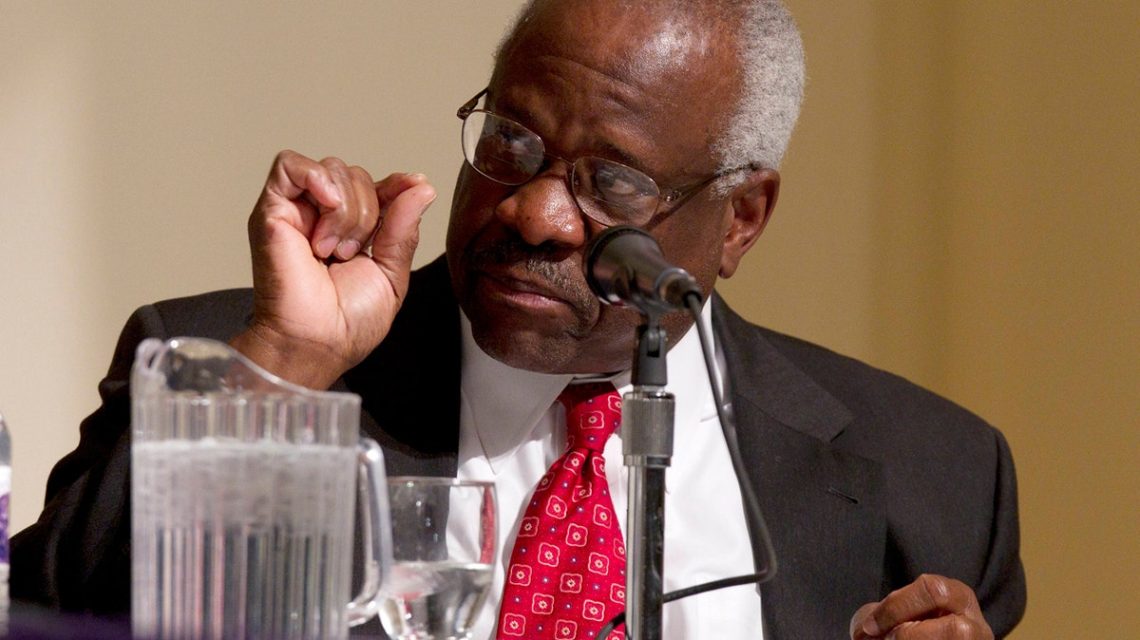
Supreme Court Justice Clarence Thomas challenges the notion that Black Americans should conform to specific political views based on race. During an interview with Republican Texas Senator Ted Cruz, Thomas discussed his perspective on individualism.
Thomas expressed that societal expectations often try to dictate how Black individuals should think, stating, “We had this saying [that there are] only two things I have to do: stay Black and die.” This comment was a response to Cruz’s remark about Thomas’s independent thinking.
Thomas highlighted the problem with these expectations, emphasizing a deterministic view that assigns thoughts and beliefs based on skin color. He stated, “There’s this kind of deterministic view that you’re supposed to think this because we say so.”
In rejecting these societal demands, Thomas explained that he faces criticism for deviating from perceived norms. “And so now that means that something, that I’m a walking contradiction because I’ve deviated from their perception of what I should think,” he remarked during the “Verdict with Ted Cruz” podcast.
Reflecting on his background, Thomas described his early life in poverty-stricken Georgia, growing up in a wooden shack with parents and later residing in Savannah with grandparents. He initially spoke Gullah, a creole language, and embraced left-wing Black nationalism and activism.
He admired figures like Malcolm X and founded a Black Student Union at the College of the Holy Cross. However, after being involved in a violent protest in 1970, Thomas reassessed his views and rejected left-wing activism, aligning instead with his grandfather’s ideals of self-reliance.
The justice draws parallels between restrictions on ideas and racial segregation. He recalled instances of segregation in the Savannah Public Library, using them to illustrate how restrictions on accessible ideas mirror segregation. “What if they allowed me in but said I couldn’t go to certain floors? That would be wrong,” Thomas argued.
He questioned why embracing certain ideas faces opposition, equating restrictions on ideas with historical limitations on access due to race. “What’s the difference?” Thomas asked, questioning people’s objections to his choice of ideas.
 Universities Should Reject Political Influence on Research Funding
  Trump’s Approach to China: Trade Dynamics and Challenges
  Media Outlets Sue After White House Ban
  American Public Opinion on Press Freedom
  Media Lawsuit Against Trump Administration for White House Ban
  The Cost of Challenging Beijing