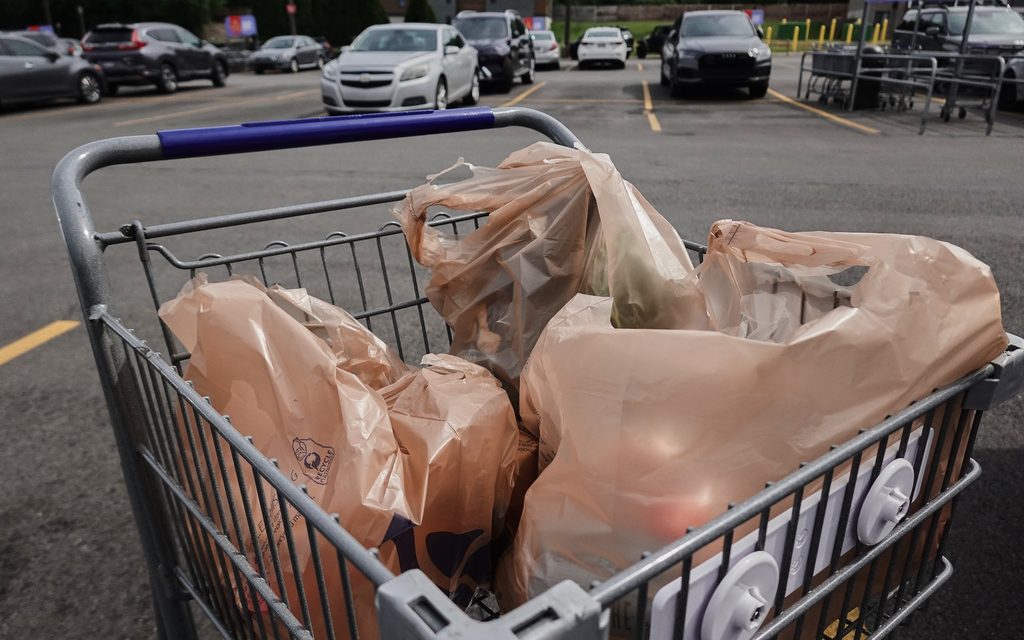
Plastic bags filled with groceries were observed in a cart on Monday, May 18, 2026, in Cincinnati. When you see the ‘chasing arrows’ symbol on a takeout container, you might assume recycling is guaranteed. But that’s not accurate. Originally designed for Earth Day in 1970 by a California college student, the symbol indicated a product’s recyclability. However, in the late 1980s, the Society of the Plastics Industry, now the Plastics Industry Association, repurposed this icon to denote plastic types, ignoring actual recyclability.
In the U.S., less than 9% of plastics are recycled, although the country produces the most plastic waste globally. Most plastics end up in landfills, are exported, or mismanaged, negatively affecting our oceans. Scientists estimate over one garbage truck’s worth of plastics enter the ocean every minute globally. Beaches are littered with unrecyclable plastics. Even small amounts of plastic can harm marine life; ingesting less than a sugar cube of plastic can fatally affect one in two Atlantic puffins.
The confusion over the chasing arrows symbol highlights a significant regulatory issue. Americans, and America’s waterways and coasts, merit better recycling clarity.
A new legislative proposal, the Truth in Labeling Act, aims to resolve the current chaotic labeling practices. This bill promises to clarify recycling labels, reduce misleading claims, and minimize contamination in recycling streams. Introduced by Sen. Jeff Merkley (D-Ore.) and Rep. Lou Correa (D-Calif.), the act sets clear federal criteria for labeling products as ‘recyclable,’ ‘compostable,’ or ‘reusable.’ It requires companies to demonstrate that their products can be widely recycled and that there’s demand for the recycled materials. Importantly, the bill excludes certain harmful chemical recycling from being classified as recycling.
The Truth in Labeling Act also restricts the use of the chasing arrows symbol on non-recyclable materials, ensuring that consumers aren’t deceived into recycling items that will ultimately end up in landfills or the ocean.
The call for transparent recycling labels has prompted two other bills, the PACK Act and the Recycled Materials Attribution Act. However, these bills fall short, as they set weak standards that could lead to more deceptive practices. For instance, the Recycled Materials Attribution Act equates plastics converted to fuels through hazardous chemical processes with truly recycled items. This approach lets plastics falsely claim to contain ‘100 percent recycled content’ through credits, even when predominantly made from new plastic. The PACK Act fails to resolve consumer confusion by allowing industry parties responsible for the confusion to certify recyclability and by preempting state-level clarity measures.
Ending ocean plastic pollution requires a reduction in plastics production, coupled with a recycling system that is simple for Americans to grasp. The Truth in Labeling Act represents a crucial reform in recycling labeling, offering much-needed clarity.
Anja Brandon, Ph.D., serves as the director of plastics policy at Ocean Conservancy.
© 2026 Nexstar Media Inc. All rights reserved. This content may not be published, broadcast, rewritten, or redistributed.
 Tree Poisoning Incidents Raise Concerns at Lake Tahoe
  Figeater Beetles: An Unusual Sight in Los Angeles
  Ethical Concerns Arise Over Betting on Wildfires and Other Disasters
  Exploring Geoengineering to Mitigate Glacier and Sea Ice Melt
  Brazil’s Oil Drilling Fuels Economic Prospects Amid Environmental Concerns
  Lake Powell Water Levels Hit Record Low, Raising Colorado River Basin Concerns