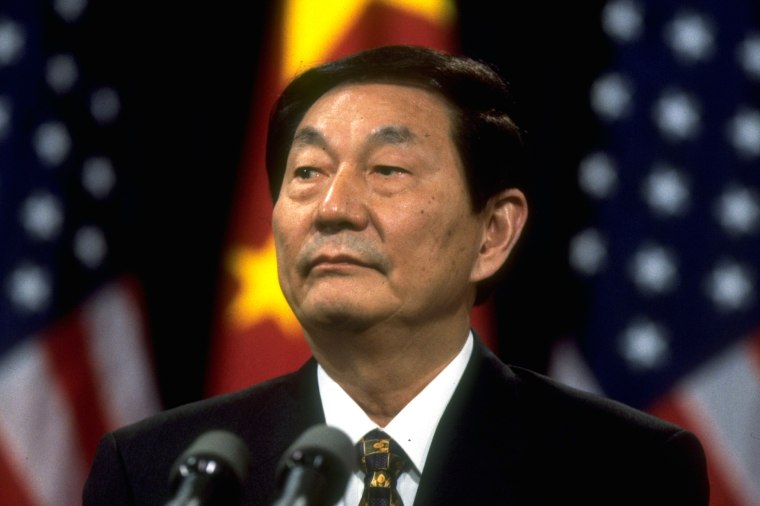
In Beijing, China conducted a solemn cremation ceremony for former Premier Zhu Rongji, who passed away last week at the age of 97. The national flag was lowered, and security measures were heightened across the city, particularly in places like Tiananmen Square and Zhongnanhai, the heart of political power. Citizens took this time to reflect on his legacy and the era he represented.
President Xi Jinping and the entire Politburo standing committee paid their respects with three bows during the cremation ceremony at Babaoshan, a cemetery reserved for top officials and national heroes. According to state-run Xinhua, former President Hu Jintao, who has not appeared publicly recently, also sent condolences via a wreath.
Zhu served as vice premier from 1991 to 1998 and as premier from 1998 to 2003. During this time, he played a crucial role in transforming China’s economy. He implemented rigorous tax and banking system reforms and tackled inflation. A major overhaul of the state sector led to the elimination of millions of jobs at unprofitable companies. These reforms paved the way for China’s accession to the World Trade Organization in 2001.
In a notable remark from 1988, Zhu once stated, “My defining trait — my guiding principle — is independent thinking,” demonstrating his commitment to candid expression. His membership in the Communist Party was revoked in the late 1950s due to a candid speech, and it was only restored after nearly two decades.
Following his death, expressions of mourning appeared on Chinese social media, though some reactions were mixed. One removed Weibo post acknowledged his role in layoffs, while others defended him as a decisive leader. Zhu himself acknowledged in 2001 that he was both respected and resented by different segments of the population.
Authorities responded to Zhu’s passing with cautious management. Historically, the deaths of former leaders in China have sparked outpourings of public emotion or, occasionally, unrest. The mourning of leaders like Zhou Enlai and Hu Yaobang in past decades had turned into broader protests.
People reminisced about Zhu’s contributions to China’s rapid economic growth after reforms began more than two decades ago. Zhao, an IT worker, noted that Zhu’s death evoked memories of China’s pivotal transition period, highlighting the nostalgia many felt for that time.
 Voters in Multiple States Engage in Crucial Primaries
  AIPAC’s Influence in U.S. Politics and Rising Controversies
  Race for Florida’s 19th Congressional District: A Spotlight on Candidates
  President Trump Criticizes Allies as Iran Deal Deadline Nears
  Debate Over Paid Leave in America as McConnell Recovers
  Senate Proposal Aims to Extend Nutrition Assistance for Low-Income Mothers