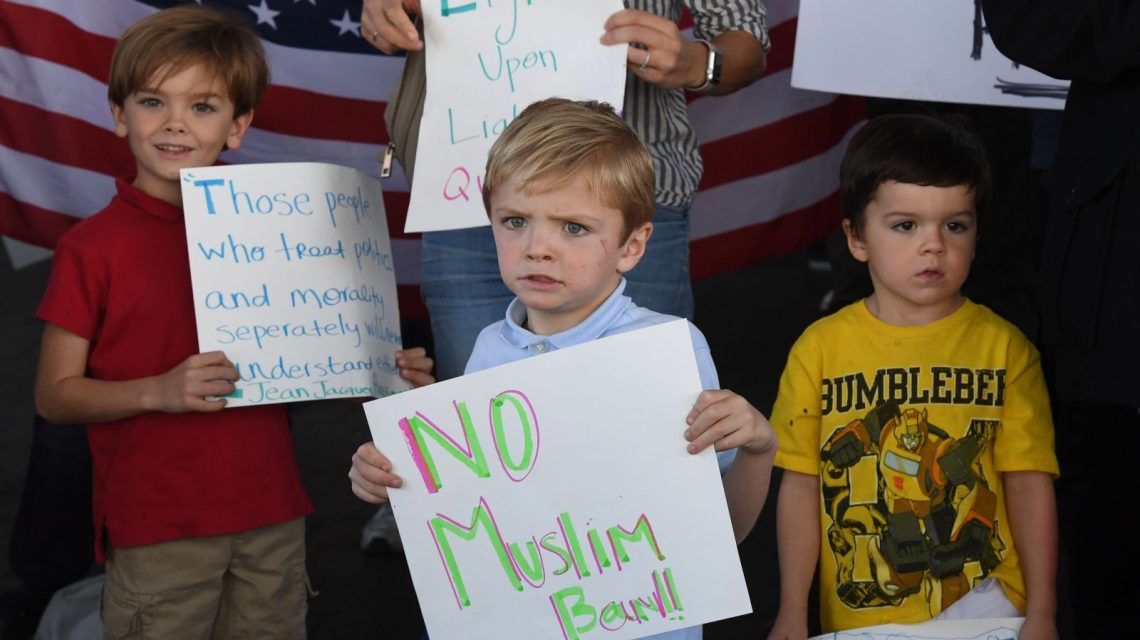
President Donald Trump’s second term has brought about a change in perception regarding his stance on Islam and Muslims. This subject, once a defining part of his political identity, has grown more intricate amid his foreign and domestic policies.
Changing Political Landscape
Trump’s earlier reputation as being hostile to Muslims seems diminished despite his continuing use of inflammatory rhetoric and restrictive immigration policies. He has developed closer ties with certain Muslim-majority governments while maintaining a combative stance against others. This nuanced approach has made it challenging to fit Trump into the previously straightforward narrative that defined him in 2017.
During his initial presidency, Trump called for a total ban on Muslims entering the United States, leading to policies that affected several Muslim-majority countries. In a Pew Survey conducted in 2017, a significant 74% of Muslim Americans viewed him as unfriendly, and only 8% voted for him. This political identity was clear, bolstered by the Democratic Party’s firm opposition.
Recent Developments Fueling Controversy
Despite the changes over time, Trump continues to provide material for critics. Following incidents like the shooting involving an Afghan national, his administration tightened immigration rules further. This expanded to restrict entry from numerous countries, predominantly Muslim-majority nations. Trump’s divisive rhetoric has also included disparaging remarks about Somalia and Muslim politicians, sparking threats and condemnation.
In a major military move, Trump, alongside Israeli forces, launched 900 strikes on Iran within 12 hours, killing Supreme Leader Ali Khamenei. This military action represented one of the largest U.S. interventions in a Muslim-majority country.
Political arguments surrounding these actions focused on constitutional aspects rather than religious motivations. Despite criticisms from Democrats pushing legislative action, the complexity of Trump’s policies has blurred lines that once clearly labeled him as Islamophobic.
Rising Tensions and Changing Sentiment
Advocacy groups such as the Council on American-Islamic Relations have reported soaring discrimination complaints, highlighting the persistent tensions. The Islamophobia Index indicates an increase in negative stereotypes about Muslims, though FBI-reported hate crimes show a contrasting downward trend.
While individual Democrats have persisted in critiquing his policies, the language has shifted. Legislative efforts like the NO BAN Act continue to target religious discrimination in immigration policies, yet without explicitly using terms like ‘Islamophobic.’ Instead, discussions have shifted toward broader themes of racial and ethnic discrimination.
Electoral Influence and New Alliances
Electoral dynamics have added layers to the narrative. Muslim voters, though predominantly Democratic, no longer serve as an unequivocal opposition to Trump. Surveys from the Institute for Social Policy and Understanding reveal a split among Muslim voters, showcasing a segment’s support for Trump.
Anger regarding U.S. support for Israel influenced voting patterns, particularly in regions with substantial Muslim populations. This shift indicates that the traditional alignment has evolved, though it doesn’t equate to widespread Muslim endorsement of Trump.
Complex Foreign Policy Impacts
Examining foreign relations, Trump’s interactions with Muslim-majority countries such as Saudi Arabia, Qatar, and the UAE add complexity to his image. Commercial ties juxtaposed with aggressive military actions against Iran complicate the understanding of his motivations and relationship with Muslims globally.
While foreign partnerships don’t directly address domestic treatment of Muslims, politically these relationships blur the lines previously set. A balance between denouncing certain Muslim communities, while pursuing alliances with others, demonstrates a multifaceted approach.
Familiarity and Evolving Criticism
There is a notion of exhaustion within the political discourse. Trump’s constant presence over the years might have desensitized the public to previous accusations. Google Trends data exemplifies this shift in focus from ‘Muslim ban’ to broader ‘travel ban’ discussions.
Though criticism remains prominent, particularly among advocacy groups, there is a noticeable reduction in straightforward political attacks linking Trump exclusively to Islamophobia. Political fatigue is feasible, however, the existing sentiment signals active awareness.
Future Implications and Political Testing
Upcoming election cycles present opportunities to further explore these dynamics. Changes in Muslim voter alignment could reinforce or challenge the narrative. Policies leaning toward reducing immigration might suggest shifts in political reasoning.
The intricate political reality may impact how accusations of Islamophobia continue to influence Trump’s relationship with Muslim Americans. Despite persistent criticisms, the evolving political landscape and diverse responses have altered the straightforward understanding of ‘Trump the Islamophobe’.
 Think Tank Proposes Funding for Enhanced Unemployment Benefits Amid AI Job Concerns
  Secretary of State Warns About Iranian Economy in Greece Visit
  Trump Meets Baltimore Ravens Players at Tradepoint Atlantic Event
  Labor Unions and Faculty Groups Sue Trump Administration Over Immigration Policies
  Collins and Jackson Face Off in Key Maine Senate Debate
  Israel Commemorates Third Anniversary of Hamas-Led Attacks