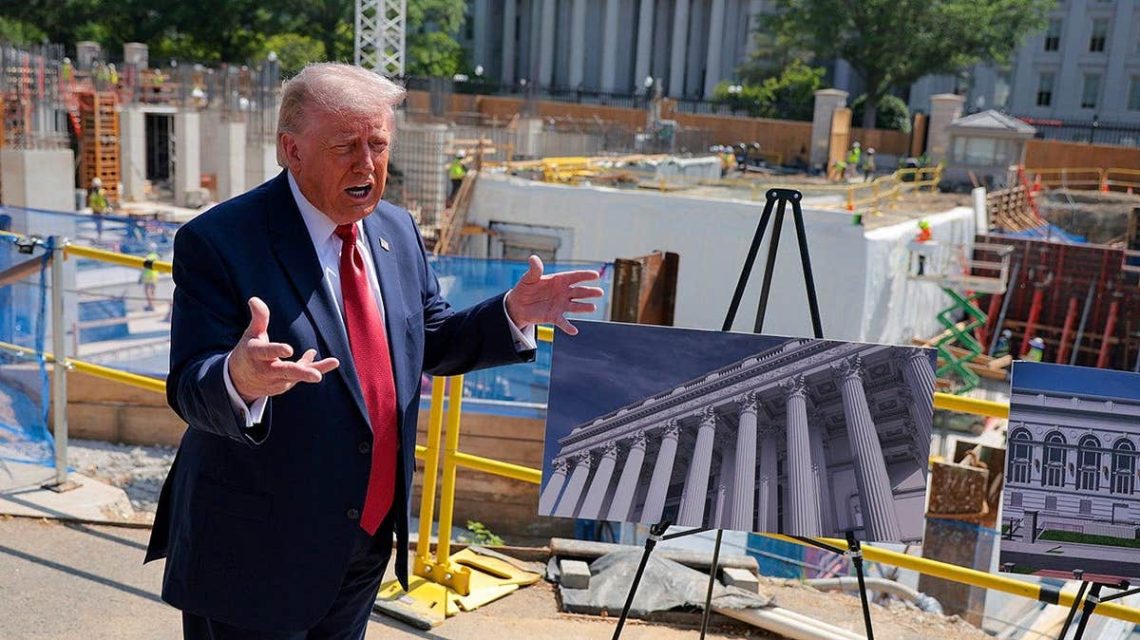
President Donald Trump is hopeful about winning the legal battle over his proposed White House ballroom. Legal experts suggest that the U.S. Supreme Court may resolve the issue without addressing the fundamental constitutional question. Trump’s commitment to fighting this case was evident in his recent social media post, where he promised to appeal to the Supreme Court after a D.C. Circuit decision upheld a lower court ruling blocking the ballroom construction.
The appeals court, in a 2-1 decision, stated that the project needs Congressional approval to proceed. Trump highlighted the dissent by Judge Neomi Rao as the basis for appealing. Appointed by Trump during his first term, Rao argued that the plaintiffs, the National Trust for Historic Preservation, lack the necessary legal standing in the case.
The National Trust’s case relies on Alison Hoagland, a member living near the White House, who claims that the ballroom’s structure would reduce her enjoyment of the area. However, Rao contends that the National Trust didn’t show the required injury to invoke court authority to halt the project.
“The district court elevated the aesthetic displeasure of a single passerby over the government’s security interests,” Rao wrote.
Former Justice Department attorney Abhishek Kambli echoes this stance, suggesting that the National Trust might struggle to prove standing in the Supreme Court. He notes that, although Congress established the National Trust, the group must prove its lawsuit aligns with its interests. The ballroom’s location, President’s Park, is not owned by the National Trust, making the argument tougher.
Kambli further explains that proving aesthetic injury is challenging unless the plaintiffs use the affected space. Citing a similar case from July, when U.S. District Judge Amit Mehta dismissed a lawsuit against an event at the White House, Kambli underscores the difficulty in establishing aesthetic harm for standing.
Hans von Spakovsky, from Advancing American Freedom, predicts Trump will succeed on appeal due to the standing issue.
“Under Supreme Court precedent, you cannot bring a claim without demonstrating a concrete, actual injury,” Spakovsky stated.
He asserts that the notion of a passerby claiming aesthetic injury lacks credibility and defies precedent. If the Supreme Court hears the case, it might resolve it by addressing the standing question rather than evaluating the administration’s authority to build the ballroom.
Von Spakovsky mentioned the slim chances of Congress collectively establishing standing due to partisan divides. The National Trust argues that new construction on federal land requires Congressional approval. Meanwhile, the administration believes current law grants the president authority to modify federal properties, including the White House.
Abhishek supports Rao’s view that terms like “alteration” and “improvement” should retain their conventional real-property meanings.
“If I have an extension to my house, it doesn’t become a new house,” Abhishek explained, highlighting the statutory authority implications in real property context.
Elaine Mallon writes for Fox News Digital and Fox Business, focusing on national politics.
 Court Rules Against Third-Country Deportation Policy
  Trump Administration Bars News Networks from White House
  Lawsuit Filed Over Preeclampsia Death in Texas Amid Abortion Ban Controversy
  Cook County’s Loan Program Assists Suburban Agencies Amid Property Tax Delays
  Freddy Cazares: Navigating the Limbo of Immigration Detainment and Uncertain Release
  Controversy Over Immigration Policy Protest in South Carolina